
NYC Event Compliance in 2026: The Corporate Planner's Complete Permit & Liability Guide
Beyond the Gala: The Unseen Strategy Behind NYC Event Compliance
Planning a corporate event in New York City is one of the most exciting things your brand can do. The venues are extraordinary, the energy is unmatched, and the opportunity to make a real impression on clients, partners, and teams is right there for the taking. But behind every seamless gala in Midtown or polished rooftop product launch in Hudson Yards, there is a layer of groundwork that most people never see — and it starts with NYC event compliance.
With 25 years of experience and more than 5,000 successful events produced, EMRG Media knows that getting it right means your event runs like clockwork. Miss a permit, overlook a certificate of insurance requirement, or skip an FDNY pre-event inspection, and you could be facing fines, last-minute shutdowns, or liability that lands directly on your brand.
This guide breaks down everything corporate planners, marketing directors, and company leaders need to know about navigating NYC event compliance in 2026 — with confidence, clarity, and zero surprises. Reach out to EMRG Media now to start planning your future event.
Corporate Event Planner Inquiry
What Is NYC Event Compliance — and Why Can It Make or Break Your Event?
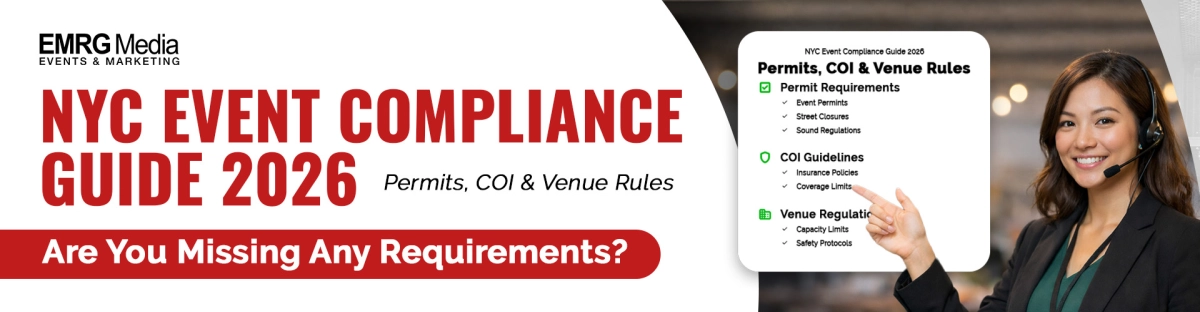
NYC event compliance covers the full set of regulations, permits, licenses, and insurance requirements that govern how events are planned, produced, and executed across the five boroughs.
It includes everything from pulling a street activity permit with the NYC Department of Transportation to ensuring your caterer holds a valid Temporary Food Service permit from the NYC Department of Health. In a city as dynamic and fast-moving as New York, these rules exist to protect your guests, your vendors, your venue partners, and ultimately your brand.
The Real Cost of Skipping Compliance in New York City
The consequences of overlooking compliance are not always visible until it is too late. A missing Certificate of Occupancy can result in a venue shutdown on the evening of your event. A lapse in vendor insurance can shift liability directly onto your organization. An unpermitted outdoor activation in Tribeca or a noise violation in SoHo can bring a very early end to what was otherwise a perfect night.
Beyond the immediate disruption, these incidents can damage relationships with venue partners, reduce future access to premium spaces, and — in the most serious cases — open the door to civil litigation. When the stakes are this high, NYC event compliance is not a background task. It is a core part of your event strategy.
What Has Changed in NYC Event Regulations in 2026?
New York City has continued refining its event permitting landscape as we move through 2026. Outdoor activations along the Hudson Yards corridor and High Line now require permit submissions 10 to 12 weeks in advance due to peak spring season demand. The FDNY has updated its temporary structure and tent inspection protocols, adding a new pre-event sign-off requirement for open-air events with occupancy over 150 guests. NYC Parks Department permits for popular green spaces like Bryant Park and Prospect Park are in particularly high demand for Q2, with availability shrinking fast.
Staying current on these changes is a full-time responsibility — and it is one of the many reasons companies trust our corporate event planning team at EMRG Media to stay ahead of the compliance curve on their behalf.
NYC Event Permit Landscape: Which Agency Issues What
One of the most confusing parts of NYC event compliance is knowing which city agency owns what. According to the NYC Mayor’s Office of Citywide Event Coordination and Management (CECM), the answer depends on your event type, location, and scale — and in New York City, navigating the landscape usually requires coordinating between multiple Primary and Supporting permitting agencies.
NYPD Special Event Permits — When You Need One and How to Apply
Any event that impacts public space, requires crowd management support, or involves road closures in NYC will likely require an NYPD Special Event Permit. This applies to product launches with outdoor components, large-scale conference arrivals at Midtown venues, and branded experiential activations on public-adjacent property. Applications are submitted through the NYPD Highway District and typically require a minimum of 30 days’ lead time.
NYC Parks Department Permits — From Bryant Park to Prospect Park
If your event touches any NYC Parks property — even briefly, for a branded photo opportunity — you will need a Parks permit. For corporate events, this also applies to private venue spaces that fall within park jurisdiction boundaries. Spring 2026 bookings for parks across Manhattan, Brooklyn, and Queens are moving quickly, so submitting early is strongly advised.
NYC DOT Street Activity Permits — Outdoor Activations and Street Closures
Branded activations, red-carpet arrivals, and street-level events in areas like FiDi, SoHo, or the Flatiron District require Street Activity Permits from the NYC Department of Transportation. These permits govern everything from blocking a sidewalk to closing a traffic lane and come with their own specific insurance and indemnification requirements that must be satisfied before approval is granted.
FDNY Compliance — Temporary Structures, Tents, and Occupancy
The Fire Department of the City of New York has jurisdiction over tents, temporary stages, pyrotechnics, and occupancy loads at events throughout the city. In 2026, FDNY requires pre-event inspections for outdoor structures at events hosting 150 or more guests. Venues must also have current Certificates of Fitness on file for designated event staff — a requirement that applies equally to boutique venues in Brooklyn’s Williamsburg neighborhood and full-scale ballrooms on the Upper East Side.
Venue Compliance Checklist for NYC Corporate Events in 2026
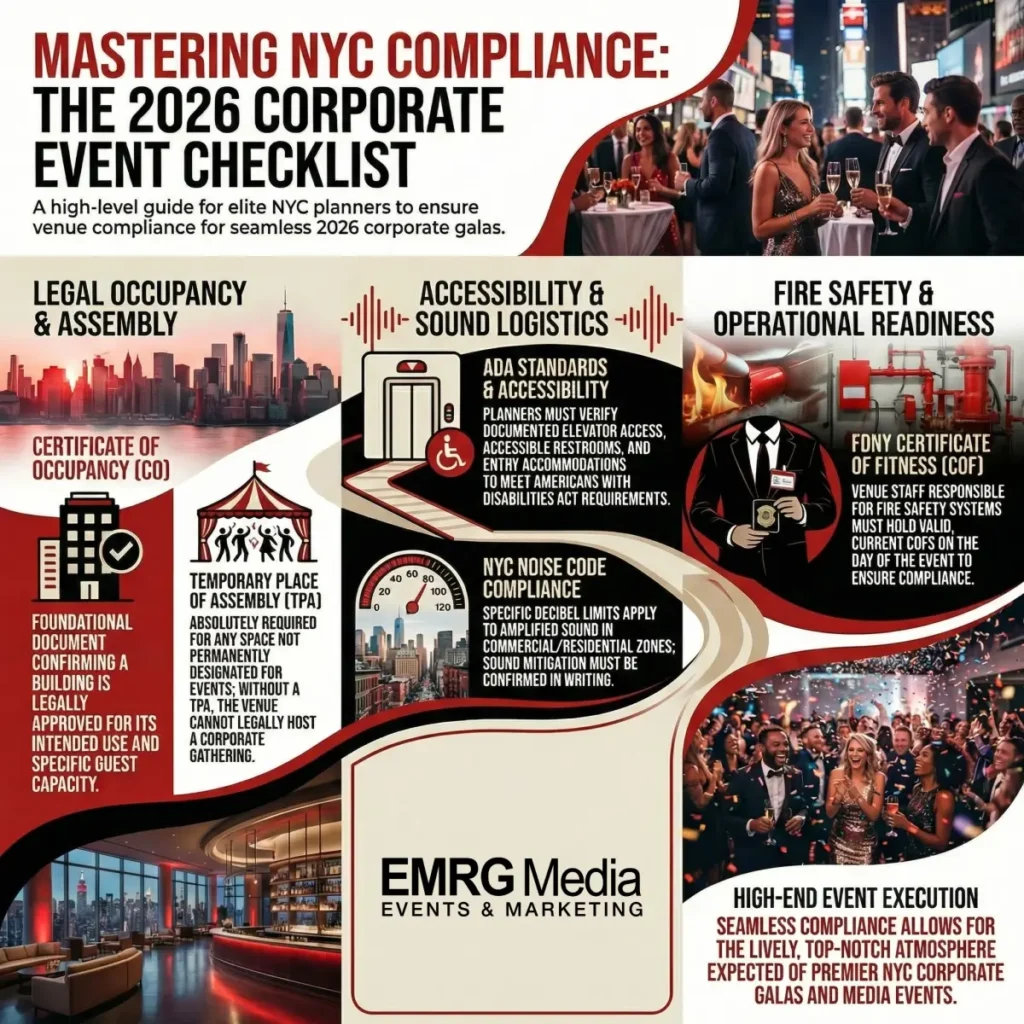
When selecting a venue, NYC event compliance starts before the contract is signed. Here are the essential documents and certifications every corporate planner should verify upfront:
- Certificate of Occupancy (CO): Confirms the building is legally approved for its intended use and guest capacity.
- Temporary Place of Assembly (TPA): Required for spaces not permanently designated for event use. Without a TPA, a venue cannot legally host your corporate gathering — full stop.
- ADA Accessibility: All NYC event venues must meet Americans with Disabilities Act standards. Confirm elevator access, accessible restrooms, and entry accommodations are documented before you finalize the booking.
- NYC Noise Code Compliance: The city’s Noise Code sets specific decibel limits for amplified sound in commercial and residential zones. If your event features live music or DJ sets near residential buildings in neighborhoods like Chelsea or the Lower East Side, confirm the venue’s sound mitigation setup in writing.
- FDNY Certificate of Fitness: Venue staff responsible for fire safety systems must hold current COFs on the day of your event.
When selecting a venue, NYC event compliance starts before the contract is signed. Here are the essential documents and certifications every corporate planner should verify upfront:
- Certificate of Occupancy (CO): Confirms the building is legally approved for its intended use and guest capacity.
- Temporary Place of Assembly (TPA): Required for spaces not permanently designated for event use. Without a TPA, a venue cannot legally host your corporate gathering — full stop.
- ADA Accessibility: All NYC event venues must meet Americans with Disabilities Act standards. Confirm elevator access, accessible restrooms, and entry accommodations are documented before you finalize the booking.
- NYC Noise Code Compliance: The city’s Noise Code sets specific decibel limits for amplified sound in commercial and residential zones. If your event features live music or DJ sets near residential buildings in neighborhoods like Chelsea or the Lower East Side, confirm the venue’s sound mitigation setup in writing.
- FDNY Certificate of Fitness: Venue staff responsible for fire safety systems must hold current COFs on the day of your event.
Food, Beverage & Liquor Compliance for NYC Corporate Events
Serving food and beverages at a corporate event in New York City means operating under two separate regulatory frameworks. Both demand advance preparation to ensure your event runs without interruption.
At-a-Glance: Food & Beverage Compliance
Regulatory Body | Required Permit / Authorization | Who Needs It? | Risks of Non-Compliance |
NYC Dept. of Health & Mental Hygiene | External caterers, pop-up stations, and food trucks | Catering shut down mid-event | |
NYS Liquor Authority (SLA) | Off-premise alcohol service, outdoor extensions, and external bar vendors | Significant fines and immediate event termination |
1. NYC Health Department Temporary Food Service Permits
If your event utilizes any catering operation outside of the venue’s permanent, in-house culinary team, you must secure a Temporary Food Service Establishment permit.
- What it covers: External caterers bringing prepared food on-site, branded pop-up food stations, and food trucks booked specifically for your event.
- The stakes: Failure to secure this permit can result in the Department of Health shutting down your catering operation mid-event—a conversation no event planner wants to have with a room full of executives.
2. NYS Liquor Authority (SLA) Special Event Permits
Serving alcohol requires strict compliance with the New York State Liquor Authority. While a venue’s existing on-premises liquor license often covers standard indoor service, many corporate events require additional permitting.
- When you are covered: If your event is fully contained within a venue that holds a valid, active on-premises SLA license.
- When you need a Special Event Permit: If your event includes outdoor venue extensions, rooftop activations not explicitly covered by the venue’s license, or off-premise scenarios (like a warehouse or gallery).
- Catering requirements: External caterers hired to serve alcohol must carry their own valid Catering Authorization.
- The stakes: This is one of the most frequently overlooked areas of compliance. Operating without the proper SLA permits can lead to severe financial penalties and the immediate termination of your event.
Certificate of Insurance (COI): The NYC Corporate Event Non-Negotiable
If there is one element of NYC event compliance that consistently surprises corporate clients, it is the depth of COI requirements in New York City.
Standard COI Requirements for Manhattan Venues
Most Manhattan event venues require a minimum of $1 million in General Liability coverage per occurrence and $2 million in aggregate. High-profile venues in Midtown, Hudson Yards, and Lower Manhattan frequently require higher limits — plus the venue named as an additional insured on the policy.
Liquor Liability, Worker’s Comp & Vendor Certificates
Beyond the base General Liability policy, every vendor participating in your event — AV companies, caterers, entertainment acts, and production crews — should carry their own General Liability, Workers’ Compensation, and where applicable, Liquor Liability coverage. A single uninsured vendor creates significant exposure for your entire organization.
As NYC’s leading corporate event planning agency, EMRG Media manages vendor COI collection and verification as a built-in part of every engagement, so nothing slips through the cracks.
Compliance for Hybrid, Rooftop & Outdoor NYC Events in Spring 2026
Spring 2026 is shaping up to be one of New York City’s most active event seasons. With rooftop venues and outdoor spaces rapidly filling their Q2 calendars, mastering NYC event compliance for non-traditional formats is more critical than ever.
Rooftop Corporate Events
While rooftops offer a signature NYC experience, they carry strict regulatory demands. Structural load certifications, FDNY occupancy limits, and wind-rated tent permits are mandatory. Always verify a rooftop is officially certified for event use before finalizing your contract.
Outdoor Event Activations
Hosting activities in high-footfall zones like Hudson Yards or the FiDi waterfront frequently requires simultaneous DOT and Parks permits, plus specialized insurance. Additionally, unique spaces like the High Line corridor operate under their own distinct event policies alongside standard city rules—a detail that often surprises planners.
Hybrid Event Compliance
Hybrid events introduce digital compliance layers that are easy to overlook. Streaming live or recorded music requires ASCAP and BMI licensing. Furthermore, collecting attendee data digitally triggers New York State’s SHIELD Act, dictating strict privacy and breach notification obligations. Prioritize these digital requirements at the top of your planning checklist.
How EMRG Media Manages NYC Event Compliance So You Don't Have To
This is where working with an experienced partner changes everything. At EMRG Media, managing NYC event compliance is not a side responsibility — it is built into every phase of our planning process from day one.
Our 2026 NYC Event Compliance Checklist — From Permit Pull to Close-Out
Our team handles permit applications, COI collection, FDNY coordination, SLA filings, and vendor verification from the first planning meeting through post-event documentation. We maintain active relationships with city agencies, venue managers, and insurance contacts across all five boroughs — which means we move faster, anticipate issues earlier, and hit far fewer walls.
Neighborhood-by-Neighborhood Compliance Experience
Every New York City neighborhood carries its own event culture and compliance nuances. Midtown Manhattan venues operate under some of the highest COI demands in the city. SoHo and Tribeca require careful attention to noise ordinances and loading dock rules for production crews. Brooklyn venues in Williamsburg and DUMBO come with their own FDNY and structural requirements. Wherever your event is headed, our team has been there before. Find us on Google Maps and let’s start the conversation.
Why NYC Compliance Is a Strategic Advantage — Not Just a Formality
When your event runs without a single incident — when guests move freely, vendors operate seamlessly, and nothing interrupts the night — that is the direct result of compliance done right. Brands that consistently produce flawless events treat compliance as a strategic investment, not an administrative checkbox. In fact, running a fully compliant and seamless activation is the foundational first step in how NYC marketing events are being used to build long-term brand equity.
Common NYC Event Compliance Mistakes to Avoid
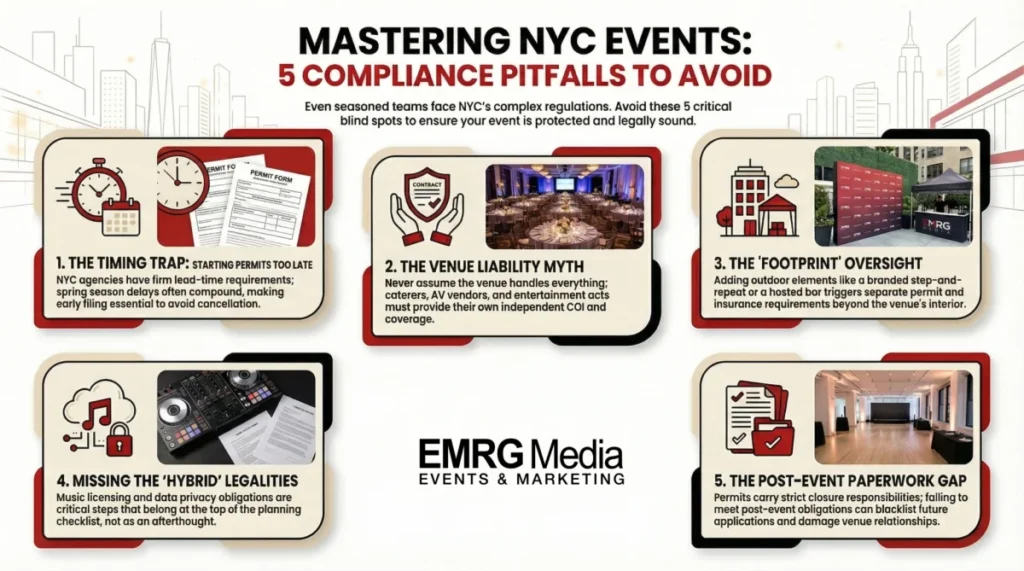
Even experienced in-house teams run into NYC event compliance challenges. Herae are the most common mistakes we help EMRG Media clients avoid entirely:
- Starting the permit process too late: NYC agencies have firm lead-time requirements, and spring season delays compound quickly.
- Assuming the venue handles everything: Venues are responsible for their own CO and COI. Your caterers, AV vendors, and entertainment acts each need their own coverage independently.
- Forgetting outdoor extensions: Adding a branded step-and-repeat or hosted bar outside your venue footprint triggers separate permit and insurance requirements.
- Skipping hybrid compliance steps: Music licensing and data privacy obligations are often the last items added to a planning checklist. They should be near the top.
- Missing post-event close-out obligations: Permits carry closure responsibilities. Failing to meet them can impact future applications and venue relationships.
FREQUENTLY ASKED QUESTIONS (FAQ’s)
It depends on the agency and event type. NYPD Special Event Permits require a minimum of 30 days. NYC Parks and DOT permits for high-demand spring 2026 dates are being recommended at 10 to 12 weeks out. The earlier you begin, the more options you protect.
In most cases, yes — for specific elements. External caterers require a Temporary Food Service Permit. Third-party alcohol service may require an SLA Special Event Permit. Any public-facing outdoor component connected to your venue will likely require a DOT or Parks permit as well.
Liability can shift directly to the event host or the venue. This is precisely why COI collection and verification must be completed for every participating vendor — not just the primary ones.
A TPA is issued by the NYC Department of Buildings for spaces not permanently designated for assembly use. If your event is held in a gallery, loft, warehouse, or other non-traditional venue, a TPA is almost always required and should be confirmed well in advance.
Yes. Our team coordinates permit applications, agency filings, and compliance documentation on your behalf as a standard part of our full-service planning model. Give us a call at 212-254-3700 and we will walk you through exactly what your event needs.
Plan With Confidence. Execute Without Limits.
NYC event compliance does not have to feel overwhelming. With the right partner by your side, it becomes one of the most manageable parts of your entire planning process — and one of the strongest protections for your brand, your guests, and your event investment.
At EMRG Media, we have spent over two decades producing high-profile corporate events, conferences, galas, and experiential activations across New York City. We know the agencies, the venues, the neighborhoods, and the rules — and we work every single day to make sure our clients never have to worry about any of them.
Your next great event starts with a conversation. Connect with NYC’s leading corporate event planning agency today. NYC dates fill fast in spring 2026 — let’s make sure yours is completely covered.