
Beyond the Checklist: The Veteran’s Blueprint for a Profitable NYC Exhibition
When tackling trade show planning NYC professionals know it requires much more than simple logistics management. Here in Manhattan, unique local challenges like strict municipal compliance, complex union labor rules, and steep venue costs can quickly destroy your budget. Treat this process like a basic checklist, and you will likely walk off the Javits Center floor with zero qualified leads and massive overspending.
Fortunately, you have found exactly what you need to succeed: a proven operational framework that protects your investment. With exhibitors spending billions annually, perfecting your strategy is critical. This guide provides the precise tactics veteran producers use to conquer local regulations, optimize costs, and design booths that actually generate real revenue.
Whether you are an enterprise executive or a brand director organizing a large-scale industry showcase, expert guidance makes all the difference. Stop leaving your event success to chance. Book a comprehensive strategy session and partner with our experienced event planners at EMRG Media to transform your upcoming vision into a flawless reality.
Corporate Event Planner Inquiry
Why NYC Trade Show Planning Is a Different Discipline
Manhattan’s event infrastructure is uniquely unforgiving. Producing a successful exhibition here requires experienced conference planning services to proactively navigate logistical challenges that simply do not exist at the same intensity in cities like Chicago or Phoenix.
Mandatory Union Labor
Union rules strictly govern Tier 1 venues like the Javits Center and major Midtown hotel ballrooms. Operations fall directly under IATSE for stagehand labor and Teamsters for freight. Drayage costs frequently hit $180 to $250 per hundredweight, meaning a standard 20×20 booth might incur up to $4,000 in freight handling fees before assembly even begins. Relying on traditional square-footage budgeting alone guarantees immediate and costly surprises for exhibitors.
Strict Municipal Permitting
NYC compliance mandates extensive operational lead times. Standard midtown brand activations routinely require strict approvals from the Street Activity Permit Office (SAPO) for sidewalk use, the Department of Buildings for structures exceeding 10 feet, and the NYPD for amplified sound. These are foundational requirements, not optional edge cases.
Strategic Seasonal Timing
Booking during the high-demand spring and fall seasons requires at least 9 to 12 months of lead time to secure elite AV vendors. Most critically, the 2026 FIFA World Cup (June 11 through July 19) will consume local hotel blocks and inflate transit, labor, and security costs by over 300 percent. To protect your budget and ensure viability, marquee 2026 events must strategically target early May or late September.
How to Plan a Trade Show in NYC: The Step-by-Step Framework
Step 1: Define Your Format
Before venue outreach begins, answer one foundational question: are you hosting your own branded expo, exhibiting within an existing trade show, or producing a corporate customer conference that functions like a trade show? Each format carries a different budget structure, compliance scope, and production team requirement.
For conference event planning in NYC that includes expo-floor elements, the planning process begins 10 to 12 months out. For standalone exhibit participation, 6 to 9 months is the functional minimum.
Step 2: Select Your Venue and Neighborhood
Each Manhattan corridor sends a signal to your audience before a single session begins.
Venue District | Best For | Key Advantage | Avg. Lead Time |
Javits Center (Hudson Yards) | 500+ attendee flagship expos | Max scale, dedicated exhibit infrastructure | 12+ months |
Midtown Hotel Ballrooms | 200–800 attendee corporate expos | Transit access from Penn Station and Grand Central | 9–12 months |
Financial District / FiDi | Finance, legal, professional services | Authority positioning, strong value per sq. ft. | 6–9 months |
Brooklyn (Williamsburg / DUMBO) | Tech, media, creative-led expos | Aesthetic differentiation, waterfront venues | 6–9 months |
Long Island City | Mid-sized summits with expo elements | Manhattan views, lower venue rates, 7-line access | 4–6 months |
For guidance on matching your attendee count and AV needs to the right space, see our full resource on how to choose an NYC conference venue.
Step 3: Lock Your Production and AV Team
NYC’s top AV companies, staging crews, and production directors operate on retainer relationships with established clients. They are not available on short notice. A properly specified AV build for a 200- to 500-person NYC corporate expo includes line array speaker systems sized by acoustic modeling, broadcast-quality confidence monitors for keynote speakers, multi-camera capture for hybrid broadcast, and dedicated fiber internet infrastructure running independently of the venue’s shared network.
Standard hotel AV packages do not meet this specification. Planning teams that default to in-house hotel AV consistently pay for the upgrade at the worst possible moment: during load-in.
Step 4: Navigate NYC Permits and Compliance
A certificate of liability insurance with the City of New York listed as an additional insured for a minimum of $1 million is required for all commercial and promotional events managed by SAPO. Beyond insurance, FDNY assembly permits apply to indoor events with 500 or more attendees, and Department of Buildings permits apply to stages exceeding two feet or trusses exceeding ten feet in height. File exterior branding and sidewalk activation permits through SAPO at least 90 days before the event. The NYC Mayor’s Office of Citywide Event Coordination and Management (CECM) publishes the full compliance framework at nyc.gov/site/cecm.
EMRG Media resolves all permit and compliance requirements before the venue contract is signed, not after load-in begins.
Step 5: Build Your Booth Strategy
The objective of trade show booth ideas and exhibit design is not to create a visually impressive display. The objective is to generate qualified conversations and capture usable lead data. Those two goals require different design decisions.
An inline 10×10 booth at $8,000 to $15,000 fully built serves brand visibility well. A 20×20 island booth at $25,000 to $60,000 enables interactive product demos, breakout conversation zones, and integrated technology. A 30×50 custom exhibit at $75,000 to $200,000 or more functions as a destination on the floor, with multiple engagement stations, private meeting rooms, and dedicated hospitality.
The choice between a dynamic, interactive booth and an informative, content-driven one should follow your audience profile. A pharma or legal audience responds to credibility signaling and private meeting space. A tech or SaaS audience responds to live demos, hands-on product trials, and social capture moments.
Step 6: Staff, Train, and Execute On-Site
Booth staff are the highest-leverage variable in your trade show ROI. A well-designed exhibit staffed by unprepared representatives underperforms a modest exhibit with a trained, proactive team. Before the event, assign each team member a specific role: qualified lead conversation, product demonstration, or hospitality. Train them to open with questions, not pitches. Set shift rotations of no more than three hours to maintain energy levels throughout the day.
For association and membership-driven shows, where audience relationships are the primary currency, see our resource on association and membership conference planning.
What Does It Cost to Exhibit or Host a Trade Show in NYC?
The variables that move the number are venue tier, attendee count, booth size, AV scope, and union labor requirements. Use these ranges as planning anchors, not final budgets.
Event Format | Attendee Range | Budget Range |
Exhibiting: inline booth (10×10) | Any | $15,000–$35,000 all-in |
Exhibiting: island booth (20×20) | Any | $40,000–$90,000 all-in |
Hosting: single-day corporate expo | 100–300 | $50,000–$150,000 |
Hosting: multi-day branded trade show | 300–800 | $150,000–$500,000 |
Hosting: flagship industry conference with expo floor | 800–2,000+ | $500,000+ |
Ranges above include venue, AV and production, registration, F&B, and EMRG Media’s planning fee. They exclude speaker honoraria, attendee travel, and accommodations. Combined New York State and NYC sales tax is 8.875 percent. Hotel administrative and service charges at most four-star Manhattan properties range from 22 to 26 percent on catering and should be fully grossed up in any initial budget model.
For a detailed production cost breakdown and timeline, review our essential trade show planning checklist and our ultimate guide to trade show management.
The 2026 NYC Trade Show Planning Timeline
Even with recent industry moderation, companies continue to see clear value in face-to-face engagement, with expectations of moderate economic growth and easing inflation positioning the exhibition industry to gradually strengthen through 2026. That sustained demand means venue availability is tighter, not looser.
10–12 months out: Venue search, hold, and contract review
8–9 months out: AV/production partner engaged; technical site survey completed
6–7 months out: Catering contract executed; union requirements confirmed
4–5 months out: Permit review completed; SAPO/FDNY applications filed
2–3 months out: Run-of-show drafted; speaker and exhibitor tech requirements confirmed
30 days out: Final attendee communications distributed; weather contingency plans issued
Event week: On-site team setup, technical rehearsal, full venue walkthrough
Compressing this timeline is possible. It increases cost, reduces vendor options, and introduces execution risk at every stage.
The Most Common Trade Show Mistakes NYC Teams Make
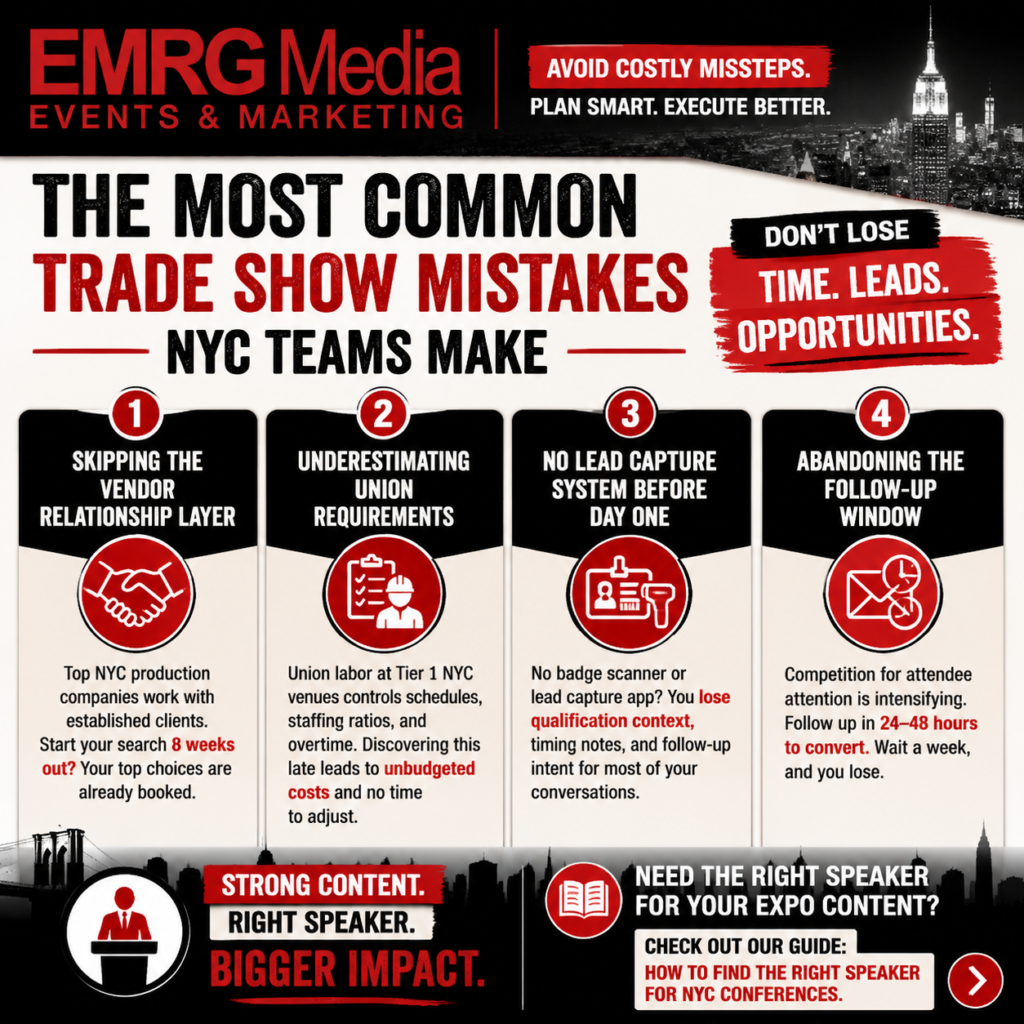 Skipping the vendor relationship layer. NYC’s top production companies are not waiting for inbound calls. They operate on retainer relationships with established clients. Beginning a production search 8 weeks out means your first choice, your second choice, and often your third choice are already committed.
Underestimating union requirements. Union labor at Tier 1 NYC venues governs setup and breakdown schedules, minimum staffing ratios, and overtime thresholds. Planning teams that discover this during pre-event walkthroughs face unbudgeted costs with no time to adjust.
No lead capture system before day one. A badge scanner or lead capture app configured before the show opens is not optional. Teams that rely on business cards collected in a bowl at the end of day one lose qualification context, timing notes, and follow-up intent for the majority of their conversations.
Abandoning the follow-up window. The strongest trade show activity since the pandemic’s onset was recorded in Q4 2024, indicating that competition for attendee attention at shows is intensifying. In a more competitive exhibitor environment, the companies that follow up within 24 to 48 hours of the event’s close capture the conversion advantage. Those that wait a week do not.
To find the right speakers to anchor your expo content, review our guide on how to find the right speaker for NYC conferences.
Trade Show Management Services: What EMRG Media Handles
EMRG Media provides full-service trade show management and expo planning in NYC for corporate hosts and exhibitors across every major Manhattan, Brooklyn, and Long Island City venue corridor.
Our standard scope for a hosted corporate trade show or expo includes:
- Venue sourcing, contract negotiation, and F&B minimum review
- Full AV and production design, including line array systems, video walls, and broadcast-grade livestream
- Managing the complete digital registration process, curating specific attendee tracks, producing event credentials, and providing a fully staffed physical information desk.
- Exhibitor and sponsor activation management
- FDNY, SAPO, and Department of Buildings permitting handled in standard scope
- On-site team for setup, run, and teardown: stage manager, AV crew, registration lead, and floor producers
- Providing comprehensive wrap-up documents that include presentation replays, guest reviews, exhibitor success metrics, and overall profitability assessments.
One senior conference producer owns your program end-to-end, from the venue walk-through through the final debrief. You speak to one person, not a rotating cast of department leads.
Clients including Bloomberg, EisnerAmper, Diligent, VideoAmp, and Sotheby’s have trusted EMRG Media with their highest-stakes NYC events. EMRG holds a 5.0 rating across 138 verified Google reviews.
Frequently Asked Questions
Our team secures Fire Department capacity approvals, DOB clearances for elevated platforms and overhead rigging, and Street Activity authorizations for outdoor pedestrian marketing alongside exterior branding. We also manage all venue certificate of insurance (COI) mandates. To guarantee a smooth process, we finalize this regulatory paperwork prior to executing your venue contract rather than scrambling during the week of the event.
Yes. EMRG serves as a full production partner for hosted corporate expos and as an exhibit management partner for companies exhibiting within larger shows. Scope is quoted individually based on booth size, event duration, and on-site staffing requirements.
A corporate conference centers on a programmed agenda with keynote and breakout sessions. A trade show centers on an exhibit floor with buyer-seller interaction and brand activation. Many NYC corporate events now combine both formats, running a plenary program in the morning and an exhibit floor or sponsor showcase in the afternoon.
Yes, hybrid capabilities are built into our standard offerings. Our team supplies professional-tier onsite filming, digital portal synchronization for remote guests, live camera toggling, and recorded content hubs for later viewing. Guaranteeing a flawless stream means mapping out the tech requirements early and establishing an independent data pipeline distinct from the facility’s shared Wi-Fi.
Set measurable goals before the event: qualified leads generated, demos completed, meetings booked, and cost per lead. Track these metrics live on the floor using a lead capture application synced to your CRM. Post-event, calculate total investment divided by leads captured, then monitor conversion rates over 60 and 90 days to establish true revenue attribution.
Plan Your NYC Trade Show With EMRG Media
Mastering the chaotic landscape of the city takes more than just a standard timeline; it demands elite local expertise. When it comes to trade show planning NYC professionals understand that success hinges on anticipating strict union hurdles, securing complex municipal permits, and captivating a highly discerning audience. Ultimately, the difference between a forgotten exhibition and a dominant industry presence lies entirely in the caliber of your execution team.
True production depth cannot be replicated from a remote satellite office. For 25 years, EMRG Media’s in-house roster of veteran producers, AV specialists, and permit coordinators has engineered high-ROI events across every major New York business district. Stop gambling your budget on generic strategies and outsourced logistics. Secure your competitive edge today by requesting a custom conference proposal at info@emrgmedia.com to strategize directly with a senior event producer. Visit us at 60 Sutton Place South, New York, NY 10022, and let us engineer your most profitable event yet.