

New York City hotel sales managers start blocking rooms for fall corporate season as early as January, right as the Javits Center’s conference calendar fills the Hudson Yards corridor with out-of-town attendees months in advance.
If you’re running a group event in Midtown or near Penn Station in 2026, understanding what is a hotel room block before you sign anything protects both your budget and your guest list.
In short, defining what is a hotel room block is a set number of rooms a hotel holds at a negotiated rate for your group, tied to a minimum pickup requirement and a financial penalty called attrition if that minimum isn’t met.
Room rates on a blocked inventory in Manhattan typically run 10% to 20% below standard rack rate for the same dates, though peak weeks around Fashion Week or the UN General Assembly in September can shrink that discount considerably.
How a Hotel Room Block Actually Works Behind the Front Desk
When evaluating what is a hotel room block in practical terms, it starts with a signed contract between your organization and the hotel’s sales department, not a casual phone call to the front desk.
The hotel reserves specific inventory, say, 40 rooms a night across three nights and releases those rooms to your attendees at the agreed rate through a private booking link or code.
Understanding how a hotel room block works matters because the hotel is taking those 40 rooms off the market for other guests, which is exactly why it requires guarantees in return.
Courtesy Block vs Guaranteed Block: Which One Are You Signing?
Most first-time event organizers researching what is a hotel room block assume every agreement carries the same risk, it doesn’t.
A courtesy block requires no minimum room commitment and carries no attrition penalty, the hotel simply holds rooms until the cut-off date, then releases anything unsold back into general inventory.
Hotels near Times Square and the Javits Center rarely offer courtesy blocks above 25 rooms because too much revenue sits on the table during peak conference weeks.
The Cut-Off Date and the Attrition Math That Determines What You Owe
A vital component of what is a hotel room block agreement is the cut-off date, the last day your attendees can book at the group rate before unsold rooms return to the general public.
In Manhattan, this date typically falls 21 to 30 days before arrival, though luxury properties near Central Park South sometimes tighten that window to 14 days during high-demand months like October and December.
Book only 65, and you owe the hotel for the 15-night shortfall at the group rate calculated either cumulatively across the whole event, where strong nights offset weak ones, or per-night, where each date is judged on its own with no offset.
The Rooming List Deadline Adds a Second Layer of Pressure
Beyond the standard cut-off, another essential rule in what is a hotel room block management is the rooming list deadline.
A separate date by which you must submit attendee names, arrival dates, and payment methods for every room.
Missing this deadline can trigger automatic cancellation of unassigned rooms before the general cut-off even arrives.
How Many Rooms Should You Actually Block for a NYC Event?
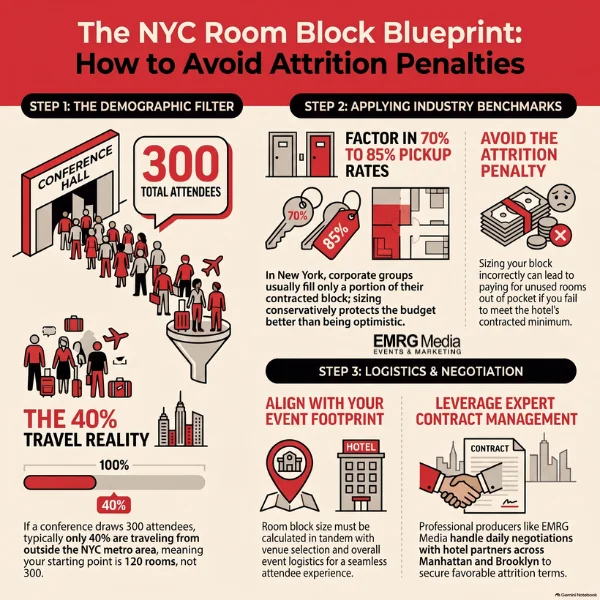
If your conference draws 300 attendees but only 40% are traveling from outside the metro area, blocking 120 rooms instead of 300 avoids an attrition penalty on a hotel room block you’ll likely pay out of pocket.
Industry pickup rates for corporate groups in New York typically run 70% to 85% of the contracted hotel room block, so a conservative estimate protects your budget better than an optimistic one.
Sizing your block correctly pairs closely with overall event logistics, our guide to Venue Selection And Booking walks through how block size interacts with your event’s full footprint.
If negotiating block size and attrition terms feels like more than your internal team wants to take on, EMRG Media’s producers handle these contracts daily across Manhattan and Brooklyn hotel partners.
Comp Rooms and Negotiating Your Rate Structure
Every negotiation regarding what is a hotel room block should include a conversation about complimentary rooms.
Most Manhattan properties offer a comp room ratio of one free room for every 40 to 50 rooms booked and picked up, though this varies by season and property tier.
Ask for this upfront rather than after signing, since sales managers rarely volunteer it.
The Audit Clause Smart Planners Negotiate Before Signing
A lesser-known safeguard when learning what is a hotel room block commitment is the audit clause. Attrition penalties assume the hotel lost revenue on your unsold rooms.
But if the property sells out to general guests on a night your group fell short, the hotel effectively double-dips on that inventory.
Experienced planners negotiate an audit or resell clause into the hotel room block contract, requiring the property to credit or waive attrition charges for any room it successfully resold at or above your group rate.
Group Rate vs Corporate Rate: Picking the Right Structure
A group rate vs corporate rate distinction matters here, group rates are negotiated for a specific event with a defined block and cut-off date, while corporate rates are standing, year-round discounts tied to a company’s ongoing travel volume.
If your organization already holds a corporate rate with a Midtown property, compare it against the proposed group rate before signing, since the corporate number sometimes wins out during shoulder season weeks in February and August.
For programs that also need meeting space alongside guest rooms, reviewing Conference Venues NYC options early helps align your room block size with your meeting room capacity before both contracts get finalized separately.
Key Takeaways
- A hotel room block reserves rooms at a negotiated rate, tied to a cut-off date and possible attrition penalty.
- Attrition thresholds run around 80% of the block; shortfalls are billed cumulatively or per-night depending on contract language.
- Guaranteed blocks carry financial risk if pickup falls short; courtesy blocks release unsold rooms penalty-free.
- Realistic pickup runs 70% to 85% of the contracted block block conservatively.
- An audit/resell clause can credit back attrition charges on rooms the hotel resold to the public.
Getting Your Next NYC Room Block Right From Day One
A hotel room block only protects your budget if the contract terms match your group’s actual travel pattern, not a hopeful headcount projection.
The organizers who avoid attrition penalties in 2026 are the ones who negotiate cut-off dates, resell language, and pick up minimums before signing, not after the invoice arrives.
If your event needs more than guest rooms, breakout space, a general session room, or a private retreat setting, pairing your room block strategy with Conference And Retreat Center Rentals NYC keeps lodging and meeting logistics moving on the same timeline.
Ready to lock in a room block that actually protects your budget? Connect with EMRG Media on Facebook or call our producers to review your contract terms before you sign anything.

FAQs About What Is a Hotel Room Block
What is a hotel room block?
A hotel room block is a set number of hotel rooms reserved at a negotiated group rate for a specific event, held until a contracted cut-off date. It guarantees lodging availability and pricing for attendees traveling to the same event dates.
How many rooms should you block?
Block based on realistic overnight need, not total headcount typically 70% to 85% of traveling attendees pick up rooms. Overblocking without adjusting the contract risks attrition penalties on inventory your group never used.
What is a cut-off date?
A cut-off date is the final day attendees can book within your room block at the group rate, usually 21 to 30 days before arrival in Manhattan. After this date, unsold rooms return to general inventory and rates rise.