
Stop Losing Money on NYC Hotel Room Blocks: The Ultimate 2026 Guide
Signing a NYC conference venue without securing your hotel room block first is the fastest way to inherit a five-figure attrition bill. A hotel room block is a fixed number of guest rooms a hotel holds for your group at a negotiated rate for specific dates. While this guarantees your attendees discounted lodging, it also exposes your organization to severe financial risk.
In Manhattan, hotel inventory near Grand Central Terminal and Penn Station vanishes during peak conference season. When you reserve a block, the hotel removes those rooms from general sale. If your attendees fail to book them by the cut-off date, you are legally obligated to pay for the unsold inventory.
Are you prepared to pay thousands for empty rooms because of a simple miscalculation? Hotel availability for Q4 2026 is disappearing rapidly. Do not leave your event budget vulnerable to ruthless NYC attrition penalties. Contact EMRG Media today for a room block risk assessment before you sign your venue contract!
Corporate Event Planner Inquiry
How Does a Hotel Room Block Work in Manhattan?
A room block moves through three stages. First, EMRG negotiates a contracted number of rooms per night, a group rate, and an attrition clause with the hotel’s sales team, typically 9 to 12 months before a Q4 event, per the timeline outlined in our guide to booking NYC conference venues. Second, the hotel builds a private booking link or reservation code, and attendees book directly against that block until the cut-off date. Third, the hotel reconciles actual pickup against the contracted number, and any shortfall beyond the allowed attrition percentage triggers a penalty invoice.
Group Rate vs. Corporate Rate: Which One Saves Attendees More?
A group rate is negotiated for your specific event dates and usually runs 10 to 20 percent below the hotel’s standard rate, but it only applies inside the room block and disappears after the cut-off date. A corporate rate is a standing, year-round discount some hotels extend to companies with recurring travel volume, typically 5 to 10 percent off rack rate on any date. For a single multi-day conference, the group rate almost always wins. For an organization running quarterly NYC events, a negotiated corporate rate can be the better long-term tool, and both options should be discussed during venue selection and booking negotiations.
The Room Block Cut-Off Date and Why 21 to 30 Days Is the NYC Standard
The room block cut-off date is the deadline by which attendees must book inside the block before the hotel releases unbooked rooms back into general inventory. Most Manhattan hotels set this 21 to 30 days before arrival. After that date, remaining rooms are no longer guaranteed at the group rate, and attendees who wait risk paying rack rate or finding the hotel sold out, particularly during high-demand windows described in our NYC Conference Venue Fall 2026 blog post.
How Many Rooms Should You Block for a NYC Conference?
 Many event planners overbook out of fear. This mistake causes expensive attrition bills. Sizing your hotel room block is a precise math exercise, not a blind guess.
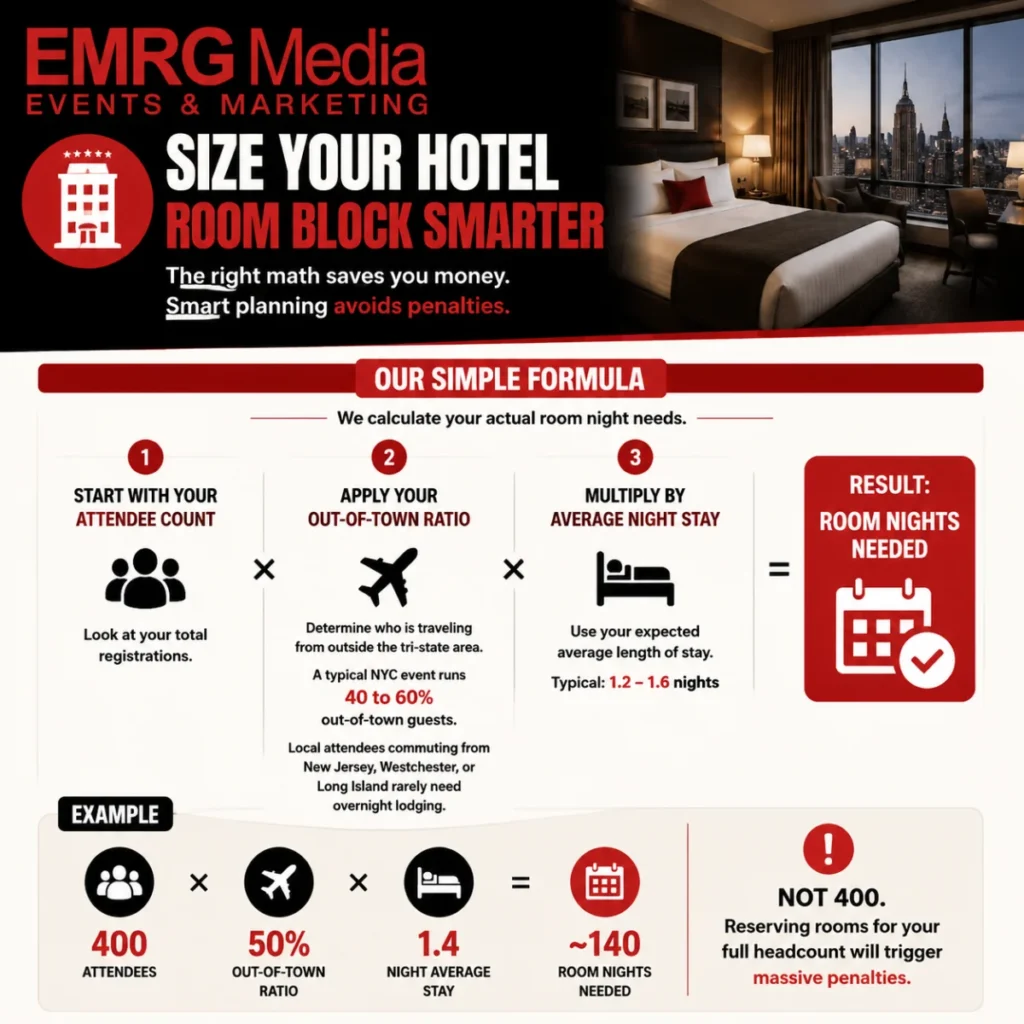
At EMRG Media, we calculate your actual needs using a simple formula:
- Start with your attendee count: Look at your total registrations.
- Apply your out-of-town ratio: Determine who is traveling from outside the tri-state area. A typical NYC event runs 40 to 60 percent out-of-town guests. Local attendees commuting from New Jersey, Westchester, or Long Island rarely need overnight lodging.
For example, a 400-person conference with a 50 percent out-of-town ratio and a 1.4-night average stay only requires roughly 140 room nights, not 400. Reserving rooms for your full headcount will trigger massive penalties.
Understanding the Comp Room Ratio
A comp room ratio is the number of free rooms a hotel gives you based on paid room nights. In 2026, Manhattan hotels typically offer one free room for every 40 to 50 paid rooms.
- Strategic usage: A 150-room block earns you 3 to 4 free rooms. Use these for VIP speakers or your production staff.
- Get it in writing: Ensure the hotel calculates these free rooms based on rooms actually picked up, not just the original contracted number.
The Attrition Clause: NYC's Most Expensive Line Item
An attrition clause sets the minimum percentage of rooms you must fill. It is the most underestimated expense in NYC event budgets. Most Manhattan hotels require you to fill 80 to 90 percent of your contracted rooms. The small buffer they allow is called “allowable slippage.”
How Hotels Calculate Attrition Penalties
Let us look at a real-world scenario. Imagine you contract 150 rooms for two nights at $329 per night, with an 85 percent threshold.
- Requirement: You must fill at least 128 rooms per night.
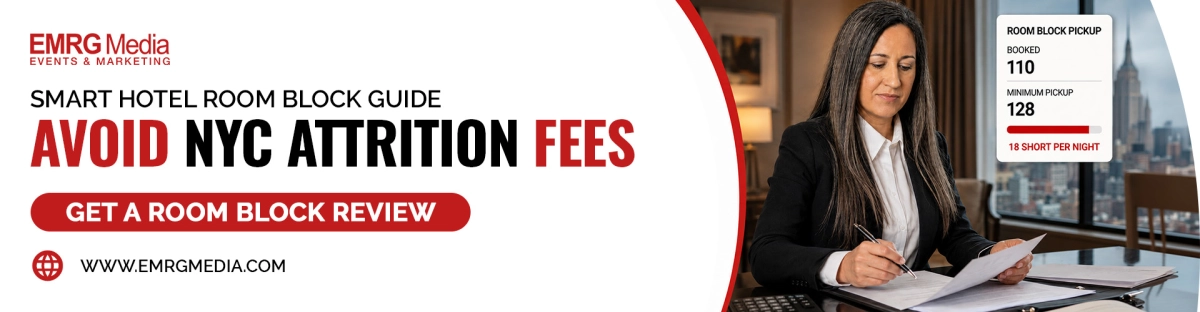
- Actual Pickup: You only fill 110 rooms per night.
- Shortfall: You miss the mark by 18 rooms per night (36 total room nights).
- The Penalty: The hotel bills your group a massive $11,844.
Negotiate Before You Sign
EMRG Media highly recommends negotiating your attrition threshold before signing anything. If your event lacks a NYC booking history, hotels often impose strict terms. Protect your budget with these simple steps:
- Push for a lower threshold: Aim for 75 to 80 percent instead of 90 percent.
- Demand a “wash clause”: This ensures that rooms booked outside your official block still count toward your total pickup.
Both concessions are standard requests during contract negotiations for NYC association events and cost the hotel nothing if your group performs as projected. Let EMRG Media protect your bottom line.
What Happens If You Do Not Fill the Room Block?
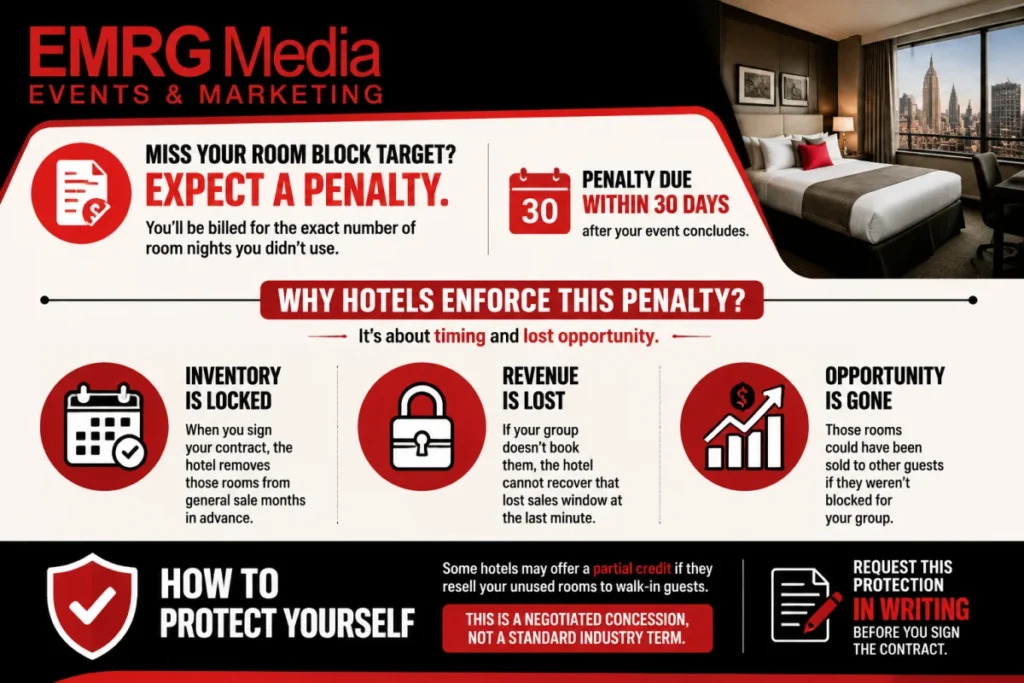 If you fall short of your attrition threshold, expect a penalty invoice based on the exact number of room nights you missed. This bill is typically due within 30 days after your event concludes.
Why Hotels Enforce This Penalty? Hotels do not forgive attrition penalties simply because the rooms went unused. The reasoning comes down to timing and lost opportunity:
- Inventory is locked: When you sign your contract, the hotel removes those rooms from general sale months in advance.
- Revenue is lost: If your group does not book them, the hotel cannot magically recover that lost sales window at the last minute.
How to Protect Yourself? Some properties will offer a partial credit if they manage to resell your unused rooms to walk-in guests. However, this is a negotiated concession, not a standard industry term. You must explicitly request this protection in writing before you sign the contract.
The Risk of Booking Outside the Block
Can attendees book outside your official hotel room block? Yes, but doing so directly hurts your group’s financial position.
When guests use third party travel websites or different rate codes to reserve their stays, those rooms will not count toward your contracted pickup total unless you have specifically negotiated a wash clause.
This creates a dangerous scenario: your organization could still owe a massive attrition penalty, even if the hotel is sitting completely full with your own attendees.
To protect your budget and ensure every reservation is properly credited, you must tightly control the booking process. Provide your attendees with exactly one booking link and one specific group code. Repeat these instructions everywhere.
Matching Your Room Block to the Right NYC Neighborhood
Midtown: High Cost, Maximum Convenience Midtown, which includes the Grand Central and Penn Station corridor, carries the highest room rates in Manhattan. However, it offers the shortest walking distance to major venues. Most Fortune 500 clients EMRG Media works with default to this area for programs near Bryant Park or Rockefeller Center. You can read about our successful corporate events and client experiences on our Google Business Profile.
FiDi and Hudson Yards: Better Value and Leverage Hotel blocks in the Financial District (FiDi) and Hudson Yards typically run 10 to 15 percent below comparable Midtown rates. These neighborhoods also feature newer hotel inventory and allow for easier attrition negotiations because they compete much harder for group business.
Weighing the Trade-Off This price difference is always worth reviewing alongside your broader venue search. To understand exactly how your neighborhood choice impacts both your event space and lodging costs together, explore our complete guide on conference and retreat center rentals in NYC.
The 2026 NYC Risk Calendar for Room Block Planning
Three 2026 windows compress Manhattan hotel inventory beyond normal peak season. The FIFA World Cup, June 11 to July 19, removes most Midtown room blocks from availability entirely, a risk detailed in our NYC tech conference and summit planning guide.
The UN General Assembly, mid to late September, spikes surrounding hotel rates 30 to 40 percent. The NYC Marathon, the first Sunday in November, disrupts vendor load-in and attendee arrival citywide. A mid-October date clears all three windows and still allows competitive attrition negotiation on remaining Q4 inventory.
Room Block Contract Checklist
Contract Term | What to Confirm Before Signing |
Attrition Threshold | Percentage of block required, typically 80 to 90 percent |
Cut-Off Date | Usually 21 to 30 days before arrival |
Comp Room Ratio | Rooms complimentary per paid rooms picked up |
Wash Clause | Whether outside bookings count toward pickup |
Rate Guarantee | Group rate versus corporate rate applicability |
Penalty Formula | Per-room-night shortfall calculation and payment deadline |
How EMRG Media Manages Room Blocks and Attrition Risk
EMRG Media secures hotel room blocks as a standard step in every multi-day conference engagement. Before you sign a contract, our experts rigorously review the attrition language, comp room ratios, and critical cut-off dates to protect your bottom line.
We never size a block based on blind headcount guesses. Instead, our team cross-references your actual registration data against historical pickup patterns. This data-driven strategy supported by peer-reviewed event management research in the Journal of Convention & Event Tourism ensures we calculate your room block based on realistic pickup probability.
For corporate clients running compliance-heavy programs, this analytical review process aligns perfectly with the strict permitting frameworks required across New York City. By applying these proactive standards, we lock in the exact inventory you need without exposing your organization to massive financial liabilities. Explore our complete guide on conference event planning in NYC
Frequently Asked Questions
A wash clause lets room nights booked outside your official block, through third-party sites or individual rate codes, still count toward your contracted pickup total. It protects your group from paying attrition penalties on rooms attendees found and booked on their own, outside the hotel’s block link.
Not always. A group rate is typically 10 to 20 percent below rack rate, but online travel sites occasionally undercut it during low-demand periods. The room block’s real value is guaranteed inventory and a fixed rate on high-demand NYC dates when individual rooms sell out entirely.
The organization that signed the hotel contract is financially responsible for the attrition penalty, not individual attendees. This is why EMRG Media reviews attrition language before a client signs, since the invoice arrives against the company’s contract regardless of why individual employees booked elsewhere.
Yes. Combined New York State and city hotel occupancy tax adds roughly 14.75 percent plus a flat per-night fee to any negotiated group rate, and most Manhattan properties add a separate service charge on meeting-related food and beverage. Always request a fully taxed rate before comparing hotel proposals.
Sometimes, but it depends on the force majeure and cancellation language in the original contract. Some Manhattan hotels allow a one-time date transfer without penalty if the request comes 60 or more days before arrival. Confirm this provision before signing, not after a postponement forces the conversation.
Protect Your Budget Before You Sign
A hotel room block is not a formality attached to your venue contract. It is a separate financial commitment with its own penalty structure, and in New York City, that structure is written to protect the hotel first. Planners who size the block against real attendee data, negotiate the attrition threshold before signing, and confirm the cut-off date in writing walk into their event with a predictable budget instead of a post-event invoice.
That is the standard EMRG Media applies to every hotel contract we negotiate on a client’s behalf, from a 100-person single-day summit to an 800-person multi-day program across multiple Manhattan properties.
Ready to lock in your room block before Q4 2026 inventory disappears? Reach out directly at EMRG Media today, and a senior producer will map your attrition risk before you sign anything.