
The 2026 Manhattan Countdown: A Month-by-Month Strategy to Protect Your Investment
Your NYC conference planning timeline does not start six months before the event. It starts the moment you commit to a date. New York City operates at a pace that exposes underprepared planners fast. Premium venues from Midtown to the Financial District’s East River waterfront fill 12 to 18 months in advance.
City permit requirements, union labor agreements, and a conflict calendar loaded with the UN General Assembly, Fashion Week, and major finance summits add real weeks to your schedule — weeks most planners never see coming. The problem is not ambition. It is the absence of a New York-specific roadmap.
This guide solves that directly: a precise, month-by-month NYC conference planning timeline covering every critical decision — from venue selection to day-of execution — built specifically for 2026.
EMRG Media has managed conference timelines across all five boroughs for 25 years. We know this city, its venues, its rules, and its pace better than anyone.
Ready to plan with confidence? Contact EMRG Media today — and let’s build a 2026 conference New York will remember.
Corporate Event Planner Inquiry
Why Planning a Conference in New York City Is Different
Manhattan Venues Book Faster Than Any City in the Country
Top conference venues from grand Midtown ballrooms to sleek Financial District spaces along the East River waterfront are booked an average of 12 to 18 months in advance. For peak windows in spring (April–June) and fall (September–November), that lead time stretches even further. The moment you have a target date, your venue search must begin. There is no grace period in New York.
NYC’s Regulatory Layer: Permits, Unions, and Building Rules Add Time
New York City operates within a layered regulatory environment that catches first-time conference planners completely off guard. Depending on your event’s size and location, you may need permits coordinated through the NYC Mayor’s Office of Citywide Event Coordination and Management (CECM) , the agency that oversees permitting for events on city property and coordinates across multiple municipal departments.
Beyond city permits, many Manhattan venues operate under union agreements with IATSE (International Alliance of Theatrical Stage Employees) and the Teamsters, which govern AV setup, lighting installation, and load-in logistics. Ignoring these requirements even accidentally results in delays, unexpected labor costs, and serious vendor friction. Build extra lead time into your timeline from day one.
The NYC Event Calendar: Dates That Will Cost You
In 2026, key conflict windows include the UN General Assembly (mid-to-late September), New York Fashion Week (February and September), the NYC Marathon (first Sunday in November), and the cluster of financial sector conferences dominating Q1 and Q4. The wrong date doesn’t just hurt attendance, it inflates hotel room blocks and vendor rates significantly.
The NYC Conference Planning Timeline: 18 Months to Event Day
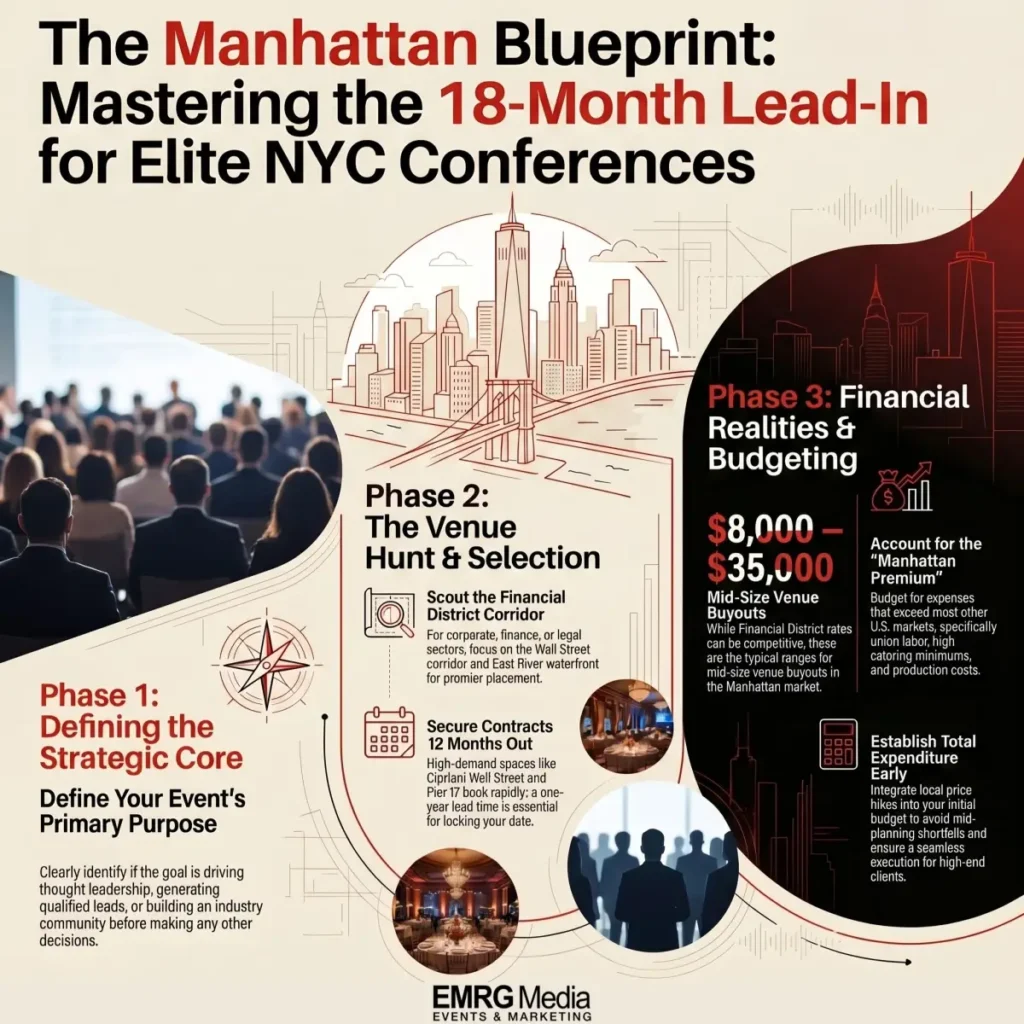
18–12 Months Out: Strategy, Venue Search & Locking Your Date
Planning a successful Manhattan conference requires strategic foresight and early-stage hustle. Follow these essential steps to secure your next event’s success:
- Define Your Purpose: Identify if you are driving thought leadership, generating qualified leads, or building an industry community. Every subsequent decision depends on this foundation.
- Scout the Financial District: For corporate, finance, or legal sectors, the Wall Street corridor is a premier choice. High-demand spaces like Cipriani Wall Street, Pier 17, and East River waterfront venues book rapidly, so finalize your contract twelve months in advance.
- Anticipate NYC Costs: Mid-size venue buyouts typically range from $8,000 to $35,000. While Financial District rates can be more competitive than Midtown, always account for Manhattan’s steep premiums. This includes union labor, high catering minimums, and production expenses that exceed most other U.S. markets.
- Establish Your Budget: Set your total expenditure early, integrating these local price hikes to avoid mid-planning shortfalls and ensure a seamless execution.
12–9 Months Out: Contracts, Speakers & Room Blocks
With your venue secured, focus shifts to people. Keynote speakers and high-profile panelists for NYC conferences book 9 to 12 months out. Begin outreach now and execute agreements before the 9-month mark.
Simultaneously, finalize hotel room block contracts. Manhattan hotel inventory near major conference venues disappears quickly, especially during peak season. Negotiate rates while you have real leverage waiting until the 6-month mark in New York is already late.
Begin union labor planning in this window as well. If your venue operates under IATSE jurisdiction, engage your production company now so they can plan around union call times, overtime thresholds, and crew minimums well before crunch time.
9–6 Months Out: Marketing, Registration & Vendor Selection
Your conference marketing engine needs to be live by the 9-month mark. Build your event website, open registration, and begin promoting across LinkedIn and targeted email campaigns. Early-bird pricing performs well for NYC conferences, where out-of-town attendees make travel decisions months in advance.
This is also the window to connect your conference strategy to long-term brand positioning. A conference is not a single-day event, it is a brand-building platform with compounding returns. For a deeper look at how New York organizations are using events to create lasting authority, explore How NYC Marketing Events Are Being Used to Build Long-Term Brand Equity powerful context for why conference quality translates directly into brand equity well beyond event day.
On the vendor side, lock in your caterer, AV production company, décor team, and entertainment. NYC’s top vendors reach booking capacity by the 6-month mark. Begin permit applications with the NYC CECM if applicable and confirm any building-specific permits required by your venue.
6–3 Months Out: Production Planning & Promotion Push
To stay on track with your NYC conference planning timeline, the 6–3 month window is critical for production and marketing.
- Finalize Production Design: Contract all staging, AV, and lighting by the six-month mark. Manhattan venues impose strict load-in windows and complex union call times; your production team needs ample lead time to navigate building management rules and ensure a compliant, efficient build-out.
- Simplify Logistics and Transit: Master the local transit landscape. Most attendees rely on subways or rideshares, so provide explicit transit guidance in all attendee communications. For high-security Wall Street venues or VIP guests, arrange dedicated transportation early to avoid any logistical headaches on the day of the event.
- Accelerate Promotional Efforts: Aggressively ramp up your marketing output. Leverage speaker announcements, session previews, and exclusive behind-the-scenes content across your social media channels. This strategic push is specifically designed to spark a significant registration surge during this pivotal mid-planning phase of your project.
3–1 Month Out: Final Confirmations & Run-of-Show
Every vendor contract must be signed, every payment schedule confirmed, and your run-of-show document in active draft. This is your conference’s operational bible, it outlines every moment of event day, down to the minute.
Complete your NYC Fire Marshal compliance review, confirm maximum occupancy for all event spaces, and verify ADA accessibility particularly important in older Manhattan buildings where elevator capacity and accessible routes require advance planning. Lock your final staffing plan: on-site EMRG Media coordinators, venue personnel, registration staff, and security.
Event Week & Day-Of Coordination in NYC
The week before your conference, conduct a full venue walkthrough with all vendors present. Confirm load-in times and freight elevator scheduling — a frequently overlooked constraint in Manhattan high-rises. Many Lower Manhattan buildings — including those in the Brookfield Place complex and along Broad Street — operate shared freight systems that require advance scheduling with building management, sometimes weeks before your event. Missing your assigned load-in window can trigger a cascade of setup delays that are nearly impossible to recover from on a tight event-day schedule. Confirm your freight access window in writing at the contract stage — not the week before load-in.
On event day, your on-site team should be in position at least 90 minutes before doors open. For Financial District venues, factors in building security protocols: pre-approved guest lists, lobby management, and ID verification are standard in commercial towers and must be communicated to attendees in advance.
NYC-Specific Curveballs Every Conference Planner Should Anticipate in 2026
Mastering the nuances of New York City requires significant foresight and a localized strategy. To maintain a successful and smooth NYC conference planning timeline, you must anticipate these 2026-specific hurdles early in your strategic process.
- Manage Major Conflict Dates: Identify non-negotiable avoidance zones like the UN General Assembly and Fashion Week. During these high-traffic periods, Midtown faces intense security perimeters and hotel rates skyrocket. Marking these dates on day one prevents massive logistical headaches.
- Navigate Vertical Infrastructure: Manhattan’s iconic skyscrapers present unique constraints. Many venues operate within commercial towers featuring union-controlled loading docks and restricted freight elevator schedules. Ensure your production team accounts for these specific access limitations during the contracting phase to avoid last-minute delays.
- Prepare for Seasonal Weather: For Q1 or Q2 2026 events, winter storms are a genuine threat. Build a sixty-minute weather buffer into your run-of-show and confirm your venue offers indoor receiving areas for vendor deliveries.
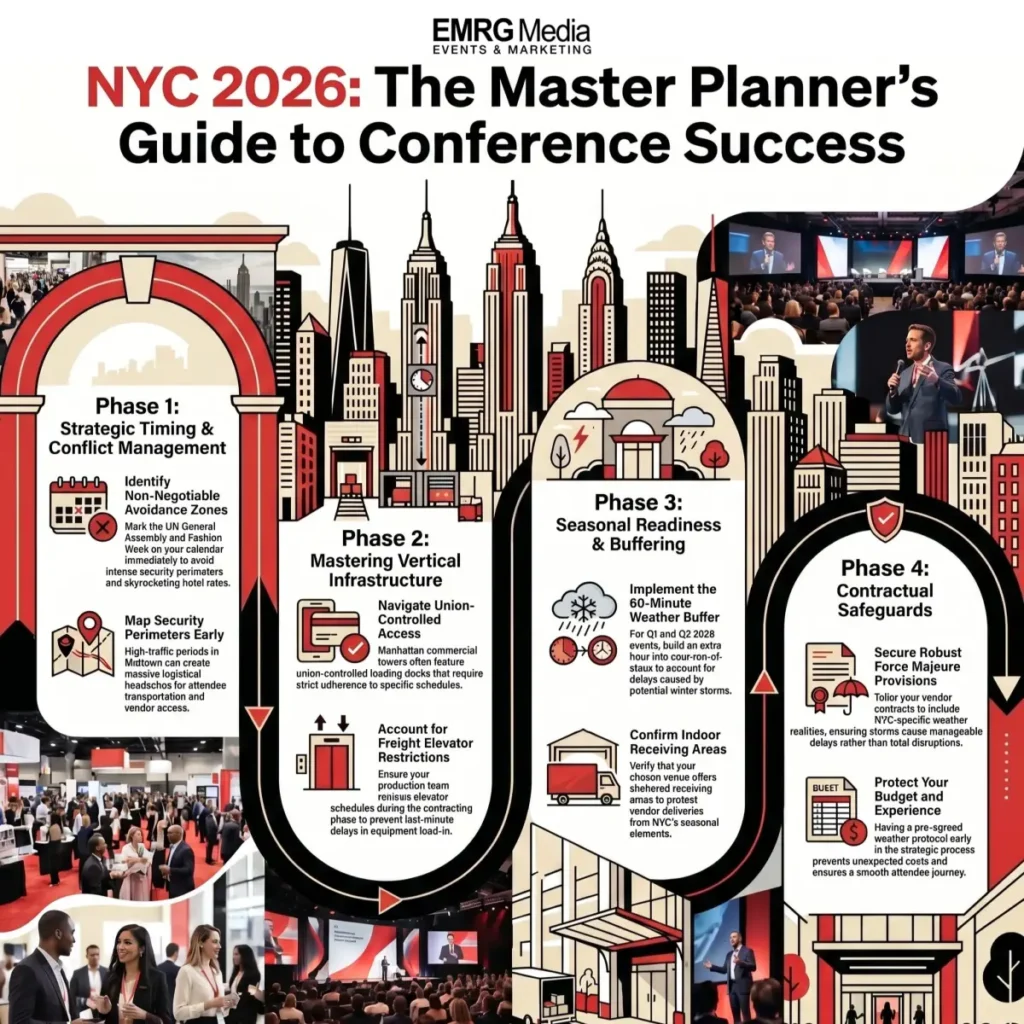
- Secure Contractual Protections: Verify that all vendor contracts include robust force majeure provisions tailored to NYC’s seasonal realities. Having a pre-agreed weather protocol ensures that unexpected storms remain manageable delays rather than total disruptions. By addressing these local curveballs early, you protect your budget and your attendees’ overall experience.
How EMRG Media Manages Your Entire NYC Conference Timeline
Our Proven Process: From Strategy to On-Site Execution
EMRG Media does not hand you a checklist and step aside. From your first planning call through final load-out, we serve as your dedicated strategic partner. Our NYC conference planning services are built to cover every critical phase — so nothing falls through the cracks in one of the world’s most demanding event markets:
- Venue Sourcing — Access to Manhattan’s most competitive and in-demand conference spaces
- Speaker Acquisition — Full coordination from initial outreach through signed agreements
- Production Management — Staging, AV, lighting, and branded installations managed end to end
- Permit Coordination — NYC CECM filings and venue-specific compliance handled for you
- Vendor Oversight — Catering, décor, entertainment, and transportation coordinated under one roof
- On-Site Execution — Our experienced team on the ground from load-in through final wrap
Why NYC’s Top Brands Trust EMRG Media
With 25 years producing conferences, trade shows, galas, and corporate events across all five boroughs, clients like Sony Music, W Magazine, and LVMH trust us to reduce risk and deliver measurable results at every stage.
Explore our full range of conference and event planning services, or find us on Google Maps to connect with our team directly.
Frequently Asked Questions
For a mid-to-large conference in Manhattan, 18 months is the gold standard. At a minimum, begin your venue search no later than 12 months before your target date particularly for Wall Street, Midtown, or any high-demand corridor.
Conferences held entirely within a private venue typically do not require a city permit. Events involving outdoor space, street closures, or public-facing activations usually do. The NYC Mayor’s Office of Citywide Event Coordination and Management (CECM) is the authoritative resource for determining which permits apply to your event.
The three costliest: starting the venue search too late, underestimating union labor lead times, and ignoring the NYC event conflict calendar when selecting your date.
Absolutely. Our full-service model covers strategic planning through day-of execution. Contact our team at 212-254-3700 or visit emrgmedia.com to schedule your consultation.
Your NYC Conference Starts With One Decision
A conference executed well in New York City does more than fill a room — it positions your organization as a recognized leader in one of the world’s most competitive and unforgiving markets. Every step covered in this NYC conference planning timeline exists for one reason: to give your team a decisive advantage before your competition even begins their venue search.
New York City will not slow down for an underprepared planner. Venues disappear. Permit windows close. Union deadlines do not move. The difference between a conference that generates lasting brand authority and one that scrambles to the finish line comes down to how early you start — and who is guiding the process beside you.
EMRG Media has spent 25 years turning complex NYC conference timelines into seamless, high-impact events for brands like Sony Music, W Magazine, and LVMH.
Your 2026 conference deserves that same standard.
Call EMRG Media today — let’s build a NYC conference timeline that puts your organization exactly where it belongs: at the front of the room.