

Corporate Event Permitting in NYC: Your Complete 2026 Step-by-Step Guide
You’ve secured the perfect Hudson Yards venue, the caterer is locked in, and the guest list is finalized. But without the right event compliance, the city can shut your activation down before the first attendee even arrives.
New York City has always set a high bar for the people who work here, and producing corporate events is no exception. Whether you are hosting a leadership gala at a Midtown Manhattan venue or rolling out a branded activation along the FiDi waterfront, the road from creative vision to flawless execution runs through one complex, unforgiving process: corporate event permitting.
Done right, securing these special event authorizations is completely invisible to your guests. Done poorly—or assumed to be the venue’s responsibility—it can bring a grinding halt to an evening your brand spent months preparing and budgeting for.
At EMRG Media, we have spent over two decades navigating NYC’s intricate regulatory landscape on behalf of marketing directors, corporate event managers, and brand leaders. This playbook gives you the complete picture of what brand activation licenses and event approvals look like in 2026—agency by agency, neighborhood by neighborhood, and week by week—so nothing catches you off guard. For more inquiries, contact us right away!
Corporate Event Planner Inquiry
What Is Corporate Event Permitting — and Why NYC Is in a League of Its Own?
Corporate event permitting is the mandatory process of securing city and state approvals before your event can legally operate. In most cities, it requires a few forms and a short wait. In New York City, it is a high-stakes logistical challenge.
Navigating five boroughs, overlapping agency jurisdictions, and fierce competition for premium spring venues demands intense coordination. Most in-house corporate teams simply do not have the institutional knowledge to manage this alone.
Who needs a permit?
Almost everyone. Assuming your event is exempt is one of the most common—and expensive—mistakes in event planning. If your production involves any of the following, you will need at least one permit, and likely several working simultaneously:
- External Caterers: Bringing in any outside food service or branded food trucks.
- Street-Level Activations: Utilizing public sidewalks or closing roads for brand visibility.
- Outdoor Extensions: Expanding your event footprint beyond the venue’s indoor walls.
- Non-Traditional Venues: Hosting in spaces not permanently licensed for large events.
- Custom Alcohol Service: Serving liquor outside the parameters of the venue’s existing baseline license.
Do not wait until the week before your event to check compliance. Missing just one authorization can instantly shut down months of hard work.
The NYC Corporate Event Permit Landscape: Agency by Agency
One of the most critical realities to understand about corporate event permitting in New York City is that there is no centralized, single permit window. Each agency operates independently, bringing its own application forms, strict lead-time requirements, and aggressive enforcement authority.
To ensure your brand activation is fully compliant, your team must navigate a complex web of regulatory bodies. For an official baseline of city rules, corporate event planners should always reference the Comprehensive Event Permitting Guide provided by the NYC Mayor’s Office of Citywide Event Coordination and Management (CECM).
Below is a clear breakdown of the primary city and state agencies your planning team will encounter:
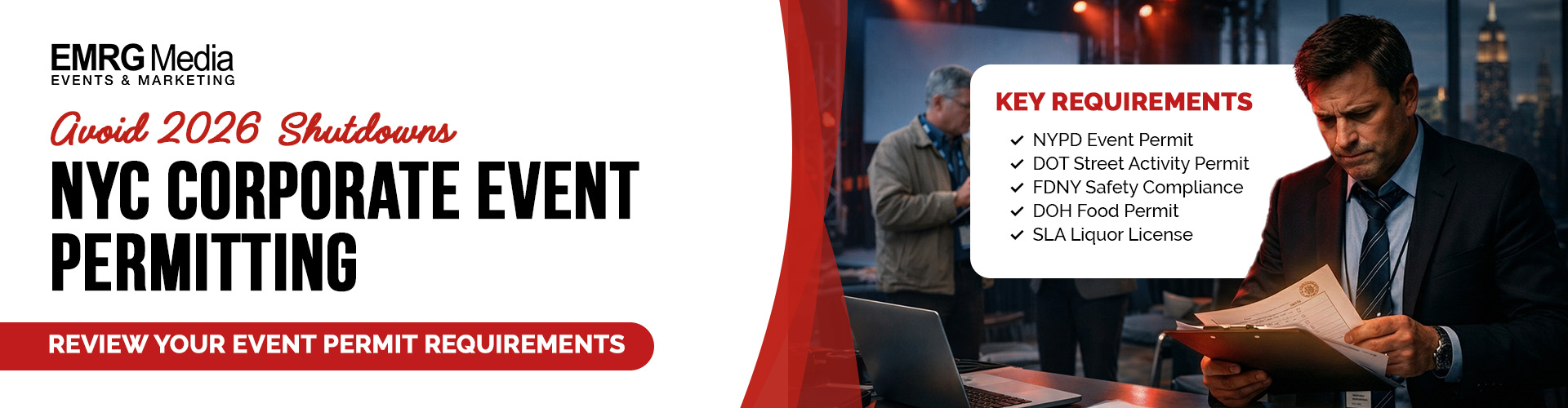
- NYPD Special Event Permits: Required for any event touching public space, involving road closures, or requiring crowd management. These must be submitted through the NYPD Highway District with a minimum 30-day lead time.
- NYC DOT Street Activity Permits: Mandatory for street-level activations in areas like SoHo or the Flatiron District. These govern everything from blocking sidewalks to closing traffic lanes, carrying strict insurance indemnification requirements that must be cleared early.
- NYC Parks Department Permits: Essential if any element of your event touches NYC Parks property. Marquee green spaces are highly competitive for spring 2026; advance notice of 10 to 12 weeks is a firm requirement rather than a suggestion.
- FDNY Compliance: The Fire Department regulates tents, temporary stages, and occupancy loads. New in 2026: a mandatory pre-event sign-off for temporary structures hosting over 150 guests. On-site venue staff must also hold current FDNY Certificates of Fitness.
- NYC Department of Health Permits: Utilizing an external caterer or branded food truck requires a Temporary Food Service Establishment Permit. Missing this authorization gives the DOH immediate authority to shut down your food service mid-event.
- NYS Liquor Authority (SLA) Permits: A venue’s baseline license generally only covers its standard indoor footprint. Outdoor extensions, rooftops, and off-premise alcohol service demand a separate SLA Special Event Permit, while external bar vendors must carry valid Catering Authorizations to avoid immediate shutdowns and heavy penalties.
Corporate Event Permitting by NYC Neighborhood: A 2026 Field Guide
Every New York City neighborhood carries its own distinct compliance personality. Understanding where you are activating is just as critical as what you are producing. Here is what to expect across key districts:
- Midtown Manhattan: This high-volume market is unforgiving. COI requirements at marquee venues consistently exceed $2 million in aggregate. Any street-level presence requires strict NYPD and DOT coordination, and last-minute applications rarely succeed.
- Hudson Yards & the High Line: This premier destination operates under highly specific venue policies alongside standard city rules. Spring 2026 demand is fierce; submit your DOT and Parks applications 10 to 12 weeks in advance to secure a spot.
- SoHo & Tribeca: These historic neighborhoods require meticulous attention to logistics. Always confirm sound mitigation documentation in writing before booking a SoHo venue. In Tribeca, complex loading dock and DOT rules frequently blindside out-of-market planning teams.
- Brooklyn (Williamsburg & DUMBO): Brooklyn’s waterfront compliance is rigorous. Rooftops often demand FDNY structural certifications. Crucially, these venues typically require a Temporary Place of Assembly (TPA) issued by the NYC Department of Buildings. You must verify TPA status during due diligence, long before any contract is signed.
Your Week-by-Week Corporate Event Permitting Timeline for Spring 2026
Spring is New York City’s busiest event season — and the difference between a smooth permit process and a last-minute scramble almost always comes down to when you start.
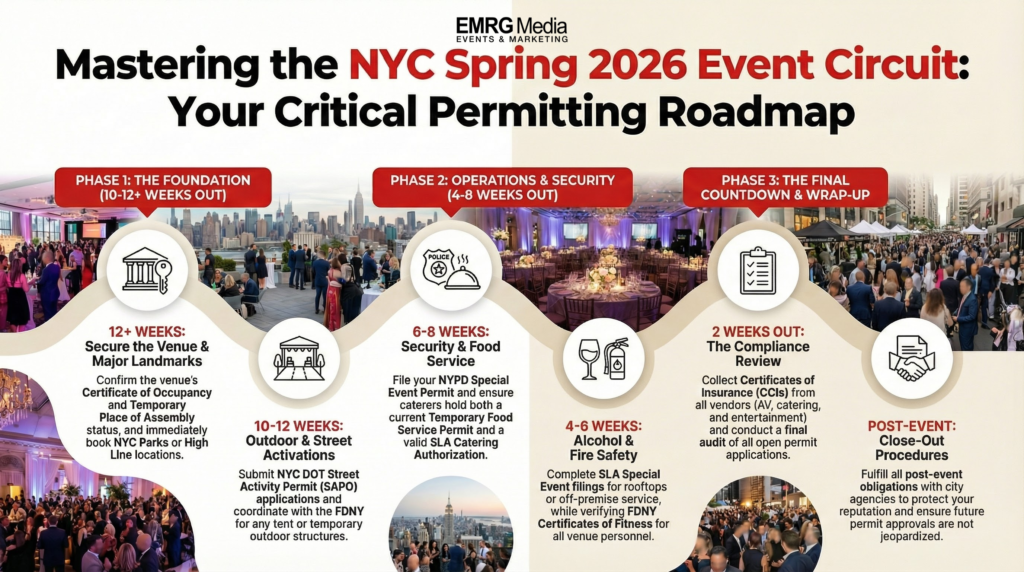
12+ Weeks Out — Confirm the venue’s Certificate of Occupancy and Temporary Place of Assembly status. Identify every agency touch point relevant to your event format. If your program includes any NYC Parks or High Line component, submit those bookings immediately.
10–12 Weeks Out — Submit NYC Parks Department and NYC DOT Street Activity Permit applications for all outdoor and street-level elements. Initiate FDNY tent and temporary structure coordination if open-air components are part of your plan.
6–8 Weeks Out — Submit your NYPD Special Event Permit application. Confirm that your external caterer holds a current Temporary Food Service Establishment Permit and a valid SLA Catering Authorization.
4–6 Weeks Out — Complete SLA Special Event Permit filings for outdoor extensions, rooftop activations, and off-premise alcohol service scenarios. Verify FDNY Certificates of Fitness for all relevant venue personnel.
2 Weeks Out — Collect and verify COIs from every vendor participating in your event — AV, catering, entertainment, and production crews. Conduct a complete compliance review against all open permit applications and flag anything outstanding.
Post-Event — Close out all permits in accordance with each agency’s specific requirements. Failing to fulfill post-event obligations can affect future permit approvals and damage relationships with the venue partners that matter most to your long-term event program.
What Corporate Event Permitting Costs in NYC: A 2026 Budget Reference
Agency permit fees are generally modest when viewed in isolation. Street Activity Permit applications typically run between $25 and $300. NYC Parks permit fees scale with event size and location. NYPD Special Event Permits for larger activations are reviewed on a cost-recovery basis that varies significantly depending on scope.
Insurance is where the real budget commitment lives. Most Manhattan venues require a minimum of $1 million in General Liability per occurrence and $2 million in aggregate. High-profile venues in Midtown and Hudson Yards frequently require higher limits — with the venue named as an additional insured on the policy. Every vendor on-site must carry independent coverage: General Liability, Workers’ Compensation, and Liquor Liability where applicable. A single uninsured vendor creates exposure that extends directly to your organization.
When you weigh those costs against the financial and reputational impact of a compliance failure — an event shutdown, a regulatory fine, or a liability claim — investing in proper corporate event permitting from the very start is one of the clearest returns your planning budget can generate. For a complete breakdown of NYC event insurance minimums, COI standards, and venue documentation requirements, visit our comprehensive NYC event compliance guide.
How EMRG Media Handles Corporate Event Permitting — So Your Team Never Has To
At EMRG Media, managing corporate event permitting is not something we add to the checklist after the venue is booked. It is built into our planning process from the very first conversation. If you are wondering how compliance fits into the broader scope of your production, check out our guide on What to Expect When You Hire a Full-Service Event Planning Team in NYC to see how we manage every detail from ideation to execution.
Our team coordinates permit applications across every relevant city agency—NYPD, DOT, Parks, FDNY, Department of Health, and the SLA—while simultaneously managing COI collection and vendor verification for every partner involved in your event. We maintain active, ongoing relationships with agency contacts, venue managers, and insurance professionals across all five boroughs. That means we move faster, resolve issues before they become problems, and protect your brand at every stage of the production.
From a branded rooftop activation in DUMBO to a multi-room leadership conference in Midtown Manhattan, our event planners has worked across the full spectrum of NYC’s corporate event permitting environment, bringing that hard-won experience to every engagement we take on.
Find us on Google Maps and let’s start the conversation. Spring 2026 dates are filling quickly, and getting ahead of the permit process is the single most powerful step you can take to protect your event investment.
Frequently Asked Questions (FAQ's)
The event stops — immediately. Beyond the disruption on the night itself, permit violations can limit your brand’s future access to premium NYC venues, trigger civil liability if injuries or damages occur, and result in financial penalties from the relevant city agency. The reputational cost with clients, partners, and attendees is often the hardest thing to recover from.
No. A venue’s Certificate of Occupancy and existing licenses cover its baseline legal operation — not the specific permits your event requires. External caterers, outdoor elements, rooftop structural load certifications, and all third-party vendors carry independent permitting and insurance obligations. Those responsibilities belong to your planning team, not the venue.
A CO confirms that a building is legally approved for its designated use and occupancy capacity. A TPA is issued by the NYC Department of Buildings specifically for spaces not permanently designated for event use — galleries, warehouse conversions, lofts — and is required before those spaces can legally host a corporate gathering. Both documents should be verified before any venue contract is executed.
Absolutely. Our team can engage at any point in the planning process — auditing your current permit status, identifying gaps, and managing all outstanding applications and agency filings on your behalf. Call us at 212-254-3700 and we will start with a clear, honest picture of exactly where you stand and what needs to happen next.
Flawless Execution Starts with Compliance
Navigating the corporate event permitting landscape in New York City is not a task for the faint of heart. With multiple agencies like the NYPD, DOT, FDNY, and SLA enforcing strict deadlines and localized neighborhood rules, compliance is the absolute backbone of any successful brand activation. Whether you are hosting a rooftop gala in Brooklyn or a street-level product launch in Midtown, securing the right authorizations, insurance policies, and venue assembly documents is non-negotiable. A single overlooked form or a missed deadline can lead to immediate shutdowns, heavy financial penalties, and severe reputational damage.
Ultimately, successful event permitting requires a highly proactive approach, an airtight timeline starting months in advance, and deep institutional knowledge of the city’s complex regulatory ecosystem. Protecting your investment means taking compliance just as seriously as your creative vision.
EMRG Media is New York City’s leading corporate event planning agency, with over two decades of experience producing seamless events across all five boroughs. From corporate event permitting to full-scale production management, we handle every detail so you can focus on what matters most — the event itself. Connect with our team today and let’s bring your next event to life.