Don’t Sign That Vendor Contract Yet: The Ultimate NYC Event Planning RFP Blueprint
An event planning rfp (request for proposal) is a structured document detailing your event’s scope, deliverables, budget threshold, and technical requirements so competing producers can submit transparent, apples-to-apples proposals. It is your single greatest defense against vague line items, runaway change orders, and inflated production fees before you sign a binding contract. In a relentless market like New York City, issuing a sloppy brief doesn’t just inflate costs—it costs you the premier vendors who routinely reject disorganized bids.
This comprehensive blueprint reveals the exact scoring criteria, timelines, and battle-tested frameworks top procurement leaders use to evaluate talent, master complex union load-in logistics, and secure elite venues. Don’t risk your company’s flagship launch or holiday gala on guesswork while rival brands lock down Manhattan’s top spaces months ahead. Grab our proven evaluation scorecard below, steal our plug-and-play RFP framework right now, and claim complete control over your event budget before peak dates vanish completely.
Corporate Event Planner Inquiry
What Is an Event Planning RFP?
A request for proposal (RFP) is not a simple quote request. While a quote strictly answers, “What does this cost?” an RFP asks, “How will you solve this, and what will your solution cost?” According to the U.S. General Services Administration (GSA), an RFP is necessary when a buyer needs to evaluate a comprehensive solution based on approach, experience, and pricing combined, rather than competing on price alone.
RFP vs. RFQ vs. Event Proposal
Document Type | Core Function | Expected Deliverable | Ideal Use Case |
Request for Quote (RFQ) | Strictly pricing | A set financial figure based on predetermined, rigid specifications. | You already have a finalized event plan and only need cost estimates for specific items. |
Request for Proposal (RFP) | Comprehensive strategy | Proposed execution methods, production schedules, labor breakdowns, and total costs. | You require an agency to engineer a solution for an event goal rather than just pricing a checklist. |
Event Proposal | The agency’s pitch | A customized submission addressing all of your RFP requirements. | This is received after issuing your RFP; it is the vendor’s actual bid to win the project. |
When You Need a Formal RFP vs. When a Call Is Enough
A formal RFP is worth the internal time investment when three or more vendors are competing, the guest count exceeds 100 people, or the budget crosses the $25,000 threshold. Below those marks, a scoped discovery call resolves operational details much faster than formal paperwork, allowing you to quickly hire top-rated NYC event planners directly.
The 7-Step Event RFP Process, With Realistic Timelines
Running a successful RFP requires a strict four-week timeline to keep vendors aligned and internal teams on track.
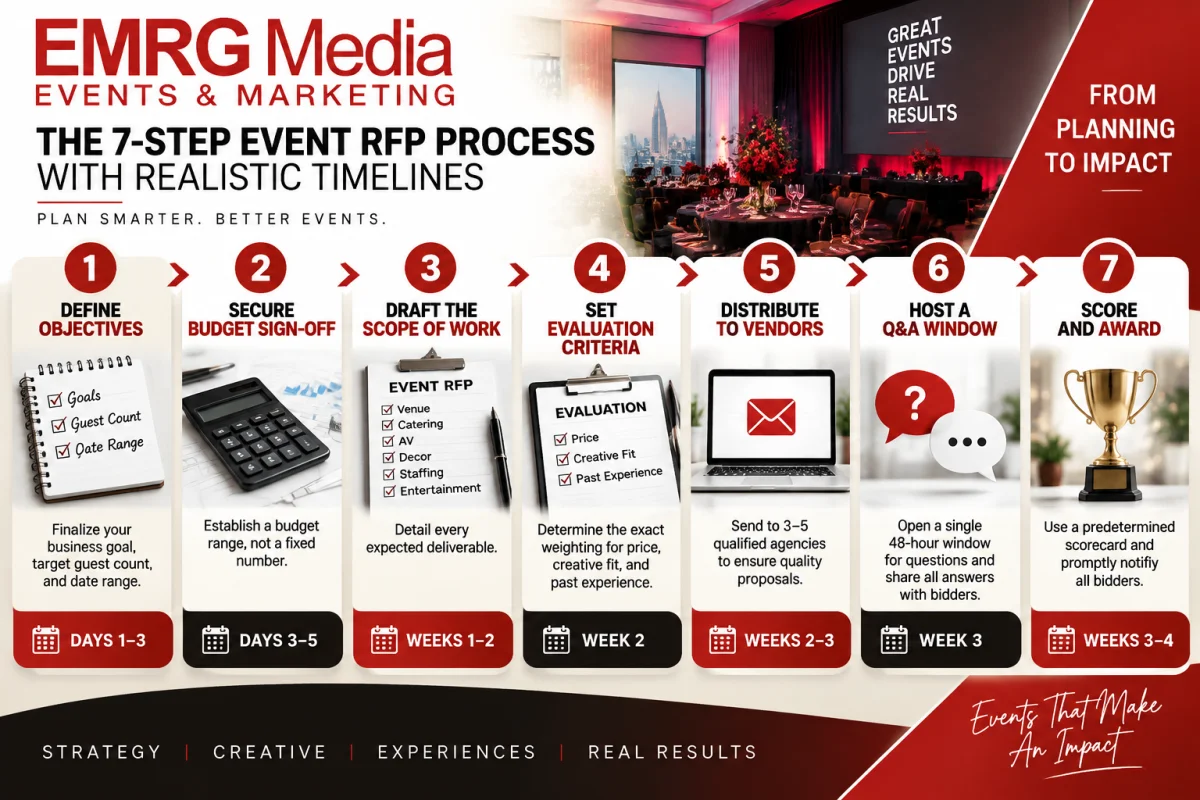
- Define internal objectives (Days 1–3): Finalize the overarching business goal, target guest count, and precise date range before engaging the market.
- Secure budget sign-off (Days 3–5): Establish a budget range rather than a fixed number. This prevents vendors from artificially underbidding or padding their margins.
- Draft the scope of work (Weeks 1–2): Detail every expected deliverable, including the venue, catering, AV, decor, staffing, and entertainment. This step is where understanding exactly what an event planner does becomes critical, as you must comprehensively itemize the logistics they will manage.
- Set evaluation criteria (Week 2): Determine the exact weighting for price, creative fit, and past experience before any proposals arrive.
- Distribute to vendors (Weeks 2–3): Limit distribution to three to five agencies. Inviting more creates internal review fatigue without improving overall proposal quality.
- Host a Q&A window (Week 3): Open a single 48-hour window for questions. Provide identical written answers to all bidders simultaneously to maintain transparency.
- Score and award (Weeks 3–4): Use a predetermined scorecard instead of gut instinct. Promptly notify unsuccessful bidders to preserve valuable relationships for future projects.
What Belongs in an Event Management RFP
A comprehensive RFP must contain six specific sections. Skipping any of these components is the quickest way to receive vendor proposals that cannot be compared side by side. To guarantee a successful event planning and management process, include the following core elements:
- Event overview and objectives: Detail the core business reason for the gathering rather than just listing the event date and estimated headcount.
- Scope of services: Itemize the venue type, catering style, audio visual needs, design direction, and specialized talent requirements.
- Budget range: Provide a clear financial floor and ceiling. Using a single fixed number encourages vendors to bid to that exact limit instead of quoting your actual operational needs.
- Timeline and key dates: Include the proposal deadline, final decision date, and event date with a scheduled buffer.
- Evaluation criteria: State your weighting, such as assigning specific percentages to price, creative approach, and highly relevant experience.
- Submission format: Outline page limits, required references, and exact insurance requirements so every single bid arrives uniformly.
This standardized structure aligns exactly with the Events Industry Council APEX framework, an initiative built by thousands of professionals to standardize universally accepted best practices across the entire meetings industry.
NYC-Specific RFP Considerations Corporate Buyers Miss
New York adds procurement variables that a generic template will not catch.
Union Labor and Load-In Rules
Venues like Terminal 5 and Chelsea Piers operate under IATSE and Local 1 stagehand agreements. Your RFP should ask each vendor to confirm whether union labor costs are included in their quote or billed separately, since this line item alone can shift a proposal by 10 to 15 percent.
Manhattan Deposit and Cancellation Norms
Most Manhattan venue contracts require a 25 to 50 percent deposit at signing, with cancellation penalties that tighten inside 90 days of the event date. Ask every vendor to disclose their cancellation schedule in the proposal itself, not after you have signed.
Widening the Radius
If Manhattan venue costs exceed budget, Brooklyn, Jersey City, and Bergen County vendors often bid 15 to 20 percent lower for comparable production value. Naming an acceptable service radius in your RFP opens this option without a separate search.
Why Q4 Compresses Your Window
September and December bookings in New York City lose access to top-tier venues roughly 4 months out. An RFP for a Q4 holiday event issued after Labor Day is already working from a shortened venue list.
Common Event RFP Mistakes That Cost You Good Vendors
Avoiding fundamental requests for proposal errors is just as critical as knowing how much does an event planner costs in NYC. When you make these three common mistakes, elite vendors will either decline to bid entirely or submit inflated proposals to cover the perceived risk.
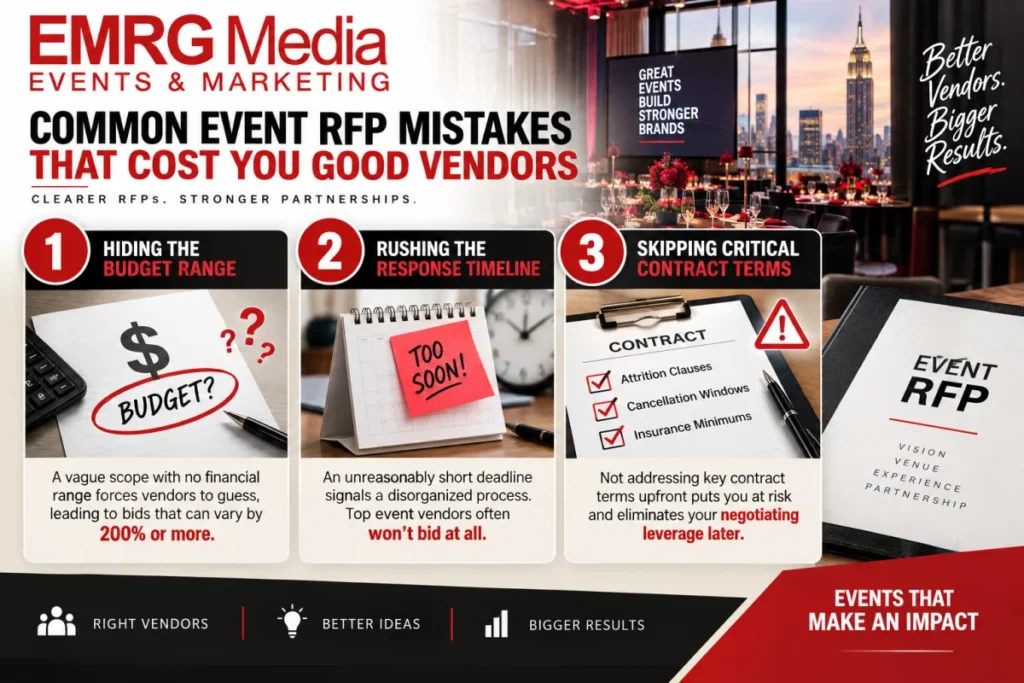
- Hiding the budget range A vague scope with no financial floor or ceiling forces vendors to guess your spending threshold. This inevitably produces bids that vary by 200 percent or more, making it impossible to compare proposals fairly side by side.
- Rushing the response timeline Sending an RFP to too many vendors with an unreasonably short deadline signals a disorganized internal process. Highly experienced event producers frequently decline to bid under these conditions rather than waste their team’s resources competing for a chaotic project.
- Skipping critical contract terms Failing to ask about attrition clauses, cancellation windows, and insurance minimums upfront is a massive liability. If you wait to discuss these details until after you have selected a winner, you immediately lose all your negotiating leverage. Always require vendors to disclose their standard contract terms directly inside their initial proposal submission.
What an Event RFP Actually Costs to Run
Managing an event RFP internally carries real financial weight, typically consuming 15 to 25 staff hours for drafting, distribution, and scoring. However, your biggest financial risk is a poorly written brief.
A vague RFP produces mismatched vendor proposals that inevitably reveal scope gaps mid-planning. These misunderstandings generate costly change orders, historically averaging 8 to 12 percent above the original quoted price.
Fortunately, you can eliminate these expensive budget overruns early. By building a comprehensively scoped document with strategic input from an experienced event planner during the initial discovery phase, you remove the majority of these costly downstream surprises before ever contacting a single vendor.
Scoring Proposals: A Simple Weighted Framework
Criteria | Weight | What to Check |
Relevant experience | 30% | Similar guest count, industry, or venue type in the last 3 years |
Price transparency | 30% | Itemized line items, not a single lump sum |
Creative approach | 25% | Does the concept solve your stated objective |
References | 15% | At least two verifiable client contacts |
Mini case study: A 150-guest product launch RFP issued by a Manhattan tech firm went to five vendors with a $60,000 to $85,000 budget range and a 10-day response window. Three proposals came back within range. The winning bid scored highest on creative approach despite sitting in the middle of the price range, because the itemized budget showed exactly where the extra spend went: a custom staging build the client had not thought to request but immediately recognized as valuable. The RFP process surfaced that idea. A single vendor call would not have.
Frequently Asked Questions
The 5 P’s are Purpose, People, Product, Place, and Promotion. Purpose defines why the event exists, People covers the audience and staffing, Product is the experience itself, Place is the venue, and Promotion drives attendance and awareness beforehand.
An internal team typically spends 15 to 25 staff hours drafting and scoring an RFP, with no direct cash cost. The real expense is indirect: a poorly scoped RFP invites change orders averaging 8 to 12 percent above the original quote once gaps surface.
An RFQ requests pricing against a fixed, already-defined specification. An RFP requests a full solution, including approach, staffing, and pricing, and is used when vendors need to propose how they would execute the event, not just what it costs.
The three most common mistakes are omitting a budget range, giving vendors under a week to respond, and skipping contract-term questions like cancellation windows and insurance minimums until after a vendor is already selected.
Send your RFP to 3 to 5 vendors. Fewer than three limits comparison, while more than five typically slows your review timeline without meaningfully improving the quality of the proposals you receive back.
Skip the Guesswork, Request a Scoped Proposal Directly
Mastering your event planning rfp is the single most effective way to eliminate budget surprises and find a vendor who truly understands your vision. By defining your scope, budget, and specific needs upfront, you force the market to compete fairly for your business. A well-crafted brief protects your internal resources, speeds up the selection process, and ensures you sign a contract with zero hidden fees.
You do not have to navigate this complex procurement process alone. If you want to skip the administrative headache and go straight to reviewing a fully itemized, transparent plan, let EMRG Media do the heavy lifting. We know exactly what it takes to execute flawless NYC events strictly on budget. Stop stressing over vendor paperwork. Contact EMRG Media today to schedule a discovery call and receive your custom, comprehensively scoped proposal.