

NYC Venue Licensing in 2026: The Corporate Planner's Complete Verification Guide
You found the venue. The exposed brick is perfect, the rooftop view aligns exactly with your CEO’s vision, and the capacity fits your entire guest list with room to spare. Before a single signature lands on a contract — stop. The most overlooked step in corporate event planning across New York City is not the catering menu, the AV stack, or the entertainment lineup. It is confirming that the space you love is actually authorized to host the event you are envisioning.
NYC venue licensing is the legal backbone behind every successful corporate event in the five boroughs. It determines whether your event is allowed to happen at all — and whether your organization is protected when anything goes sideways. At EMRG Media, we have produced over 5,000 corporate events across Manhattan, Brooklyn, Queens, and the broader metro area. What 25 years in this city has taught us above everything else: stunning spaces and compliant spaces are not always the same thing.
This guide gives corporate planners, marketing directors, and company leaders the complete, 2026-updated picture — from the documents you must request before signing a contract to the neighborhood-level rules that catch even the most experienced teams off guard. Already facing a tight deadline or a complex venue? Contact the EMRG Media team today to let our experts handle the vetting, compliance, and planning for you.
Corporate Event Planner Inquiry
The Legal Basics: Why Proper Authorizations Make or Break Your Event
Venue compliance encompasses the full set of legal authorizations a space must hold before it can lawfully host a gathering of guests. It is not the same as an event permit — which the event organizer typically applies for. Securing the foundational paperwork is the venue operator’s responsibility, and every document must be active and current before your event date appears on their calendar.
Think of it as the property’s credentials. Just as you would verify a vendor’s qualifications before hiring them, you should verify every legal document before committing to a space.
Venue Credentials vs. Event Permits: Understanding the Difference
The confusion between property authorizations and event-specific permits is one of the most persistent mistakes in corporate planning. Here is the clearest way to separate them:
- Venue licenses are held by the property — issued by city agencies based on how the building is classified, constructed, and legally approved for use.
- Event permits are applied for by the organizer — tied to specific activities, outdoor components, street access, or vendor operations.
Both must be in order for your gathering to proceed. But they are not interchangeable, and a location that passes inspection on one side can still create serious liability exposure on the other.
Why a Beautiful Space Can Still Be Legally Off-Limits
New York City has more exceptional event spaces per square mile than virtually anywhere in the country. It is entirely natural to get caught up in the design—in fact, we know exactly What Guests Notice First When They Walk Into a Luxury NYC Event. However, that immediate ‘wow’ factor cannot override compliance. A gallery in SoHo may have a breathtaking industrial aesthetic but no current Temporary Place of Assembly permit on file. A warehouse in Williamsburg may have unbeatable production potential but an outdated occupancy classification. In either scenario, your event cannot legally proceed — regardless of how spectacular the space looks in a pitch deck.
The 6-Document Compliance Checklist Every Corporate Planner Must Demand
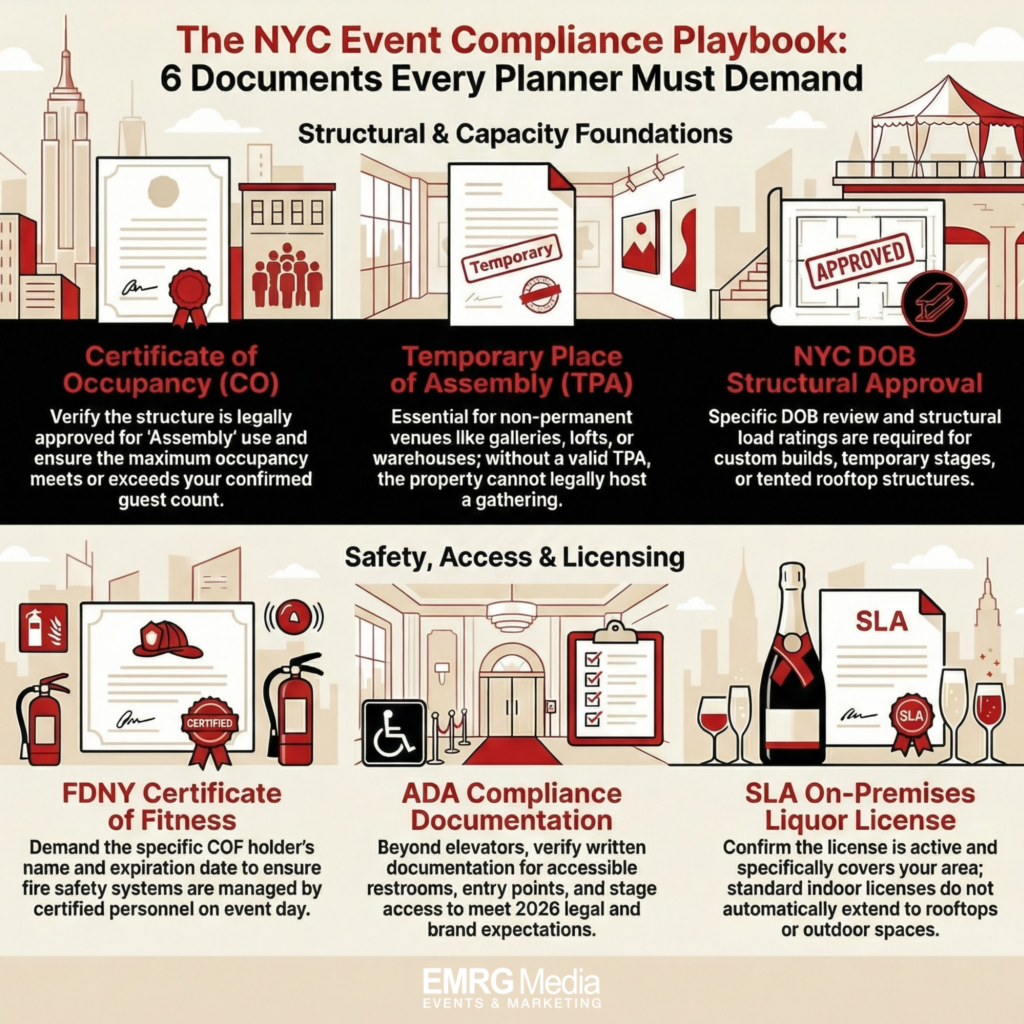
When requesting a proposal, always ask for these documents before reviewing any pricing or packages. This is the verification checklist that protects your organization, your guests, and your total investment.
- Certificate of Occupancy (CO) — Capacity, Use Class & What to Look For
Issued by the NYC Department of Buildings, this confirms that a structure is legally approved for its stated use. For event spaces, examine two things closely: the use classification must include assembly, and the maximum occupancy listed must meet or exceed your confirmed guest count. Always request the actual DOB-filed document — not a verbal summary from the sales coordinator.
- Temporary Place of Assembly (TPA) — The Most Overlooked Document in NYC
A TPA is required for any space not permanently classified as an assembly venue — which describes the majority of New York City’s most sought-after corporate event locations: galleries, converted lofts, raw production warehouses, and pop-up environments. Without a valid TPA on file, the property cannot legally host your gathering, full stop. Confirm this in writing before any contract conversation begins.
- NYC Department of Buildings (DOB) Approval — The Structural Foundation
Events involving temporary stages, elevated platforms, tented rooftop structures, or custom builds may require additional DOB review beyond the standard CO. Confirm that structural load ratings are documented and approved for your specific setup before any production agreements are signed.
- FDNY Certificate of Fitness — Who Holds It and When It Expires
Designated staff responsible for fire safety systems must hold current FDNY Certificates of Fitness. Ask for the specific COF holder’s name and the exact expiration date — not a general assurance that “someone on staff is certified.” An expired COF on your event day creates immediate compliance liability for your organization.
- ADA Compliance Documentation — More Than Just an Elevator
Accessibility for NYC venues extends beyond a working elevator. Verify accessible restroom availability, entry accommodations, and stage access where relevant — and obtain written documentation. In 2026, this is both a legal requirement and an increasingly visible brand expectation for any organization hosting a corporate gathering.
- SLA On-Premises Liquor License — Active, Valid & Correctly Scoped
If alcohol will be served, confirm the New York State Liquor Authority license is active and explicitly covers your format. An on-premises SLA license for standard indoor service does not automatically extend to rooftop activations, outdoor extensions, or events using third-party bar vendors. Verify the full scope of coverage before any bar package discussions begin.
Zoning and Permit Realities: A Neighborhood-by-Neighborhood Guide
One of the most underestimated aspects of planning in NYC is that compliance requirements vary meaningfully from one neighborhood to the next. Here is what you need to know heading into spring 2026.
- Midtown Manhattan — The Highest COI Bar in the Five Boroughs: Midtown operates under some of the most rigorous insurance and regulatory demands in the city. General Liability minimums of $2 million aggregate are standard. Documentation must be fully current; these spaces are among the most routinely inspected in New York.
- SoHo, Tribeca & FiDi — Non-Traditional Spaces, Stricter Scrutiny: These neighborhoods contain visually compelling locations — and some of the most frequently non-compliant ones. Ground-floor galleries and converted commercial lofts cycle through ownership changes that can interrupt TPA continuity. Always re-verify documentation.
- Chelsea & the Lower East Side — Noise Code and Residential Proximity: Events with live music or amplified sound here must account for strict decibel restrictions near residential buildings. Request the documented sound mitigation plan before scheduling entertainment.
- Hudson Yards & High Line Corridor — Extended Lead Times: Outdoor activations in this corridor now require permit submissions 10 to 12 weeks in advance during peak spring demand. Spaces adjacent to the High Line also operate under the park’s own policies.
- Williamsburg & DUMBO, Brooklyn — Structural Certifications: Converted industrial buildings typically require careful review of structural certifications, FDNY occupancy protocols, and DOB sign-off for temporary build elements specific to your layout.
- Rooftop Venues, All Boroughs — Non-Negotiable Limits: Every rooftop space must carry structural load certifications confirming the roof can safely bear your guest count, furniture, and production weight. Wind-rated tent permits and FDNY occupancy caps apply strictly.
When the Space's Paperwork Doesn't Cover Everything Your Event Needs
Even a fully compliant property can leave legal gaps when your format expands beyond its four walls. This is where foundational licensing intersects directly with event-specific permitting.
- Outdoor Extensions: A branded activation or hosted outdoor bar positioned outside the legal footprint immediately triggers separate permit requirements from the NYC Department of Transportation or Parks Department.
- External Caterers: Any culinary operation outside the permanent in-house team requires a Temporary Food Service Establishment permit from the NYC Department of Health.
- Alcohol Service Beyond Scope: External bar vendors hired to serve alcohol must carry their own valid SLA Catering Authorization. This remains one of the most frequently overlooked compliance items, carrying penalties that include immediate termination.
- Hybrid Events: Streaming live or recorded music requires ASCAP and BMI licensing. If collecting attendee data digitally, New York State’s SHIELD Act dictates strict privacy obligations.
How to Read Certificates and Legal Paperwork Like a Pro
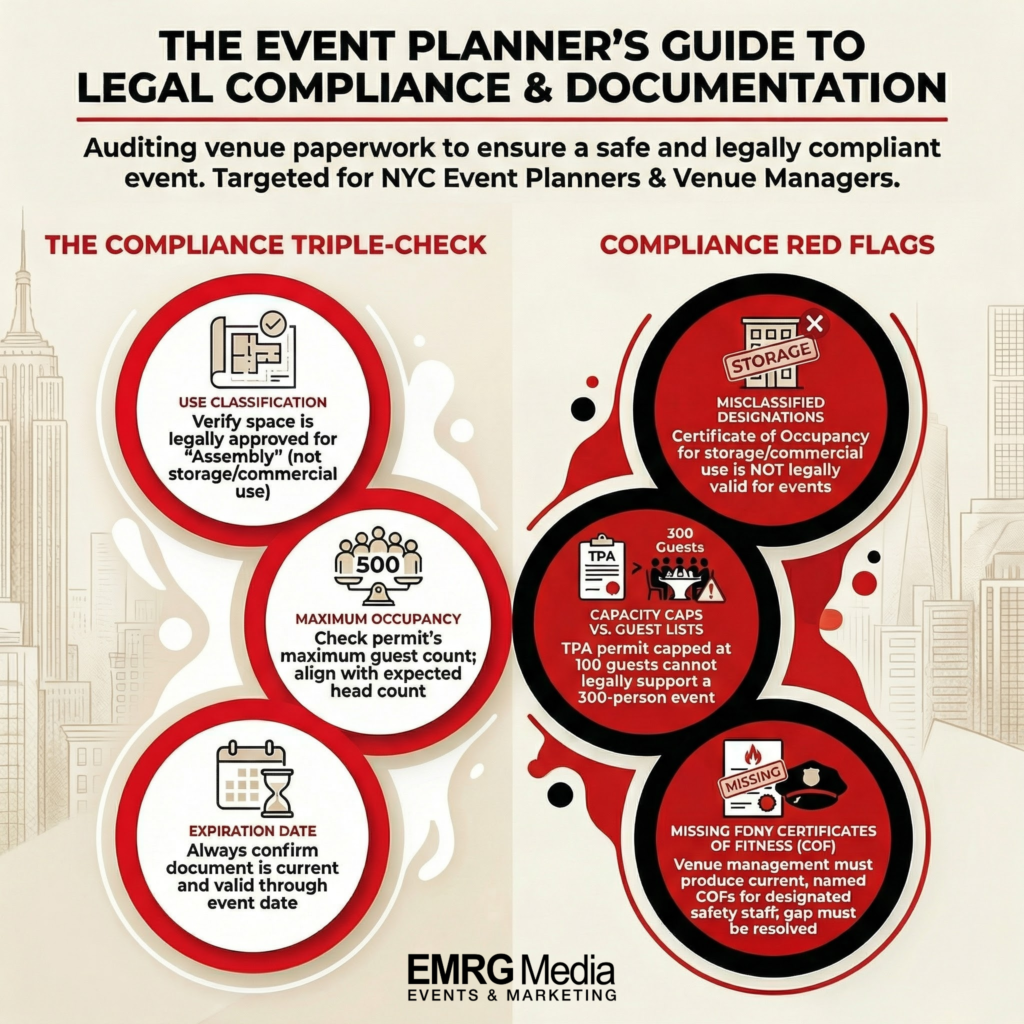
Requesting the documents is step one. Knowing what to examine inside them is what separates prepared planners from reactive ones. Focus on three things: the use classification, the maximum occupancy number, and the expiration date.
Watch closely for these warning signs:
Misclassified Use Designations: A Certificate of Occupancy issued for storage or commercial use — not assembly — means the space is not legally approved for your event.
Capacity Caps: A Temporary Place of Assembly permit capped at 100 guests cannot legally cover a 300-person corporate dinner.
Missing FDNY COF: If management cannot produce current, named Certificates of Fitness for their designated safety staff, that gap requires immediate resolution.
Spotting these discrepancies early is critical, but interpreting municipal paperwork shouldn’t consume your planning hours. At EMRG Media, we meticulously audit every line of these documents long before a venue is ever presented to you, ensuring your event is legally bulletproof from day one.
Our Verification Process: Keeping Your Corporate Event Legally Sound
Managing paperwork and municipal codes should never fall on the shoulders of an internal marketing team or executive assistant. At EMRG Media, regulatory verification is a structured process embedded into every phase of our planning workflow.
Our team maintains active working relationships with property managers, city agency contacts, and insurance professionals across all five boroughs. When we shortlist locations for your event, we conduct a full audit before a contract is ever recommended — pulling DOB records, confirming TPA status, and reviewing the full scope of every SLA license.
For our clients, this rigorous vetting runs invisibly in the background. For the event itself, it is the difference between a seamless evening and a stressful, compliance-driven disruption. Twenty-five years of producing events means we resolve bureaucratic obstacles faster than any in-house team navigating these systems for the first time.
Plan with confidence, knowing the groundwork has been flawlessly executed. Visit our event planners in NYC today, and let’s ensure your 2026 event is spectacular, secure, and fully covered.
Frequently Asked Questions (FAQ's)
At minimum, a space must hold a valid Certificate of Occupancy for assembly use, an active SLA on-premises liquor license if alcohol is being served, and a Temporary Place of Assembly permit for any area not permanently designated for events. Current FDNY Certificate of Fitness documentation is also required.
A TPA is issued by the NYC Department of Buildings for spaces not permanently classified for public assembly. Galleries, lofts, warehouses, and the majority of non-traditional formats require one.
No. If the space is not permanently designated for assembly use, a TPA is a legal requirement. This holds true regardless of how frequently they have hosted past events.
Request the original DOB-filed document directly and cross-reference it through the NYC Department of Buildings’ publicly accessible BIS portal. Do not rely on a verbal confirmation.
City inspectors or the FDNY have the authority to shut down your event on-site — even when all of your own permits are fully in order.
Plan With Confidence — and Know Your Venue Is Truly Ready
NYC venue licensing is not a detail you can revisit after the venue is booked. It is the foundational compliance layer that separates a seamless, brand-building corporate event from a last-minute shutdown that damages relationships, invites liability, and sends the wrong message to every client, partner, and team member in that room.
At EMRG Media, we have spent over 25 years making certain our clients never experience that outcome. Whether you are planning a Midtown conference, a Williamsburg product launch, or a rooftop gala in Hudson Yards this spring, we bring the expertise, the neighborhood relationships, and the fully documented verification process that turns a great venue into a truly great event.
Connect with our team today. NYC spring 2026 dates are moving fast — let’s make sure yours is completely covered.