
Fundraising Auction Guide: NYC Formats, Rules & Revenue

Maximize Your Gala Revenue: The NYC Auction Blueprint

A fundraising auction is a structured giving event where donors bid on curated items to support a nonprofit mission. In New York City, your chosen format dictates your gala’s overall success. Factually, a well-executed live and silent auction can account for 20 to 35 percent of your total event revenue. Yet, many organizations leave thousands of dollars on the table by mismanaging item counts or ignoring state compliance rules. The exact bidding format you deploy changes everything.

Most Manhattan galas do not rely on one method. Top-tier events strategically stack live, silent, and online formats to engage every donor demographic. This critical decision directly impacts your planning timeline, event staffing needs, and total program length.

Do not leave your critical fundraising night to chance while competing nonprofits secure your top donors first. Explore the full guide below to master verified revenue benchmarks, state legal guidelines, and aggressive procurement strategies. Read on immediately to protect your bottom line or connect with EMRG Media before prime Manhattan venue dates vanish. 

Corporate Event Planner Inquiry

The Three Fundraising Auction Formats NYC Nonprofits Run in 2026

Fundraising auction banner for EMRG Media's 2026 NYC guide featuring a gavel, bidder paddle, and cityscape.
  1. Live auction: A professional auctioneer sells a curated set of premium items to the room, typically after dinner when guests are seated and emotionally engaged. This format depends on room energy, so it works best with 150 or more donors physically present.
  2. Silent auction: Guests bid on items using paper bid sheets or, more commonly now, a mobile bidding app, during cocktail hour and dinner. It runs in the background of the event rather than commanding the room’s attention.
  3. Online auction: Bidding opens days before the event and closes the night of, extending the fundraising auction beyond the guests who can physically attend. This format works well for board members, past donors, and out-of-town supporters who want to give without buying a ticket.
THE WINNING STRATEGY: HYBRID STACKING

Most Manhattan galas do not pick just one format. They run silent and live together, then extend the silent portion online for one to two weeks before the event. The sequencing matters: silent auction bidding should close before the live auction begins, or the two compete for the same donor attention at the same time.

Fundraising Auction Revenue Benchmarks by Format

Revenue is not evenly distributed across formats. Here is how the numbers typically break down for a NYC gala with 200 to 300 guests, though a professional event planner can help tailor these targets to your specific donor base.

Disclaimer: Please note that actual net revenue will vary depending on underlying costs such as platform fees, venue expenses, and professional services

Format

Item Count

Minimum Item Value

Typical Runtime

Revenue Share of Total Auction

Live auction

5 to 8 lots

$2,500 per item

20 to 30 minutes

45% to 60%

Silent auction

25 to 40 items

$100 to $1,000

Runs during cocktails and dinner

25% to 35%

Online (pre-event)

10 to 20 items

Varies

7 to 14 days before the event

10% to 20%

The live auction is not where you put your most items. It is where you put your fewest, highest-value items. Adding a ninth or tenth lot to a live auction does not raise more money. It tires the room and drags down the average bid on every item after the fourth lot.

For the silent auction, item density has a ceiling. Below 25 items, the room feels sparse and bidders lose interest quickly. Above 40 items, donor attention spreads too thin across too many bid sheets, and average bids per item drop even though total item count is higher.

A 90-Day Fundraising Auction Procurement Calendar

Item procurement is the piece most committees underestimate. Waiting until 30 days out to solicit donations means settling for whatever comes in, rather than curating what sells.
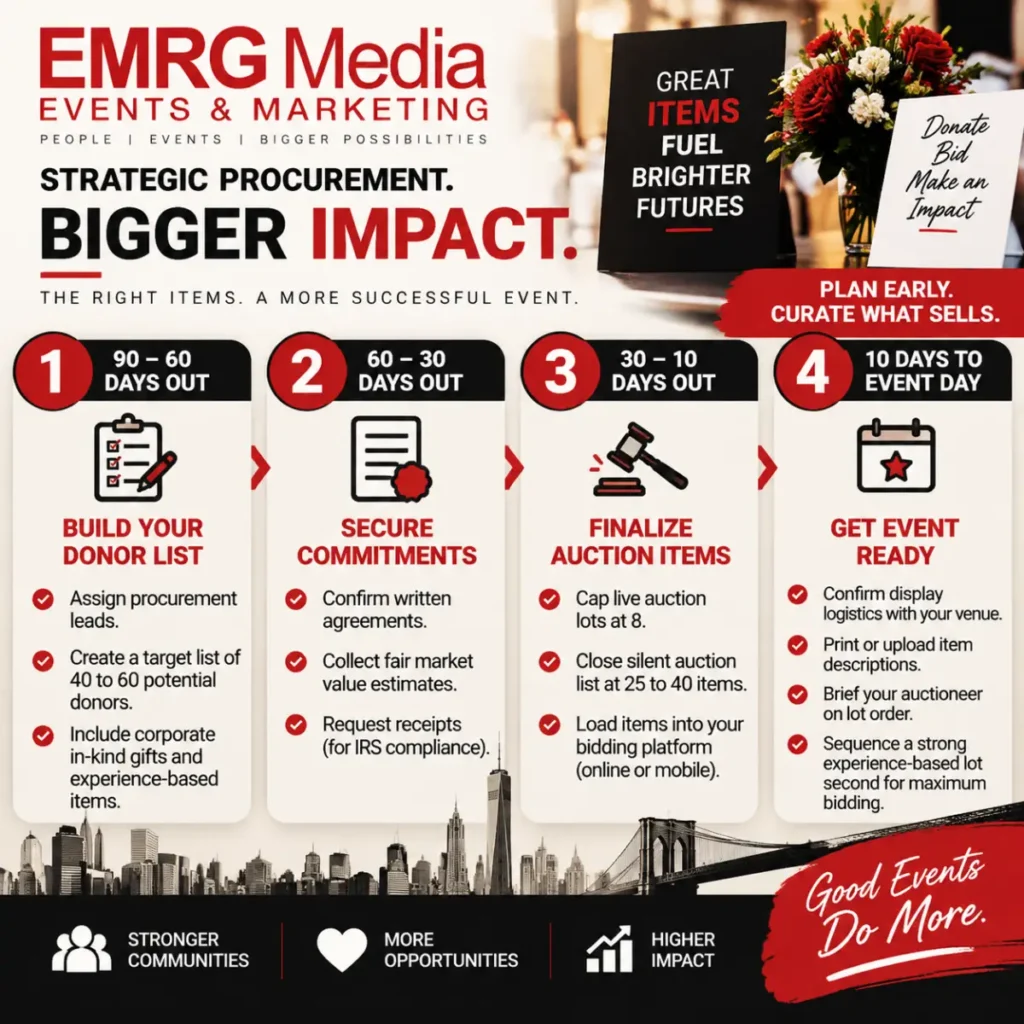
EMRG Media infographic detailing a 4-step, 90-day fundraising auction procurement timeline to build and finalize items.

  1. 90 to 60 days out: Assign procurement leads and build a target list of 40 to 60 potential donors, split between corporate in-kind gifts and experience-based items.
  2. 60 to 30 days out: Confirm written commitments and collect fair market value estimates for each item. This is also when you should request receipts, since the IRS requires charities to disclose the fair market value of any item a donor purchases for more than the item is worth.
  3. 30 to 10 days out: Finalize your live auction lots (cap at 8), close out your silent auction list at 25 to 40 items, and load everything into your bidding platform if you are running an online or mobile component.
  4. 10 days to event day: Confirm display logistics with your venue, print or upload item descriptions, and brief your auctioneer on lot order. Experiences consistently outbid physical items in a Manhattan donor base, so sequence a strong experience-based lot second in your live auction, when the room is warm but not yet fatigued.

Corporate in-kind donations from Financial District and Midtown firms are one of the fastest ways to fill a live auction lineup without a procurement budget. If your organization is also weighing a corporate-sponsored gala format, our corporate events team can walk through how sponsor-donated experiences typically get structured into an auction lineup.

New York State Compliance Rules for Charitable Auctions

This is the section most fundraising auction guides skip, and it is where nonprofits get into trouble after the event, not during it.

CHARITIES BUREAU REGISTRATION

Under New York’s Article 7-A, most organizations that solicit charitable contributions in New York State, including through an auction, must register with the Attorney General’s Charities Bureau before soliciting. Organizations with contributions under a set annual threshold may qualify for a limited exemption, but the exemption must be claimed directly through the registration portal rather than assumed. Full requirements are published directly by the New York Attorney General’s Charities Bureau.

QUID PRO QUO DISCLOSURE

Per IRS rules, when a guest pays more than $75 for an auction item or ticket that includes a benefit, your organization must disclose the fair market value of that benefit in writing, either on the invitation, the ticket, or at the point of purchase. Skipping this disclosure carries a penalty of $10 per violation, up to $5,000 per event.

WRITTEN ACKNOWLEDGMENT

Any donor who gives more than $250, including the difference between what they paid for an auction item and its fair market value, must receive a written acknowledgment from your organization. Without it, the donor’s deduction can be denied. The IRS publishes the full standard directly on its charity auction guidance page.

SALES TAX

Auction items sold to the highest bidder are generally treated as retail sales under New York tax law, which means sales tax may apply to the portion of the winning bid that represents fair market value, not the portion that is a charitable contribution.

Work with a nonprofit accountant on these specifics well before your event date, not during the post-event reconciliation.

Choosing a Fundraising Auction Platform

EMRG Media infographic comparing mobile bidding software and a professional auctioneer for a live fundraising auction.Mobile bidding software has largely replaced paper bid sheets at NYC galas because it removes the bottleneck of manual checkout and gives donors real-time outbid notifications on their phones, which measurably increases bid activity in the final ten minutes of a silent auction.

A professional auctioneer for the live portion consistently outperforms a celebrity host running the same lots, since a trained auctioneer knows how to read room energy and adjust pacing lot by lot. If you are still finalizing your venue and want the room laid out to support both a live auction stage and a silent auction display area, our gala venues guide and venue sourcing team can help you confirm load-in and display space before you sign a contract.

Bringing the Auction Into Your Full Gala Plan

An auction is ultimately just one component of a much larger event ecosystem. To maximize your return on investment, your procurement strategy must seamlessly integrate with your venue selection, ticketing, and audience acquisition. If you are still in the early phases of building your foundational timeline, our NYC Charity and Fundraising Gala Event Guide provides a comprehensive framework to structure everything from sponsorship packaging to committee roles.

For organizations managing high-profile donor cultivation, executing a flawless evening requires distinct protocols. You can explore our corporate and awards gala planning guide to master stage production, honoree management, and seating logistics that keep high-net-worth attendees engaged.

Finally, to ensure no detail slips through the cracks, download our comprehensive fundraising gala checklist. This resource ensures your overarching event executes flawlessly from load-in to post-event reconciliation.

Frequently Asked Questions

It means roughly 80% of donations typically come from 20% of donors. For a fundraising auction, this translates to focusing procurement effort on high-value live auction lots that appeal to your top donor tier, rather than spreading resources evenly across every guest.

For NYC nonprofits, a gala combining a live auction with a paddle raise and a fund-a-need moment typically outperforms a standalone auction, since the paddle raise generates direct cash gifts in minutes without requiring an item exchange.

Experiences outperform physical goods in Manhattan donor bases. Private dinners with notable figures, travel packages, and access to hard-to-get events consistently draw higher bids than merchandise, since donors are paying for exclusivity rather than resale value.

This refers to keeping each individual auction segment, particularly a paddle raise or fund-a-need, under roughly 15 minutes total. Beyond that window, donor attention drops and giving momentum stalls, regardless of how compelling the ask is.

Avoid running more than 8 live lots, skipping the fair market value disclosure on items over $75, and placing your strongest lot last. Room energy peaks early to mid-auction, so your best item should go second, not last.

Turn Donor Energy Into Unrivaled Gala Revenue

Executing a record-breaking fundraising auction demands more than securing great items; it requires precise timing, disciplined lot curation, and an environment engineered to inspire generosity. When you align your bidding formats with donor psychology and strict New York compliance standards, your auction transitions from a hopeful side activity into the high-yield financial engine of your entire gala evening.

You do not have to navigate venue constraints, procurement timelines, and stage momentum on your own. For over two decades, the dedicated production team at EMRG Media has helped leading organizations across Manhattan and Brooklyn transform high-stakes benefit events into seamless, unforgettable fundraising triumphs. Let our team carry the weight of complex auction logistics so you can focus entirely on championing your mission. Connect with our event specialists at EMRG Media today to start building your most profitable auction floor yet.