
If you organize conferences in New York, you already know the hardest part of sponsorship sales is not closing the deal. It is justifying the renewal.
A well-built sponsorship activation gives a sponsor a number to bring back to their CMO, not just a logo on a step and repeat.
Here is how organizers are structuring activities in 2026 to prove the spend was worth it, and the reporting method that keeps sponsors signing multi-year deals.
What Sponsorship Activation Actually Means in New York’s Conference Market
What is sponsorship activation? For organizers, it is the structured experience you build into a sponsor’s package so the deliverable is a measurable interaction rather than passive exposure.
A 300-person financial services summit in Midtown Manhattan, for example, can justify a title sponsor package priced between $25,000 and $60,000 when the package includes a keynote slot.
A staffed floor footprint, and attendee data collected under opt-in consent. Treat the activation as the product you are selling, not an add-on to the booth fee.
Why Sponsors Expect More From Your Package in 2026
A sponsor evaluating a brand sponsorship at your event is comparing it against several others competing for the same quarterly budget, and that sponsor reports results directly to their own leadership.
Great exposure does not survive that internal conversation, build every event sponsorship tier around at least one trackable number, badge scans, session attendance, or completed sign-ups.
So the sponsor has something concrete to show when the renewal conversation happens.
6 Sponsorship Activations That Give Organizers a Number to Report
Sponsorship activation examples that actually perform share one trait: each one is staffed and measured, not just installed.
Here is how to add operational weight to formats organizers already use.
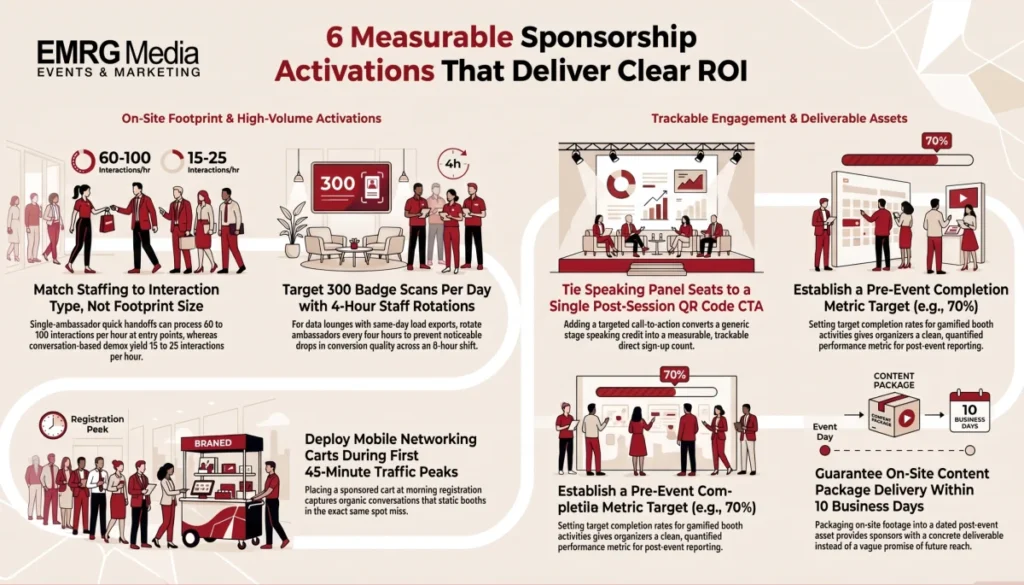
- Sampling stations staffed at a 60-to-100 interaction per hour ratio: A quick handoff format run by one trained ambassador can process that volume at an entry point, but a conversation-based demo needs a staffer working closer to 15 to 25 interactions per hour. Plan headcount around the interaction type, not the footprint.
- Badge-scan data lounges with a same-day lead export: Set a target, such as 300 scans across an 8-hour day, and staff a supervisor who rotates ambassadors every four hours since conversion quality drops noticeably after that mark.
- A sponsored networking cart placed at morning registration: Timed to the first 45 minutes when foot traffic peaks, generating organic conversations that a static booth in the same spot would not capture.
- A panel seat tied to a single measurable CTA: Such as a post-session QR code, so the stage slot produces a sign-up count instead of just a speaking credit.
- A gamified booth activity with a tracked completion rate: Setting a 70% completion target before the event gives organizers a clean post-event metric to hand to the sponsor.
- A post-event content package built from on-site footage: Delivered as a dated deliverable for example, within 10 business days so the sponsor can point to a concrete asset, not a vague promise of amplification.
Sampling-heavy formats in particular need precise staffing math to avoid over- or under-resourcing the floor.
The 2026 NYC Experiential Sampling Guide breaks down staffing ratios and interaction benchmarks organizers can build directly into a sponsor deck.
Building a sponsor package around one of these formats? EMRG Media’s producers help organizers scope the staffing and build before the pitch goes out, so the numbers in the deck match what actually happens on site.
How to Measure Sponsorship ROI After the Event Closes
How to measure sponsorship roi starts with defining the conversion before the floor opens, not afterward.
Badge scans, email sign-ups, and sample counts tell a sponsor whether the activation drove the specific action it was built for, while impressions alone only provide context.
Well-designed activations typically deliver 3:1 to 5:1 returns on spend, with top-performing formats reaching up to 10:1, a benchmark covered in more depth in experiential marketing in NYC brand events that convert.
Reporting those numbers against the pre-set target, rather than against headcount, is what turns a one-time sponsor into a repeat buyer.
Packaging an Entry-Level Tier Mid-Size Sponsors Will Say Yes To
Not every sponsor needs a premier Title slot, and organizers who only sell at the top tier leave revenue on the table.
An accessible Silver or Bronze entry tier gives mid-size brands an entry point they can approve without a lengthy internal review, including:
- Exhibit space: Dedicated floor presence to engage foot traffic directly.
- Core branding: Standard program logo placement and digital promotional mentions.
- High-impact add-ons: The option to pair base access with a single activation such as a sampling table or a registration networking cart delivering premium visibility without forcing a jump to a Gold commitment.
The full tier architecture and packaging framework for building out these offerings are covered in how to price conference sponsorship packages.
Where Production Experience Changes the Outcome
A sponsorship activation only delivers its promised numbers if the build, staffing, and permits hold up on site.
EMRG Media has produced sponsorship activations and brand activation events in NYC for conferences tied to Google, Bloomberg, and Netflix.
Work that required the staffing ratios and reporting structures above to be planned before load-in, not improvised during it, more client feedback is available on the EMRG Media facebook page.
Key Takeaways
- A sponsorship activation should be built around one trackable number, not general exposure.
- Staffing ratio matters more than footprint size sampling and demo formats need very different headcounts.
- ROI should be measured against a target set before the event, not reconstructed from attendance figures afterward.
- An entry-level tier with one optional add-on helps organizers sell to mid-size sponsors without discounting the top tier.
Build the Sponsorship Package Sponsors Renew
The organizers who keep sponsors coming back are the ones who treat each activation as a staffed, measured product rather than a signage placement.
That requires knowing the interaction math before the pitch goes out and reporting against it after the floor closes.
Need help scoping your next sponsor package? Get in touch with EMRG Media has produced more than 1,100 events across New York City and works with organizers to build activations that hold up against the numbers in the deck.
FAQs About Sponsorship Activation
What is sponsorship activation?
Sponsorship activation is a structured, live brand experience such as stage time, an interactive lounge, or data capture built into a partner’s package beyond static logo placement.
It provides the sponsor with measurable attendee interactions and tangible data to justify their investment.
How do you get event sponsors and fulfill sponsor deliverables?
Securing sponsors requires opening sales six to nine months early and pitching verified audience demographics, such as job titles and revenue tiers, rather than simple attendance totals.
Fulfilling those agreements means tracking every promised touchpoint from badge scans to speaking slots and delivering a detailed post-event metrics report.
How can a mid-size company sponsor or exhibit at a conference?
Mid-size companies can enter through accessible silver or bronze tiers to secure core floor space, program branding, and digital exposure.
Pairing this entry package with a single high-impact add-on, like a networking cart or sampling table, delivers premium visibility without requiring a top-tier budget.