

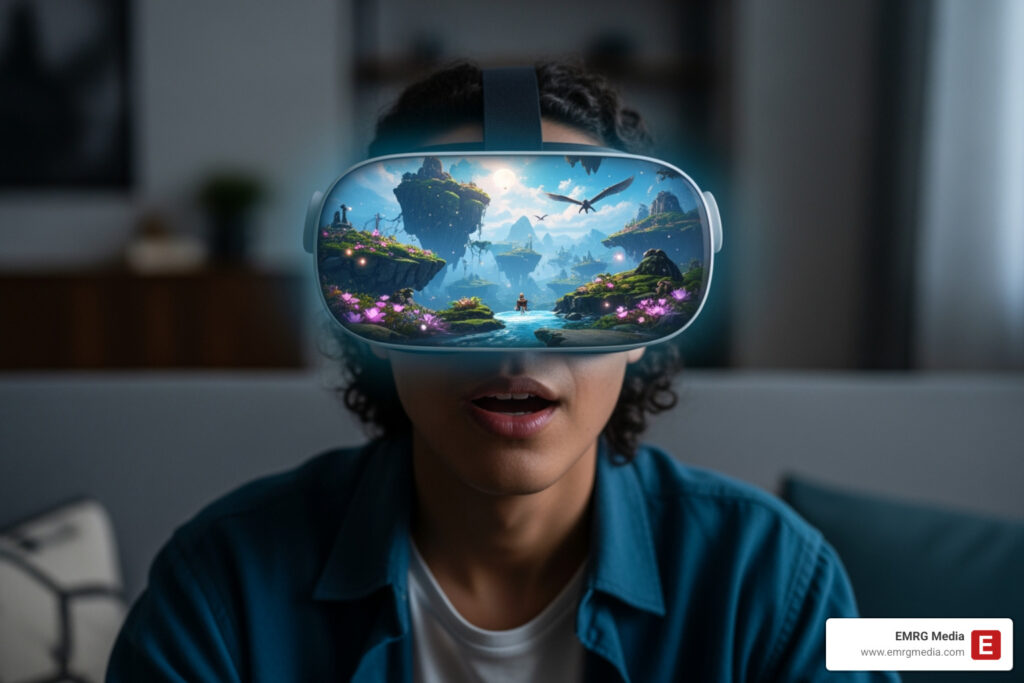

Virtual Reality Entertainment: A New Dimension for Your Next Event
Virtual reality entertainment is changing how we experience gaming, concerts, sports, and social gatherings by creating fully immersive digital worlds that engage your senses and emotions in ways traditional entertainment simply cannot.
Here’s what you need to know:
- What it is: VR uses head-mounted displays and motion tracking to place you inside interactive 3D environments where you can look around, move, and interact naturally
- Why it matters: The VR entertainment market is projected to reach $100 billion by 2025, with a growth rate of 35% annually
- Where it’s used: Gaming, virtual concerts, theme parks, corporate events, team building, social gatherings, and location-based entertainment venues
- Key benefits: Complete immersion, active participation, new storytelling possibilities, and accessibility to experiences that would otherwise be impossible
- Main challenge: Hardware costs and motion sickness affect some users, though technology continues to improve
Virtual reality isn’t just a gaming technology anymore. It’s revolutionizing entertainment across every sector, from film and theater to live music and sports. When you put on a VR headset, you’re not watching entertainment—you’re inside it. You can attend a concert from the front row without leaving your living room, explore virtual museums, or participate in team-building exercises that transport your colleagues to entirely different worlds.
The technology has evolved dramatically from the bulky, expensive systems of the 1990s. Today’s VR headsets are lighter, more affordable, and offer stunning visual quality. By 2025, experts predict that 1 in every 10 people will own a VR headset, making this technology increasingly mainstream for both personal and professional events.
I’m Jessica Stewart, Vice President of Marketing & Sales at EMRG Media, where I’ve spent years helping event planners find cutting-edge technologies like virtual reality entertainment to create unforgettable experiences for corporate gatherings, fundraisers, and private celebrations. Throughout my career at EMRG Media, I’ve witnessed how VR transforms ordinary events into extraordinary, memorable occasions that guests talk about for years.
The Evolution of Immersive Worlds: From Sci-Fi to Your Living Room
Have you ever wondered how we got from clunky helmets in sci-fi movies to the sleek, powerful VR headsets we use today? The journey of virtual reality entertainment is a fascinating tale of innovation, driven by a desire to push the boundaries of human experience. It’s how the technology behind VR evolved to enable these experiences, and its historical development, that has set the stage for today’s immersive worlds.
A Brief History of VR Technology
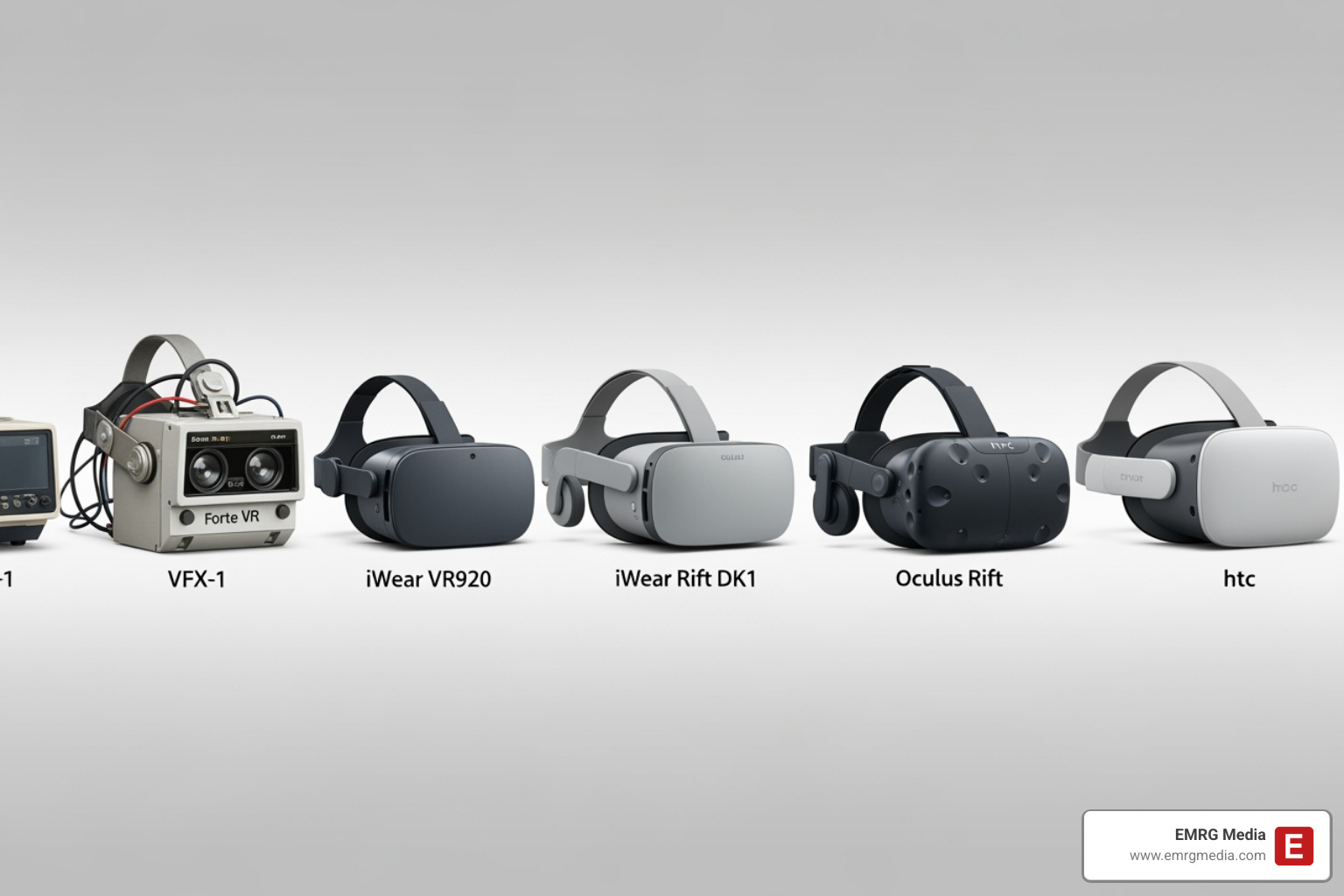
The concept of virtual reality isn’t as new as you might think. French avant-garde playwright Antonin Artaud described the illusory nature of theatre as “la réalité virtuelle” as early as 1938. Fast forward to the mid-20th century, and early concepts like Morton Heilig’s Sensorama (1962) aimed to stimulate multiple senses—sight, sound, smell, and touch—to create a more complete illusion. Then came Ivan Sutherland’s “The Sword of Damocles” in 1968, a pioneering head-mounted display that, despite being too heavy to wear without ceiling support, offered a glimpse into interactive 3D graphics.
The 1970s and 80s saw continued experimentation. Myron Krueger’s VIDEOPLACE system (starting in 1969) explored how human actions could interact with computer-generated environments, prioritizing responsiveness over visual fidelity. A pivotal moment for interaction was the development of the data glove. The first data glove was created in 1977 at the University of Illinois, but it was Thomas Zimmerman’s optical glove in 1982, inspired by “air guitar,” that truly paved the way. Later, VPL Research, founded in 1985, released the famous VPL DataGlove, which even graced the cover of Scientific American in October 1987. This invention was iconic because it allowed users to manipulate virtual objects directly, not just see them. NASA also contributed significantly with their Virtual Environment Workstation (VIEW) project in 1985, focusing on multisensory immersive environments.
The 1990s brought the first wave of commercial VR, though it wasn’t quite the personal home revolution many predicted. Instead, “location-based entertainment” (LBE) systems, like VR arcades and simulators, gained traction. Companies like Virtual World Entertainment opened BattleTech centers in 1990, where players sat in individual “pods” to engage in competitive game experiences. Virtuality, launched in 1991, became the first mass-produced, networked, multiplayer VR entertainment system. Even Sega announced the Sega VR headset in 1991, though it never saw a full commercial release, and Nintendo’s Virtual Boy in 1995 ultimately struggled. These early attempts showed promise but were often limited by bulky hardware, high costs, and technical constraints that led to issues like motion sickness.
After a period of relative quiet in the 2000s, VR re-emerged with a vengeance in the 2010s. Palmer Luckey’s Oculus Rift prototype in 2010 (showcased at E3 in 2012) ignited the modern consumer VR wave, leading to Facebook’s acquisition of Oculus in 2014. Valve’s breakthrough with low-persistence displays in 2013, shared freely with the industry, significantly reduced lag and improved the VR experience. This period saw the rise of major players like HTC (with the Vive, developed with Valve), Sony (PlayStation VR), and Google (Cardboard, then Daydream). More recently, standalone headsets like the Oculus Quest 2 (2020), Meta Quest Pro (2022), and Meta Quest 3 (2023) have made VR more accessible than ever, with the Oculus Quest 2 alone accounting for 80% of all VR headsets sold in 2021. And in 2024, Apple entered the market with its Vision Pro, branded as a “spatial computer,” signaling a new chapter for immersive technology.
The Technology Powering the Experience
At its core, virtual reality entertainment relies on several key technological components working in harmony to create that sense of “being there.”
- Head-Mounted Displays (HMDs): These are the headsets you wear, featuring screens (often one per eye for stereoscopic 3D) and lenses that trick your brain into perceiving depth and a wide field of view. Modern HMDs boast higher resolutions, wider fields of view, and faster refresh rates than their predecessors, significantly enhancing visual immersion.
- Tracking Systems: For you to move and interact naturally within a virtual world, the system needs to know where your head and hands are. This is achieved through sophisticated tracking. Early systems often used external sensors (outside-in tracking), but newer standalone headsets, like the Meta Quest series, use “inside-out” tracking, where cameras on the headset itself map your surroundings. This allows for greater freedom of movement without needing a dedicated setup.
- Controllers: Handheld controllers allow you to manipulate objects, steer menus, and interact with the virtual environment. Many offer haptic feedback, providing vibrations or resistance that mimic sensations like touching a surface or firing a weapon. Some advanced systems even incorporate wired gloves or full-body tracking for more natural interactions.
- Haptic Feedback: Beyond controller vibrations, advanced haptic systems aim to simulate a broader range of tactile sensations, like the texture of virtual objects or even temperature changes. Projects like “Wireality” are exploring ways to enable complex tangible geometries in VR with worn multi-string haptics, bringing a new dimension of realism.
- Spatial Audio: Sound plays a massive role in immersion. Spatial audio simulates how sound travels in the real world, allowing you to pinpoint the direction and distance of sounds within the virtual environment. This improves the sense of presence and makes virtual worlds feel more alive.
- Content Creation Methods: Creating these rich virtual worlds involves various techniques. Beyond traditional 3D modeling, omnidirectional cameras capture 360-degree video, allowing for real-world environments to be brought into VR. Photogrammetry is also increasingly used to create incredibly detailed 3D objects and environments by stitching together multiple photographs.
- Software and Performance: Underlying all this hardware are powerful software platforms and optimization techniques. Standards like VRML (Virtual Reality Modeling Language), X3D, and experimental APIs like WebVR allow for the creation and delivery of VR content. Crucially, factors like display resolution, image latency (the delay between your movement and the image updating), and display refresh frequency (how many times the image updates per second) are paramount. High refresh rates (e.g., 120Hz) and low latency are essential to prevent motion sickness and maintain a seamless, immersive experience.
These technological advancements are what allow us to craft truly extraordinary virtual experiences for events, changing everything from corporate meetings to large-scale productions. For more insights into how technology shapes event experiences, explore our guide on virtual event production.
The Expanding Universe of Virtual Reality Entertainment
The magic of virtual reality entertainment lies in its ability to transport us. It’s not just about seeing a new world; it’s about being in it, interacting with it, and feeling connected to the experience in a profound way. This goes far beyond traditional forms of entertainment, enhancing specific sectors like gaming, film, live events, and theme parks in ways we once only dreamed of.
Key Advantages of Virtual Reality Entertainment
Why are we so excited about VR? The advantages are clear and compelling:
- Unparalleled Immersion: This is VR’s superpower. When you put on a headset, the outside world fades away, and you’re fully enveloped in the virtual environment. This “feeling of presence” is incredibly powerful, making experiences feel more real and impactful. We’ve seen it transform how guests react at events, creating unforgettable moments.
- Active Participation: Unlike passive viewing, VR often puts you in the driver’s seat. You’re not just watching a story; you’re often the protagonist, making choices and directly influencing the narrative. This active engagement creates a deeper connection to the content.
- New Storytelling Possibilities: VR opens up entirely new ways to tell stories. Imagine a film where you can look around 360 degrees, choosing where to focus your attention, or a theatrical performance where you can explore different perspectives. This transforms the audience from observers to participants.
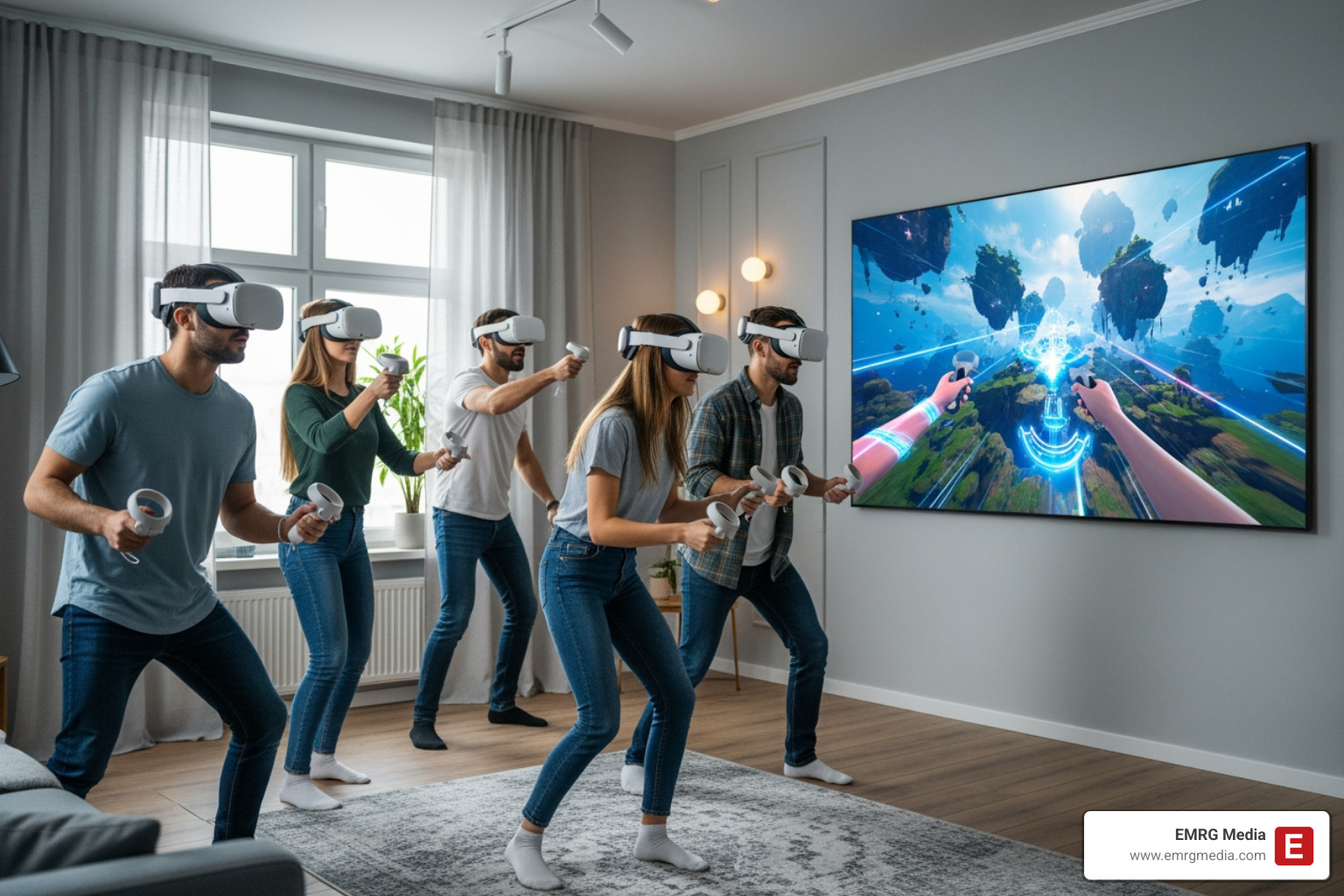
- Improved Social Connection: While VR might seem isolating, it’s actually fostering new forms of social interaction. Shared virtual spaces allow friends, family, and colleagues to connect and interact in ways that transcend geographical boundaries. For events, this means bringing people together from around the globe. This is one of the many benefits of hybrid events, where VR can play a significant role.
- Accessibility to Otherwise Impossible Experiences: VR can take you anywhere. Want to explore ancient Rome, fly through space, or attend a concert by your favorite artist from the front row? VR makes these experiences accessible, regardless of your physical location or limitations.
Immersive Gaming and Interactive Stories
Gaming was VR’s initial proving ground, and it continues to be a dominant force in virtual reality entertainment. The global VR gaming market was valued at USD 10.03 billion in 2022 and is projected to grow at a compound annual growth rate of 27.1% from 2023 to 2030. We’ve seen countless examples of how VR lifts gaming, from adrenaline-pumping action titles and intricate puzzle games to expansive open-world explorations. Games like Beat Saber have become cultural phenomena, demonstrating how full-body interaction and intuitive controls can create wildly engaging experiences.
But VR’s narrative potential extends far beyond traditional games. Interactive stories in VR films allow for a new level of narrative agency. Take Oculus Story Studio’s “Dear Angelica” as a compelling example. This VR film uses hand-drawn, immersive environments to tell a deeply personal story, resonating with viewers on an emotional level by placing them directly within the protagonist’s memories. Similarly, imagine exploring classic literature in a whole new way; you can even explore interactive Shakespeare in VR, joining the witches in Macbeth or looking for ghosts in Hamlet!
Social multiplayer platforms like VRChat also offer unique interactive experiences, allowing users to connect, play, and create together in a multitude of user-generated virtual worlds.
Live Events, Social Gatherings, and Team Building
For us at EMRG Media, one of the most exciting applications of virtual reality entertainment is its capacity to transform live events, social gatherings, and even corporate team building.
- Virtual Concerts: Imagine attending a concert by your favorite artist, not from a static screen, but from a virtual front-row seat, or even exploring the virtual venue with other fans. Artists like Travis Scott have drawn millions of viewers to virtual concerts within games like Fortnite, and Justin Bieber performed in WaveXR in 2021. Jean-Michel Jarre has hosted concerts in VRChat. These experiences break down geographical barriers, allowing global audiences to participate in live music events.
- Immersive Sports Viewing: VR offers sports fans unprecedented access and perspectives. Imagine watching a basketball game from a courtside seat, or a football match from the sidelines, or even a skydiving event from the perspective of the jumper. VR provides angles and immersion impossible with traditional broadcasting, creating a feeling of truly being there.
- Social VR Platforms: Beyond concerts, social VR platforms are becoming vibrant spaces for people to gather, socialize, and connect. During the pandemic, these platforms even served as mental health tools, fostering social connectedness. We see immense potential for these platforms in corporate settings, offering unique virtual corporate event ideas that can boost morale and collaboration for remote teams.
- Location-Based Entertainment (LBE) & VR Arcades: For those seeking a shared, out-of-home VR experience, LBE venues and VR arcades are thriving. In New York City, you can find exciting options like Escape Virtuality or Tidal Force VR, offering multiplayer VR experiences that range from action-packed adventures to mind-bending escape rooms. These venues often feature state-of-the-art equipment and specialized setups for group play. Theme parks have also acceptd VR, integrating headsets onto roller coasters and rides to create new dimensions of storytelling and thrills. For instance, The Titanic V-R Immersive Experience is now in Sacramento!, showcasing how VR can bring history to life in an interactive format.
At EMRG Media, we’re particularly adept at leveraging these innovations. For example, our Virtual Golf Simulator rental brings a realistic golf course experience to any event, measuring distance and accuracy, allowing guests to practice their swing or play renowned virtual courses right here in NYC. It’s an instant focal point that captivates guests and sparks conversation.
Navigating the Virtual Frontier: Challenges and Future Innovations
While virtual reality entertainment promises incredible experiences, it’s still a relatively young technology, and like any frontier, it comes with its own set of challenges. However, the pace of innovation is rapid, and we’re constantly looking ahead to the exciting future trends that will shape tomorrow’s immersive worlds.
Current Challenges and Limitations
- Hardware Cost: High-end VR systems, especially those offering the most fidelity and features, can still be quite expensive. While standalone headsets like the Meta Quest series have made VR more accessible, advanced systems like the Apple Vision Pro come with a premium price tag, which can be a barrier for widespread consumer adoption.
- Cybersickness (Motion Sickness): This is perhaps the most common and persistent challenge. The disconnect between what your eyes see (movement) and what your inner ear feels (no movement) can induce nausea, dizziness, and headaches in some users. Approximately 25-40% of people experience some form of VR sickness, with women reportedly being more affected than men. Developers are constantly working on techniques to minimize this, such as higher refresh rates and smoother locomotion options.
- Content Development: Creating compelling VR content is technically complex and requires a unique blend of traditional storytelling skills and specialized technical expertise. It’s a demanding field, and the pool of experienced VR developers is still growing.
- Physical Space Requirements: While some VR experiences can be enjoyed seated, many of the most immersive ones require “room-scale” play, meaning you need a clear physical space (often 6.5 x 6.5 feet or more) to move around freely. This can be a limitation for those in smaller living spaces, especially in a city like NYC.
- Privacy Concerns: VR headsets collect a vast amount of data, including head movements, gaze direction (eye-tracking), and even biometric information. This raises significant privacy concerns, as this data can potentially reveal sensitive personal information about users. The way this data is collected and used by platforms like Meta has drawn scrutiny, particularly regarding account requirements and data sharing.
- Physical Injuries: While rare, accidents can happen. When fully immersed in a virtual world, users can lose awareness of their physical surroundings, leading to bumping into furniture, falling, or even more serious injuries. We always advise caution and ensuring a clear play space when using VR.
To better understand the hardware landscape, here’s a quick comparison of the two main types of consumer VR systems:
| Feature | Standalone VR (e.g., Meta Quest 3) | PC-Tethered VR (e.g., Valve Index, PS VR2) |
|---|---|---|
| Setup | All-in-one; no external PC or console needed | Requires powerful PC or PlayStation console |
| Portability | Highly portable; can be used anywhere | Less portable; tied to a computer/console |
| Graphics | Good; limited by onboard processing | Excellent; leverages high-end PC/console power |
| Cost | Generally lower entry price | Higher total cost (headset + PC/console) |
| Ease of Use | Very easy; quick setup and play | More complex setup; software configuration |
| Content Library | Large; growing rapidly (Meta Quest Store) | Massive; often includes AAA titles and indie games |
| Tracking | Inside-out (cameras on headset) | Inside-out or outside-in (external sensors) |
The Future of Virtual Reality Entertainment
Despite the challenges, the future of virtual reality entertainment is incredibly bright and brimming with innovation. We anticipate several exciting trends:
- Lighter, More Comfortable Headsets: Expect headsets to become sleeker, lighter, and more comfortable for extended wear, reducing fatigue and making them more appealing for everyday use.
- Higher Fidelity and Realism: Advancements in display technology, processing power, and eye-tracking (allowing for foveated rendering where only the gazed-at area is rendered in high detail) will lead to even more photorealistic graphics and immersive environments.
- Advanced Haptics and Multi-Sensory Integration: Beyond basic vibrations, future haptic systems will simulate a wider range of sensations, like texture, temperature, and even resistance. We might see more full-body haptic suits that make virtual interactions feel incredibly real.
- AI Integration: Artificial intelligence will play a massive role in creating more dynamic and responsive virtual worlds. Imagine NPCs (Non-Player Characters) with adaptive behaviors, or environments that subtly change based on your actions and emotions.
- Cloud-Based VR: As internet speeds increase, cloud-based VR will become more prevalent. This means the heavy processing needed for high-fidelity VR experiences can be done on remote servers and streamed to your headset, democratizing access to top-tier VR without needing an expensive gaming PC.
- The Metaverse: The concept of a persistent, interconnected virtual world, often referred to as the Metaverse, is gaining momentum. This vision involves social, economic, and creative interactions taking place in shared virtual spaces, offering boundless opportunities for entertainment, work, and social connection. This vision aligns perfectly with the future of virtual events, where immersive, persistent spaces could host everything from concerts to conferences.
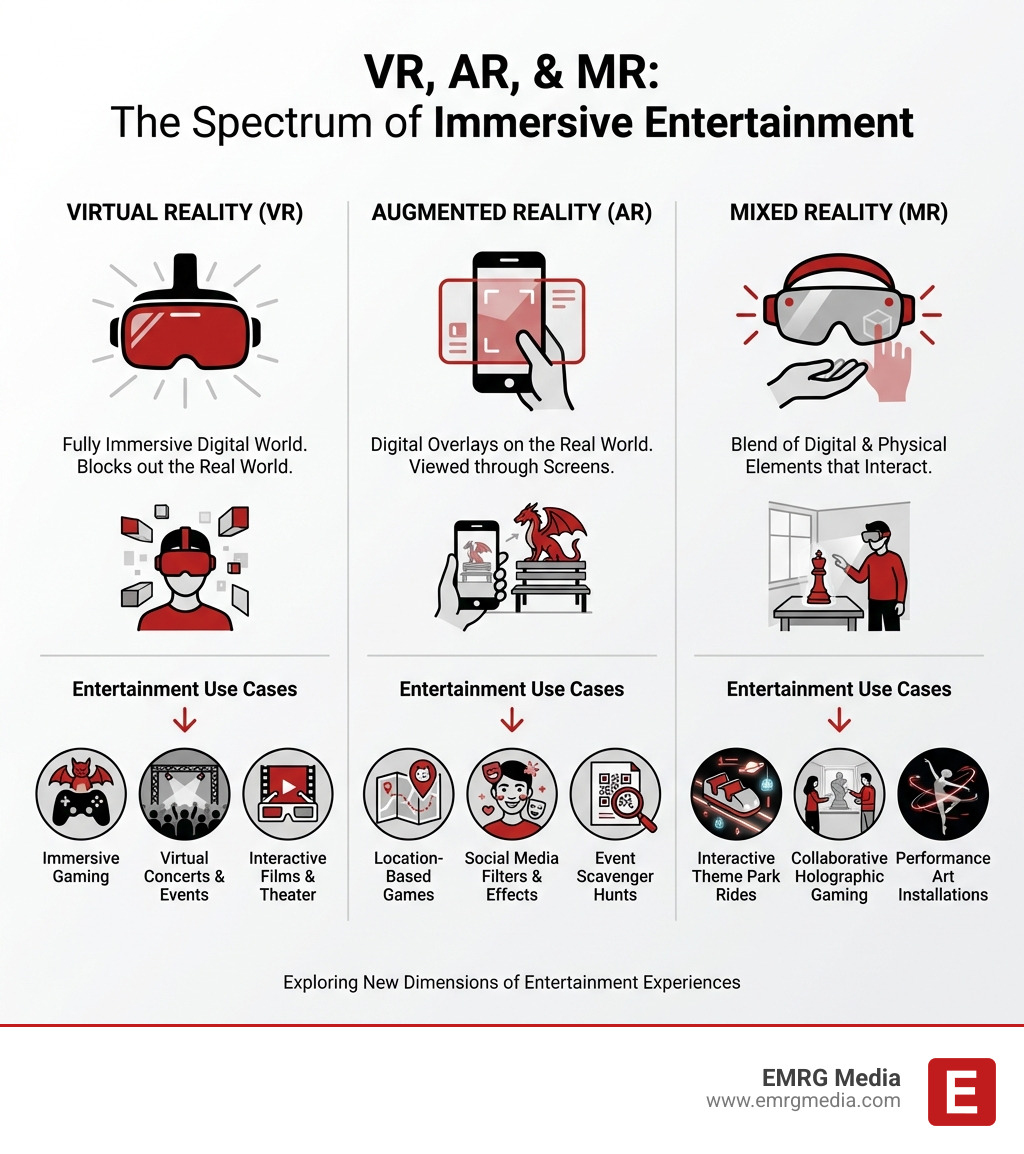
- Cross-Reality (XR): The lines between virtual reality, augmented reality, and mixed reality will continue to blur, leading to seamless “cross-reality” experiences. This will allow for fluid transitions between fully immersive virtual worlds and digital overlays on our real environments.
Frequently Asked Questions about VR Entertainment
We often encounter common questions about virtual reality entertainment. Here are some of the most frequent ones:
How much space do I need for VR?
The space you need for VR depends on the type of experience:
- Seated VR: For experiences like flight simulators, cinematic viewing, or some puzzle games, you only need enough space to sit comfortably in a chair.
- Standing VR: Many games and applications can be enjoyed while standing in a small area, typically around 3×3 feet (1×1 meter). This allows for some upper body movement and turning.
- Room-Scale VR: This offers the most immersive experience, allowing you to walk around and physically interact with the virtual environment. It usually requires a cleared space of at least 6.5 x 6.5 feet (2×2 meters), but some setups can accommodate larger areas.
Always ensure your play space is clear of obstacles to prevent accidental bumps or falls while you’re immersed!
Can I wear glasses with a VR headset?
Yes, most modern VR headsets are designed to accommodate users who wear glasses. Many have adjustable straps and enough internal space to fit most standard frames. However, the fit can vary between headsets and individual glasses.
For optimal comfort and to protect your glasses and headset lenses, some users opt for:
- Prescription Lens Inserts: These custom-made lenses attach directly to your VR headset, eliminating the need to wear your glasses inside.
- Contact Lenses: If you wear contacts, they often provide the most comfortable and unrestricted visual experience in VR.
Is VR entertainment just for gamers?
Absolutely not! While gaming certainly propelled VR into the mainstream, virtual reality entertainment has diversified significantly. Today, you can explore:
- Cinematic Experiences: Watch 360-degree films and interactive narratives that place you at the heart of the story.
- Live Events: Attend virtual concerts, sports events, and even theatrical performances from anywhere in the world.
- Social Platforms: Connect with friends, meet new people, and participate in virtual communities.
- Educational and Cultural Tours: Explore virtual museums, historical sites, and even distant planets.
- Fitness and Wellness: Engage in VR workouts, meditation, and relaxation experiences.
- Creative Tools: Sculpt, paint, or design in 3D using VR applications.
We’ve seen VR used for everything from virtual corporate team-building exercises to immersive art exhibitions in NYC, proving its appeal reaches far beyond the gaming community.
Conclusion: Your Next Unforgettable Experience is Virtual
Virtual reality entertainment has truly arrived, offering a paradigm shift in how we engage with digital content. We’ve journeyed through its fascinating history, marveled at the intricate technology that powers it, and explored the myriad ways it’s changing gaming, film, live events, and social gatherings. From the earliest, clunky prototypes to today’s sophisticated headsets, VR has consistently pushed the boundaries of immersion and interaction.
The advantages are undeniable: unparalleled immersion, active participation, boundless storytelling potential, and the ability to connect people and places across vast distances. While challenges like hardware cost and cybersickness persist, the rapid pace of innovation, fueled by advancements in AI, haptics, and cloud computing, promises an even more seamless and captivating future.
For individuals and businesses alike, leveraging VR for entertainment projects means embracing a technology that can create truly unforgettable experiences. Whether it’s for a private celebration, a corporate gathering, or a large-scale public event, VR offers a unique solution to lift engagement and leave a lasting impression.
At EMRG Media, we pride ourselves on staying at the forefront of event innovation. Our expertise in crafting customized, stress-free events, combined with cutting-edge technologies like virtual reality entertainment, ensures that your next event in New York City will be nothing short of spectacular. Ready to explore how VR can transform your upcoming celebration or corporate function into an extraordinary, immersive adventure? Plan an unforgettable Mitzvah or NYC event with cutting-edge entertainment with us today!
