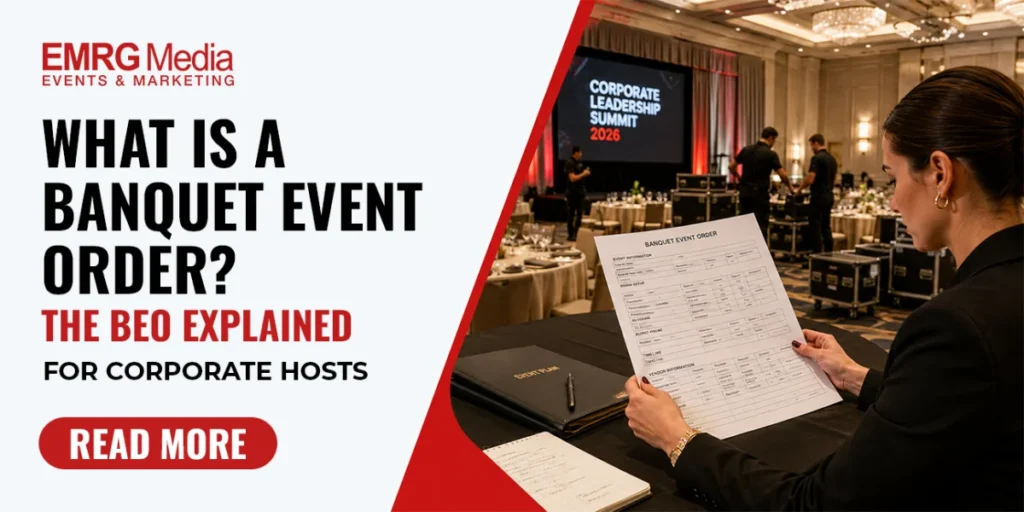
A Midtown hotel ballroom near Park Avenue can turn over three separate events in a single day, a corporate breakfast at 7 AM, a law firm networking reception at 5 PM, and a nonprofit dinner by 8 PM. That kind of turnaround only works because every detail is locked down on paper long before the first guest arrives.
That paper is the banquet event order. If you’re planning your first corporate event in a New York City hotel or catering hall, understanding what is a banquet event order matters before you sign anything, because this single document controls whether your event runs on schedule or falls apart during setup.
In short: it’s the master reference sheet that tells the kitchen, banquet captain, AV crew, and housekeeping staff exactly what your event needs, room by room and hour by hour.
What Is a Banquet Event Order, Exactly?
At its core, a banquet event order (BEO) is a detailed internal document that a venue or caterer generates for every scheduled event. Every department at the property, culinary, banquet service, engineering, AV, receives a copy before event day.
The document typically spans one to several pages depending on event complexity. A 40-person board lunch might generate a single-page BEO, while a 300-guest gala with multiple courses and vendor load-ins can run four or five pages.
Understanding what a banquet event order is means recognizing it’s not a marketing document or a sales proposal. It’s an operational script, written for staff execution, not client persuasion.
Why NYC Venues Depend on This Document More Than Most Cities
New York venues operate under conditions that make the BEO more critical here than almost anywhere else in the country.
- Many Manhattan hotel ballrooms host two to four separate events per day, so timeline precision on the BEO prevents room-turnover collisions.
- Freight elevator windows at Midtown properties can run as short as 30 minutes, and the BEO specifies exact load-in and load-out times for every vendor.
- Open-flame restrictions inside most commercial towers mean the BEO must list confirmed cooking methods before the kitchen ever fires up.
- Dense vendor markets mean AV companies, florists, and outside caterers all work from the same BEO to avoid scheduling conflicts.
This is exactly why the contents of your banquet event order become a practical concern the moment you book a Manhattan venue with a full events calendar.
What Information Lives Inside a Banquet Event Order
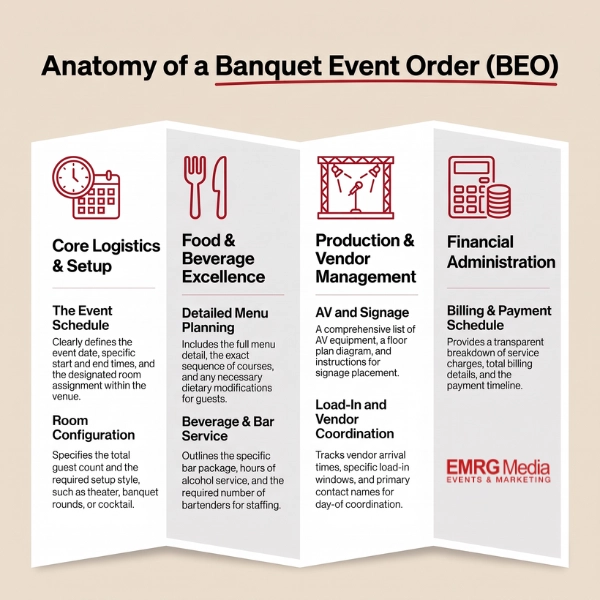
A complete BEO answers nearly every operational question a venue team could ask on event day. Standard sections include:
- Event date, start and end time, and room assignment.
- Guest count and room setup style (theater, banquet rounds, cocktail).
- Full menu detail, including course sequence and dietary modifications.
- Bar package, alcohol service hours, and bartender staffing count.
- AV equipment list, floor plan diagram, and signage placement.
- Vendor arrival times, load-in windows, and contact names.
- Billing details, service charge breakdown, and payment schedule.
Reviewing a banquet event order example from a past event is one of the fastest ways for a first-time corporate host to understand the level of detail expected before their own event date. Answering what is a banquet event order in practice means looking at exactly these fields, nothing on the page is filler.
Planning a New York corporate event with multiple vendors? EMRG Media reviews every BEO revision before it reaches your desk, so nothing gets lost between drafts.
Who Actually Writes This Document, And When
The venue’s catering or events sales manager typically drafts the initial BEO after the contract is signed, then revises it as details firm up. Understanding who prepares the BEO helps clarify why revisions happen so frequently in the weeks before an event.
Most properties issue:
- A preliminary BEO 30 to 60 days before the event, built from the signed contract.
- A revised version 10 to 14 days out, once final headcount and menu selections are locked.
- A final BEO 48 to 72 hours before the event, distributed to every operating department.
Corporate hosts working with an outside planner benefit from having someone review each revision line by line, since a missed change between draft and final version is where day-of surprises originate. Professional teams handling Catering Food Service Coordination treat every BEO revision as a checkpoint, not a formality.
How a BEO Differs from Your Venue Contract
Confusing these two documents is one of the most common mistakes corporate hosts make. The BEO vs contract distinction matters because each serves a completely different purpose.
Feature | The Venue Contract | The Banquet Event Order (BEO) |
Primary Purpose | Legal agreement and financial protection | Operational script for event execution |
Key Contents | Rental fees, cancellation terms, liability | Timelines, menu, AV setup, room diagram |
Frequency | Signed once at booking | Revised multiple times as details evolve |
Binding Status | Legally binding | Internal staff guide (though final counts can be binding) |
Some venues fold BEO acknowledgment language into a signature line, which can create binding obligations around final headcount or menu selections. That’s worth confirming directly with the venue before assuming the document is purely informational.
Common Mistakes Corporate Hosts Make When Reviewing a BEO
Corporate hosts new to New York’s hotel and catering hall market tend to repeat the same errors when a BEO lands in their inbox.
- Skimming the timeline section instead of confirming it matches the internal run-of-show.
- Failing to verify that every dietary restriction submitted actually appears in the menu section.
- Overlooking service charge and gratuity line items, which can differ from what was quoted verbally.
- Not confirming the final BEO version number, since venues sometimes send multiple drafts labeled similarly.
Most day-of confusion happens when hosts forget what a banquet event order is actually meant to do, guide staff, not just satisfy a checklist. A host who treats the catering order form hotel teams send as a rubber-stamp document rather than a working checklist is far more likely to encounter a day-of gap.
Cross-checking the BEO against your venue agreement, as outlined in Venue Selection and Booking, closes that gap before it becomes a problem.
Not sure if your venue’s BEO matches your contract terms? EMRG Media’s team catches those gaps before they become event-day problems.
Key Takeaways
- What is a banquet event order? It's the internal operational document that tells venue staff exactly how to execute your event, from menu to timeline to AV.
- The BEO meaning centers on execution, not sales; it's written for staff, not clients.
- NYC's tight freight elevator windows and multi-event ballroom schedules make BEO accuracy especially critical here.
- A BEO typically goes through preliminary, revised, and final versions before event day.
- The BEO and the venue contract are separate documents serving separate purposes.
- Reviewing every BEO revision line by line prevents most day-of surprises.
Why This One Document Decides How Smoothly Your Event Runs
At the end of the planning process, what is a banquet event order really comes down to this: it’s the difference between a venue team that executes your vision precisely and one that guesses. Every course timing, every AV cable, and every dietary substitution traces back to what’s written on that page.
Corporate hosts who treat the BEO as a working document, not paperwork to skim and sign, walk into their event with far fewer surprises. For events with multiple vendors, tight NYC building logistics, and demanding guest lists, that level of scrutiny isn’t optional.
If you’re planning a corporate event and want a team that reviews every BEO revision before it reaches your desk, EMRG Media has coordinated this process across more than a thousand New York events. Don’t leave your day-of-execution to chance.
Reach out to EMRG Media directly or explore our Corporate Event Catering NYC standards to have a senior planner walk through your next event’s BEO today.
Further Reading on BEOs
Want to know more about the standard components you should look for when reviewing your venue documentation? Check out Cvent’s excellent guide on 5 Things to Expect from Your Banquet Event Order.
FAQs About What is a Banquet Event Order
What is a banquet event order?
A banquet event order is a venue’s internal document detailing menu, timing, setup, and staffing for a specific event. It guides every department, kitchen, AV, service staff, so the event runs exactly as planned.
What is included in a BEO?
A BEO includes guest count, room setup, full menu, bar service, AV needs, vendor timelines, and billing breakdown. It functions as a complete operational script for venue staff on event day.
Is a BEO legally binding?
Typically no, the venue contract carries legal weight, while the BEO is operational. However, some venues require a signature on the final BEO, which can create binding obligations around headcount or menu changes.