

Corporate Conference Event Planning in New York City: The Complete 2026 Guide for Executive Teams
NYC Doesn't Do Average — The 2026 Corporate Conference Planning Guide for Manhattan
Conference event planning in New York City is the highest-stakes version of this work in the country. Manhattan’s venues book nearly a year in advance, and its market relies heavily on established relationships. Compliance requirements are unique to every building and district details rarely found in a venue brochure.
The gap between expectations and reality is where most events lose budget and momentum. For executives and marketing directors responsible for a high-performance conference in 2026, you need answers your venue coordinator won’t provide: true costs, municipal requirements, and the specific Manhattan districts that align with your brand.
EMRG Media has mastered corporate conference execution from the heart of Manhattan for over 20 years. We aren’t a national agency with a satellite office; we are a local team that has navigated every compliance curve this city creates. This is not a generic template it is the blueprint we use to protect our clients’ investments.
If you are ready to stop guessing and start building something New York will actually remember, talk to our team today.
Corporate Event Planner Inquiry
Why Corporate Conference Event Planning in NYC Is a Different Game
New York’s event infrastructure is the most complex in the country. That complexity has a direct effect on your conference planning timeline, your vendor options, your budget, and the final quality of what your attendees experience.
The Venue Calendar Is Competitive and the Season You Choose Matters
Manhattan’s top corporate conference venues from Midtown hotel ballrooms to purpose-built spaces in Hudson Yards are booked 6 to 12 months in advance for peak-season dates. If your conference targets September through November, the highest-demand window for corporate events in New York, your venue search needs to begin no later than Q1.
CRITICAL 2026 PLANNING ALERT: The World Cup Factor
From June 11 to July 19, 2026, the New York/New Jersey region will serve as the global epicenter for the FIFA World Cup, culminating in the Final at MetLife Stadium on July 19. With over 1.2 million visitors expected to descend on the five boroughs, June and July 2026 are effectively “sold out” for traditional corporate conference hotel blocks. Organizations planning for this window will face:
- 300% Surges: Projected increases in transit, private security, and specialized labor costs.
- Gridlock Conditions: Massive security perimeters in Midtown and Lower Manhattan fan zones will make multi-venue logistics nearly impossible.
The 2026 Strategy: To protect your budget and attendee experience, we strongly recommend pivoting 2026 marquee events to early May or late September. This avoids the “tournament tax” while securing the city’s best vendor teams before they are sequestered for World Cup operations.
2026 Seasonal Planning Note: Outside of the summer tournament window, Spring (April–June) and early fall (September–October) remain the strongest conference seasons in Manhattan. Summer events particularly any programming with an outdoor or rooftop component — require heat and humidity contingency plans; NYC’s urban heat index regularly pushes real-feel temperatures above 95°F in July and August.
January and February conferences require proactive weather contingency protocols for attendees traveling from outside the tristate area. Build flexible arrival windows into your agenda and communicate travel contingency plans at least 30 days before the event. Getting the season right is one of the most consequential decisions in NYC conference planning and one of the most overlooked.
Permits, Compliance, and What NYC Specifically Requires
New York City’s event compliance landscape affects corporate conferences more than most planners anticipate. The specific requirements depend on venue type, event size, and programming scope, but here is what corporate teams planning Manhattan events must account for in 2026:
- Amplified sound in certain venue classifications requires advance notification to building management and, in designated districts, a city noise permit filed through NYC311
- Exterior branding or street-level signage at your venue requires written coordination with building ownership and, depending on placement, a permit through the NYC Department of Transportation
- Catering operations in union-contracted venues which includes the majority of Manhattan’s premium conference properties — require advance scheduling of service timing, crew composition, and overtime thresholds before the catering contract is executed
- Fire safety documentation for large general sessions (typically 500+ attendees) requires formal coordination with the NYC Fire Department for occupancy verification and egress compliance
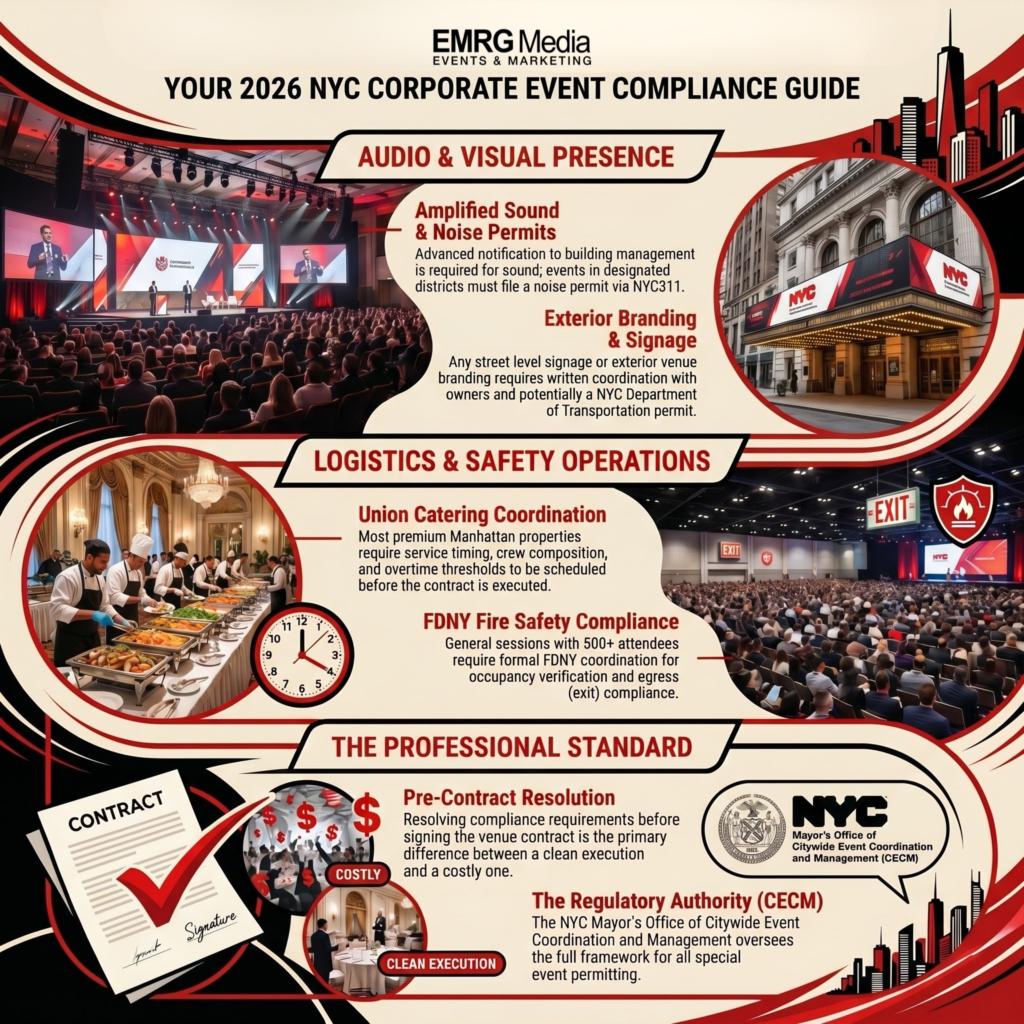
These are not edge cases. They are standard operating conditions for corporate events in this city. The NYC Mayor’s Office of Citywide Event Coordination and Management (CECM) — the city agency that oversees all special event permitting publishes the full compliance framework here. Working with a planning team that resolves these requirements before the venue contract is signed not after is the difference between a clean execution and a costly one.
The Manhattan Neighborhood Decision Where You Host Sends a Signal
The venue district you choose communicates something to your attendees before a single session begins. Each major Manhattan conference corridor carries a distinct professional identity. The right choice depends on your audience, your agenda, and your brand.
- Midtown Manhattan — The High-Volume Corporate Core
Midtown remains the highest-density corporate conference corridor in the United States. The concentration of hotel ballrooms, dedicated conference centers, and full-service event properties between 34th and 59th Streets gives planners the broadest selection at the widest range of price points. Properties anchored near Bryant Park and the Rockefeller Center campus define the premium end of the Midtown conference market and provide prestige positioning for executive-level events and national summits. For conferences where attendees are traveling from outside New York, Midtown’s transit infrastructure direct access from both Penn Station and Grand Central Terminal is an operational advantage no other district can match. - Lower Manhattan and the Financial District — Authority for Finance and Legal Sectors
For conferences in financial services, legal, professional services, and investment sectors, Lower Manhattan offers a venue environment that mirrors the weight of the content. The conversion of historic FiDi buildings into premium event spaces combined with proximity to the World Trade Center campus and the Fulton Center transit hub at Broadway and Fulton makes this district an increasingly competitive alternative to Midtown.
Key planning advantage: Lower Manhattan frequently offers stronger value per square foot for large general session formats compared to equivalent Midtown properties, with no compromise on access or attendee experience. - Hudson Yards and Midtown West — The Modern Premium Choice
Hudson Yards has changed the premium conference calculation in New York. Properties including The Shed and 30 Hudson Yards offer purpose-built event infrastructure with modern AV capacity and flexible floor plans that older Midtown properties structurally cannot replicate.
For organizations whose conference needs to signal innovation, forward momentum, or a premium brand position, Hudson Yards is the current market leader in that category. Plan for higher per-attendee cost and a longer vendor lead time — the top production crews for this corridor book early.
What Corporate Conference Planning in NYC Actually Involves
The gap between a signed venue contract and a fully executed conference is where most New York events either succeed or fall apart. These are the workstreams that define the outcome.
Vendor Access in a High-Demand Market
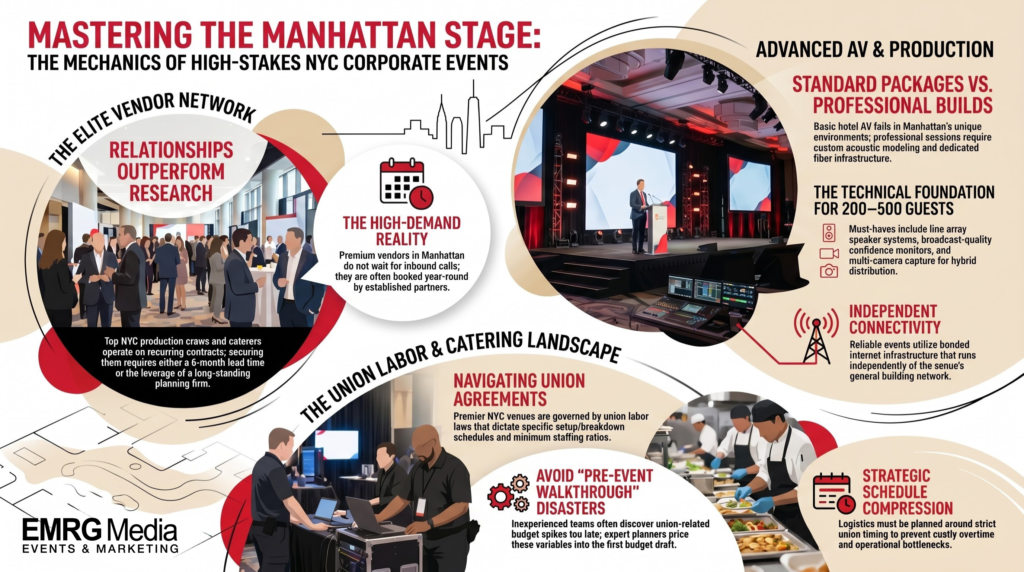
New York’s top AV companies, production crews, catering directors, and event staffing firms are not sitting idle waiting for inbound calls. They operate on retainer relationships and recurring contracts with established clients. For organizations planning their first major NYC conference or scaling an existing one accessing the best vendors requires either significant lead time (6 or more months for premium production companies) or established relationships in the market.
This is one of the primary operational advantages of engaging a long-standing NYC event planning firm. The vendor access is not something that can be replicated by starting a search from scratch six weeks before the event.
AV and Production — Why Standard Packages Fall Short
Corporate conferences in Manhattan operate in technically complex environments; high ceilings, difficult sightlines, mixed natural and artificial light, and building-specific power infrastructure. The standard hotel AV package is structurally insufficient for a professional-grade general session or multi-track conference.
A properly specified AV build for a 200 to 500 person NYC corporate conference includes:
- Line array speaker systems sized by acoustic modeling for the actual room not a default setup assigned by the venue
- Broadcast-quality confidence monitors and teleprompter rigs for executive speakers
- Multi-camera capture for hybrid broadcast or post-event on-demand distribution
- Dedicated fiber or bonded internet infrastructure running independently of the venue’s general building network
Getting the production environment right is the technical foundation but how you use that stage to hold your audience’s attention is an equally critical layer of conference strategy. If your team is still developing the programming side, our guide on 10 genius ways to boost audience engagement at conferences and corporate events covers the tactical playbook your speakers and moderators need before stepping on a Manhattan stage.
Union Catering and Service Flow
Many of Manhattan’s premier conference venues operate under union labor agreements that govern catering service timing, setup and breakdown schedules, and minimum staffing ratios. For planning teams without experience in union event environments, these requirements create unexpected schedule compression and budget variance — typically discovered during the pre-event walkthrough when it is too late to adjust.
Experienced NYC event teams price and schedule these variables from the first budget draft, not as a last-minute discovery.
The 2026 NYC Corporate Conference Event Planning Timeline
For teams beginning their planning process now, this is the sequence that protects the investment:
Timeline | Action Required |
10–12 months out | Venue search, hold, and contract review |
8–9 months out | AV/production partner engaged; technical site survey completed |
6–7 months out | Catering contract executed; union requirements confirmed |
4–5 months out | Permitting review completed; exterior branding and signage approvals filed |
2–3 months out | Run-of-show drafted; speaker tech requirements confirmed |
30 days out | Final attendee communications; weather contingency protocols distributed |
Event week | On-site team installation, technical rehearsal, full venue walkthrough |
Compressing this timeline is possible. It increases cost, reduces vendor options, and introduces execution risk at every stage.
The EMRG Media Difference — 20+ Years of Manhattan Conference Execution
EMRG Media has executed elite corporate conferences and executive summits across Manhattan for more than twenty years. This extensive history is a practical operational foundation built through hundreds of successful events across every major New York business district. Our proven approach to conference event planning is centered on the principle that every potential issue must be resolved before your attendees walk through the door.
To ensure a seamless execution in the demanding 2026 market, we focus on these four critical areas:
- We review all venue contracts for specific union and building compliance language during the initial negotiation phase.
- Technical site surveys guide our AV builds to ensure professional quality that exceeds standard hotel packages.
- Our deep local relationships provide immediate access to the city’s most sought after catering and production crews.
- A dedicated on-site team manages every moving part from room transitions to complex speaker logistics.
Partnering with a veteran allows your leadership to focus exclusively on delivering their message. We provide the market depth required to protect your investment and navigate the unique complexities of Manhattan.
Contact our conference event planner in NYC at 212-254-3700 or visit us at 60 Sutton Pl S, New York, NY 10022.
Frequently Asked Questions
For Q3 and Q4 dates — Manhattan’s peak conference season — begin your venue search 9 to 12 months in advance. Spring dates and smaller events under 150 attendees can be managed on a 6-month timeline at most venues, though earlier engagement still improves vendor options.
A professionally produced corporate conference in Manhattan typically ranges from $1,500 to $4,500 per attendee, depending on venue tier, catering format, AV production scope, and event duration. Budget planning should begin with a venue-and-production baseline estimate — not a per-head food and beverage number.
Most private venue conferences do not require a standalone city-issued event permit. However, exterior signage, amplified sound beyond venue thresholds, street-level registration activity, and certain catering setups may trigger building or city requirements. A local planning team conducts this compliance review as standard pre-event practice.
Midtown provides the most venue options and the best attendee transit access. The Financial District is the preferred positioning choice for finance, legal, and professional services events. Hudson Yards is the current premium choice for high-production and innovation-forward conferences. The right answer depends on your audience profile, budget, and brand.
Yes. EMRG Media’s production team manages full hybrid event builds including multi-camera broadcast setups, dedicated streaming infrastructure, and virtual platform coordination. Hybrid conferences require early-stage technical planning — this is a standard component of the EMRG pre-event workflow.
Your Next NYC Conference Deserves More Than a Vendor List — It Deserves a Strategy
New York City is the most demanding conference market in the world, but it is also the most rewarding. When an event lands well in this city, it carries a professional credibility that no other setting can replicate. Achieving this requires elite conference event planning that addresses every nuance from production quality to the specific weight of the occasion.
Success never happens by accident. It happens because a seasoned team made the right neighborhood call months in advance and resolved vendor hurdles before they reached the client. With experience running hundreds of Manhattan events, EMRG Media knows exactly what this city, your audience, and this moment require to succeed. Running a corporate conference in New York City is harder than it looks. That is not a warning, it is an invitation. Because when it is executed at the level this city demands, it does not just fill a room.
It moves your business forward.
That is the standard EMRG Media holds to — for every client, on every event, in the most demanding city in the world. Contact us now!