The One Document That Can Make or Break Your Event Budget
A banquet event order, commonly called a BEO, is the operational document that tells a venue and its catering staff exactly what to execute on your event day. It lists the menu, the room setup, the timeline, the guest count, and the pricing that both sides have agreed to. If you have ever been handed a multi-page document days before your event and asked to sign it under a deadline, you were looking at a BEO.
For NYC corporate events, where a single evening can involve 15 to 50 vendors and a six-figure budget, the BEO is the single reference point everyone works from on event day. Getting it wrong, or signing it without understanding the fine print, is the number one cause of preventable event-day disputes and budget overruns.
This guide breaks down exactly what belongs on a BEO, when your guest count locks in, and where NYC-specific venue rules change the game. Don’t let a single overlooked line item ruin your next six-figure event. Read on to master your BEO, or contact EMRG Media now to have our NYC experts bulletproof your vendor contracts before our Q4 planning calendar is completely booked.
Corporate Event Planner Inquiry
What Is a Banquet Event Order?
A banquet event order is a detailed internal and client-facing document, typically produced by a hotel, venue, or catering company, that specifies every operational detail required to execute a catered function. According to the Events Management Glossary maintained by the University of South Alabama’s special events department, a BEO outlines the menu, guest count, dietary instructions, room setup, and audio-visual requirements tied to a catered function, and event planners are responsible for reviewing and approving it before service begins.
BEO Meaning in Hotel and Venue Contracts
The BEO meaning in a hotel context is narrower than people expect. It is not the contract that secures your date. It is the execution sheet that follows the contract. A Midtown hotel might issue your first draft BEO 60 to 90 days out, then revise it two or three times before locking a final version 7 to 10 days before the event.
Banquet Event Order vs. Catering Contract vs. Venue Contract
These three documents get confused constantly, and the confusion is where mistakes happen.
Document | Purpose | Who Drafts It | When It’s Signed | Risk If Wrong |
Venue Contract | Secures the date and space, sets deposit and cancellation terms | Venue’s sales or legal team | At booking, often 6 to 12 months out | Loss of deposit, date, or exclusivity |
Catering Contract for Corporate Events | Sets food, beverage, staffing, and pricing structure | Caterer or in-house F&B team | Weeks to months before the event | Budget overruns, missing services |
Banquet Event Order | Operational execution sheet for event day | Venue or caterer’s event manager | Days before the event, after final headcount | Wrong setup, wrong menu, billing disputes |
The venue contract sets the relationship. The catering contract for corporate events sets the financial scope. The BEO is what the kitchen and banquet staff actually follow on the day itself.
What Should Be Included in a BEO?
A complete BEO leaves nothing to interpretation. Vague language is where problems start.
Core Line Items on a Banquet Event Order Template
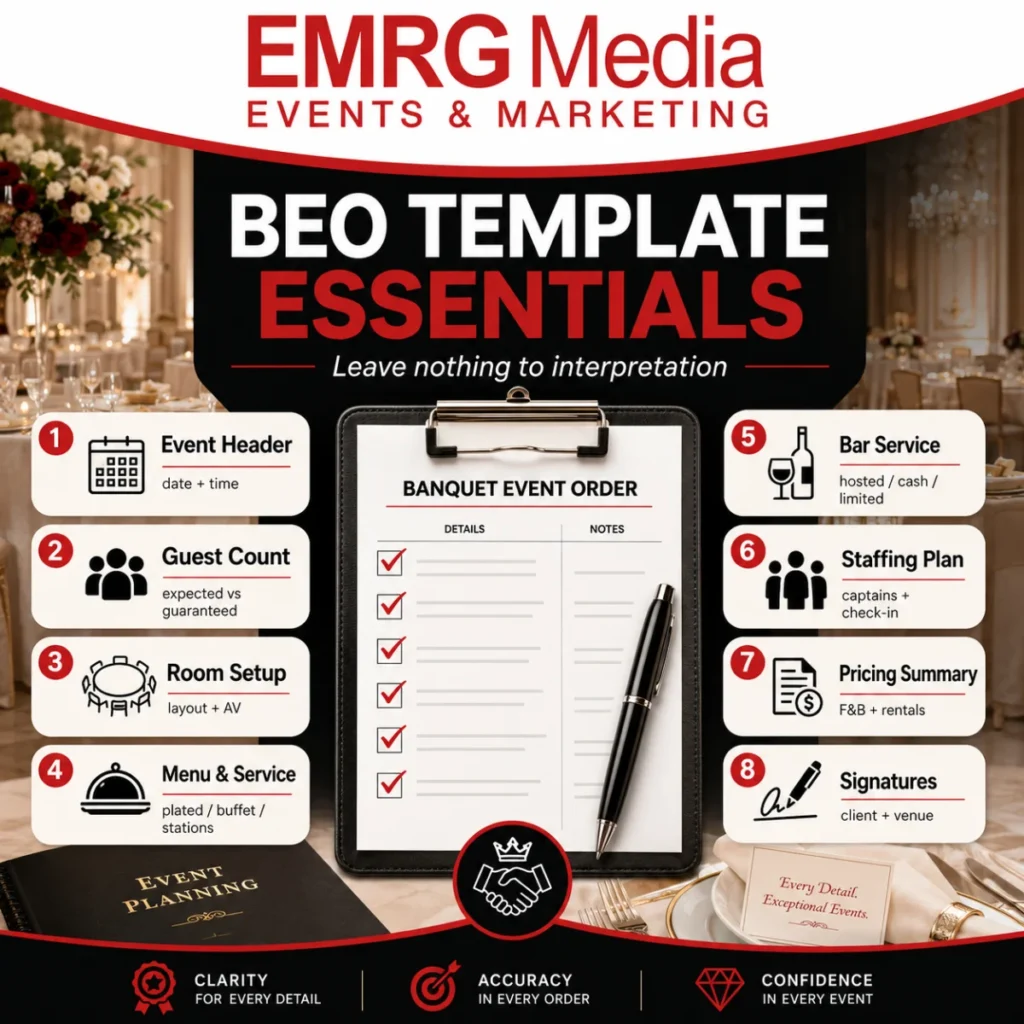
A working banquet event order template should include these sections, in this order:
- Event header: event name, date, start and end time, client contact, and the assigned event manager.
- Guest count: expected number and the guaranteed headcount, listed separately.
- Room setup: layout style, table counts, linens, staging, and AV placement, written specifically rather than generally.
- Menu and service style: plated, buffet, or station, including course sequence and timing.
- Bar service: hosted, cash, or limited, with start and end times.
- Staffing plan: server ratio, captains assigned, and check-in time for banquet staff.
- Pricing summary: per-person cost, food and beverage minimum, service charge, and any rental fees.
- Signature block: authorized signer from the client side and the venue side.
Missing any one of these fields is how a caterer arrives at a rooftop event expecting 150 covers when the client actually confirmed 180. For a full breakdown of how service style and staffing ratios affect your total spend, our corporate event catering NYC guide covers 2026 per-person benchmarks in detail.
When Is the BEO Finalized Before Your Event?
The BEO goes through at least two stages. A draft version circulates 30 to 60 days out based on early conversations. The final version locks 5 to 10 business days before the event, once the guaranteed headcount is confirmed and the menu is closed. Some Midtown hotels will not accept BEO changes inside 72 hours except for a small buffer on guest count.
The Guaranteed Headcount Deadline
The guaranteed headcount deadline is the last date you can lower your confirmed guest number without paying for the higher figure. Most NYC venues set this deadline at 72 hours before the event, though some hotel ballrooms require 5 business days. Whatever number you submit becomes the number you are billed for, even if fewer guests attend. You can typically add guests after this deadline, subject to kitchen capacity, but you cannot subtract them.
Case in point: A 180-guest partner dinner in the Financial District submitted a guaranteed headcount of 180 four days out. Twelve guests canceled the morning of the event. Because the deadline had passed, the client was billed for all 180 covers. Had the guarantee been submitted at 165 with a buffer for late additions, the same event would have cost roughly $2,700 less at a $150-per-person rate, since additions are typically easier and cheaper to accommodate than reductions after the guarantee locks.
Food and Beverage Minimums and Service Charges on the BEO
The BEO is where the financial fine print becomes visible, not just theoretical.
A food and beverage minimum is the floor amount you must spend on food and drink, regardless of how many guests actually order or consume. It is separate from any room rental fee. A venue quoting a $20,000 F&B minimum for a 150-guest reception expects to spend whether 150 guests show up or 130 do. Our venue selection and booking guide covers how these minimums get negotiated at the contract stage, before they ever appear on a BEO.
Service Charge vs. Gratuity
Service charge vs. gratuity is one of the most misread line items on any NYC banquet document. A service charge, typically 20 to 24 percent of food and beverage spend, covers the venue’s administrative and staffing costs. It is not automatically distributed to serving staff as a tip. Under New York’s Hospitality Industry Wage Order, enforced by the New York State Department of Labor, a venue must clearly notify customers in writing, on the contract and on the bill, if a charge is for administration and will not be paid out as a gratuity to staff. Without that disclosure, the law presumes the charge is a tip. Reviewing this language before signing protects both your budget and your event staff.
Who Signs the BEO?
The BEO is typically signed by an authorized representative on the client side, often the event planner or a designated company officer, and the venue’s catering or events manager on the other. Whoever signs becomes financially responsible for the figures on that document. If your company requires procurement or legal sign-off above a certain dollar threshold, route the final BEO through that approval before signing, not after.
How BEOs Differ Across NYC Venue Types
A hotel ballroom in Midtown typically issues a highly structured BEO with in-house AV and staffing pre-filled, since the same team runs multiple events per week. A loft or rooftop space in SoHo or Tribeca, by contrast, often has no in-house catering team, so the BEO must be built almost entirely from your outside caterer’s proposal, with equipment rentals itemized separately since there is no commercial kitchen on site.
Reviewing venue type before your caterer drafts the BEO avoids a mismatch between what the space can support and what the document promises. Our NYC corporate event venues by type resource breaks down these differences by neighborhood and capacity.
Common BEO Mistakes That Cause Problems on NYC Event Day
Even minor oversights on a banquet event order can lead to major event-day disasters. In New York City, three specific mistakes account for the vast majority of vendor disputes and budget overruns:
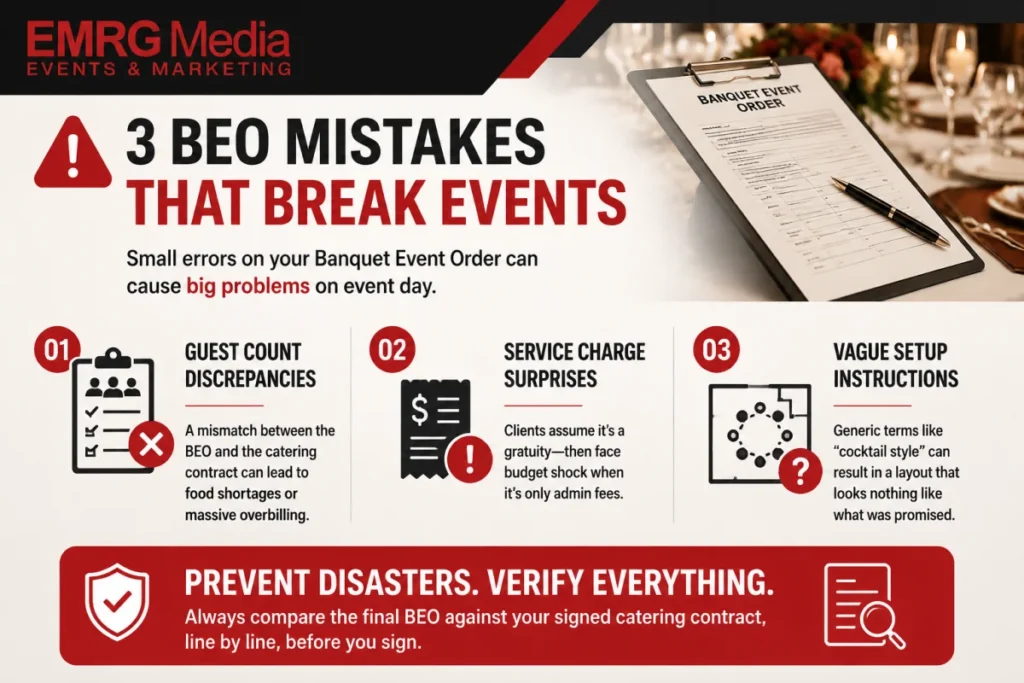
- Guest Count Discrepancies: The most frequent error is a mismatch between the BEO and the corporate catering contract. If one document confirms 200 guests and the other lists 180, you risk severe food shortages or massive overbilling.
- Service Charge Surprises: Clients frequently assume a standard service charge functions as a staff gratuity. Discovering it only covers administrative fees creates severe budget shock when the final invoice arrives.
- Vague Setup Instructions: Relying on generic terms like “cocktail style” without an attached floor plan often results in a room configuration that looks nothing like the layout promised during your initial site visit.
Fortunately, every single one of these costly event-day disasters is entirely preventable with one simple habit. Always compare the final BEO against your signed catering contract, line by line, before you sign.
How EMRG Media Manages BEOs and Catering Contracts for NYC Events
At EMRG Media, reviewing the banquet event order against your catering contract is a mandatory checkpoint in our process, never an optional add-on. Our experienced team meticulously cross-checks your guaranteed headcount figures, clarifies critical service charge disclosures, and confirms specific room setup instructions before any client signs the final document. This rigorous attention to detail ensures that nothing on event day contradicts what you agreed to weeks earlier, ultimately protecting your budget.
If you are planning a corporate event in New York City and need a team that treats your event documentation with the intense scrutiny it demands, our corporate event planning services provide full contract coordination from the first draft to final sign-off.
You can reach our Sutton Place team directly through our Google Business Profile to easily schedule a discovery call. For comprehensive support that extends well beyond the BEO into meticulous vendor vetting and on-site supervision, our dedicated catering food service coordination team flawlessly manages the entire scope of your event.
Frequently Asked Questions
Yes, but changes after signing usually require written approval from both parties and may carry additional fees. Minor adjustments, like small guest count increases, are often accommodated. Structural changes to menu or setup within a week of the event are harder to secure and may not be guaranteed.
Most full-service venues, hotels, and catering companies use a BEO for any catered function. Smaller, informal bookings or drop-off catering may skip a formal BEO, but any event with staffing, setup, or multi-course service should have one to avoid miscommunication.
You are billed for the guaranteed number regardless of actual attendance, since that figure becomes the contracted minimum once the deadline passes. This is why submitting a conservative guarantee with room to add guests later is generally the safer approach.
Yes. Once both parties sign, the BEO functions as a binding agreement on the specific details it covers, including pricing and guaranteed headcount. It typically works alongside, not instead of, the broader catering or venue contract.
Request a template during your first planning conversation, ideally 60 to 90 days before the event. Seeing the format early helps you gather guest data, dietary details, and setup preferences in the structure the venue will actually use.
Mastering Your Next NYC Banquet Event Order
Understanding the intricacies of a banquet event order is critical for executing flawless corporate events in New York City. Far more than just administrative paperwork, this document is the blueprint that safeguards your budget, aligns your vendor team, and guarantees your vision comes to life. By knowing exactly what to look for from strict guaranteed headcount deadlines to hidden service charges you can sign your final contracts with absolute confidence.
We understand that navigating uncompromising hotel policies and complex catering terms can feel incredibly overwhelming. You don’t have to carry that heavy burden alone. Don’t let a single overlooked detail derail months of your hard work. Contact EMRG Media today to schedule your discovery call. Let our expert team bulletproof your documentation and turn your next big corporate event into a seamless, stress-free success.