The Run of Show Blueprint: Don't Let Your NYC Event Turn Into Chaos
A run of show is the single most critical document that dictates whether your event feels flawlessly controlled or completely chaotic. It is the uncompromising, minute-by-minute script that tells every vendor, speaker, and technician exactly what happens next, and exactly when. For corporate planners producing a high-stakes conference, gala, or product launch in New York City, this document is never optional paperwork. It is the operational backbone that synchronizes your production crews, event planning teams, and VIP clients into one seamless powerhouse.
This comprehensive guide breaks down exactly what belongs in a professional run of show and how to build one from scratch. We are pulling back the curtain on the exact, battle-tested template structure EMRG Media uses to execute flawless New York events.
Don’t risk a very public, catastrophic delay just because your AV and catering teams are out of sync. Grab our exclusive run of show templates right now before your next major event, and walk into show day with absolute, bulletproof confidence.
Corporate Event Planner Inquiry
Defining a Run of Show and How It Differs From an Agenda
The undeniable fact is this: a run of show is the operational core of any successful NYC event production. It is a timed, task-level script. It lists every event segment, who owns it, its duration, and the specific cue that triggers the next moment.
At EMRG Media, we rely on this master document so our AV operators and catering leads never have to guess. Everyone knows exactly what happens at 6:42 p.m. without asking questions.
The Core Differences
Many people confuse these two documents. Here are the facts on how they differ:
- The Event Agenda: This is guest-facing. It tells attendees the broad schedule, like registration at 9:00 a.m. or a keynote at 9:30 a.m. While traditional event planning and management focuses heavily on crafting this overarching guest experience, it is only half the battle. It is the story your guests read.
- The Run of Show: This is strictly production-facing. It takes that same keynote and breaks it into precise internal cues. It dictates when house lights drop, walk-in music fades, and microphones go live. It is the hidden machinery.
Who Owns the Document?
Ownership always sits with the stage manager or lead producer. It never belongs solely to the AV team. While audio and lighting departments feed their cues into the master sheet, one person must consolidate everything into a single version of the truth. When multiple departments work from different timelines, shows fall apart. If you want to understand this leadership dynamic, our guide on “What is a stage manager?” explains exactly how this vital ownership role functions on event day.
What Goes Into a Run of Show Document
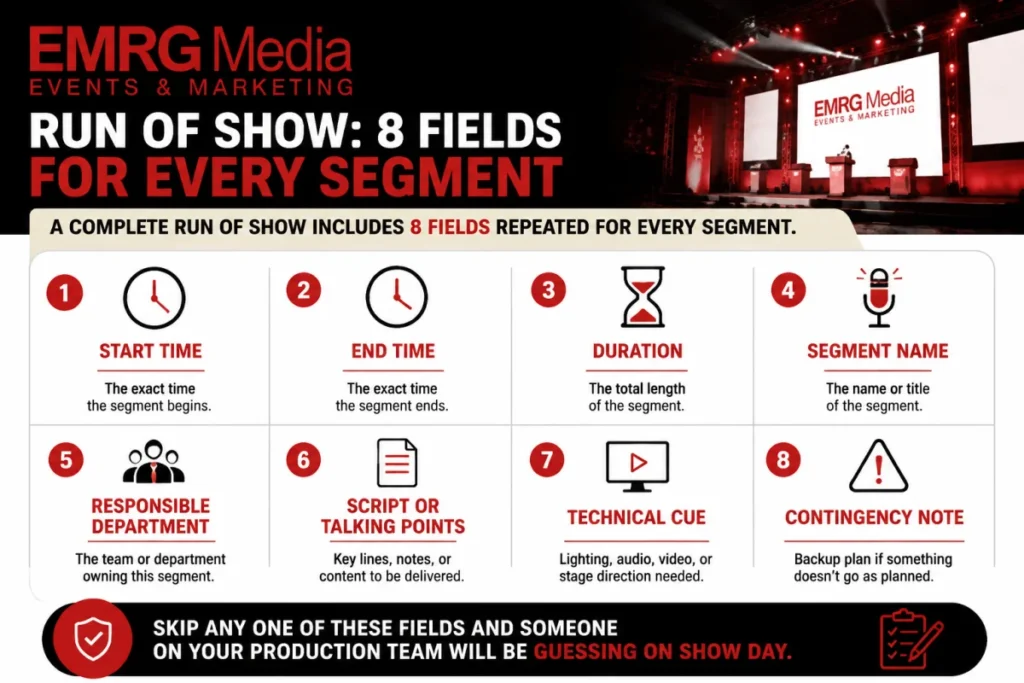
A complete run of show documents typically includes eight fields repeated for every segment: start time, end time, duration, segment name, responsible department, script or talking points, technical cue, and contingency note. Skip any one of these fields and someone on your production team will be guessing on show day.
The Anatomy of a Cue Sheet for Corporate Events
A cue sheet for corporate events is the technical layer nested inside the run of show. It isolates every lighting, sound, and video trigger into its own row, timestamped to the second where precision matters, such as a video playback during a keynote or a spotlight cue during an award presentation. According to production standards referenced by the United States Institute for Theatre Technology, documented cue tracking gives every technician the same reference point and measurably reduces on-site errors, a principle that applies directly to corporate stage production and not just theater.
How Detailed Should the Timings Be?
Never apply one universal timing standard across the entire document. Instead, match your timing precision to the risk of the moment:
- Detail to the Minute: Use this for guest-facing segments. For example, a gala dinner service can safely run in five-minute blocks.
- Detail to the Second: Use this for complex technical cues. A fast-paced product reveal synchronized to an LED wall must be exact.
The Stage Manager Call Script Hiding Inside Every Show Flow Document
Every show flow document contains an implied stage manager call script, the exact phrasing a stage manager uses over headset to move the show forward. A typical sequence reads: “Standby house lights.” Three-second pause. “House lights, go.” “Standby mic one.” “Mic one, live.” This standby-and-go structure prevents technicians from triggering a cue too early. Build this language directly into your document instead of leaving it to be improvised live on headset.
Run of Show Template: A Column-by-Column Framework
A usable run of show template needs six columns at minimum: Time, Segment, Duration, Owner, Cue/Script, and Notes. Anything more becomes difficult to read on a printed sheet backstage. Anything less forces your team to fill gaps verbally, which is exactly what a run of show is designed to prevent.
Free Event Run of Show Template Breakdown
Time | Segment | Duration | Owner | Cue / Notes |
6:00 PM | Doors open, registration | 30 min | Event staff | Playlist starts at moderate volume |
6:30 PM | Cocktail hour | 30 min | Catering | Passed hors d’oeuvres, no announcements |
7:00 PM | Welcome remarks | 5 min | Stage manager | House lights down, spotlight up, mic live |
7:05 PM | Keynote presentation | 20 min | Speaker / AV | Slide deck cued, countdown visible to speaker only |
7:25 PM | Video reveal | 3 min | AV / Production | LED wall and sound cue synced to the second |
7:28 PM | Dinner service begins | 45 min | Catering | Lights restore to dinner wash |
8:15 PM | Awards segment | 15 min | Stage manager | Standby-and-go cue for each honoree walk-up |
8:30 PM | Closing remarks, exit music | 10 min | Host | Playlist ramps up, house lights to full |
Minute-by-Minute Event Agenda Example: Midtown Ballroom Gala
Picture a 300-guest gala in a Midtown Manhattan ballroom. The guest-facing minute-by-minute event agenda simply reads “7:00 PM, Program Begins.” The run of show behind that single line has eleven separate cues across lighting, audio, and stage management, timed to the minute, because a Midtown hotel ballroom typically enforces a strict four-hour room turnover window. Miss one cue by four minutes and the entire back half of the evening compresses.
Building a Run of Show for Different NYC Event Formats
Conferences and Summits Near Midtown
Multi-day conferences need a run of show for each day, and each breakout room running in parallel. Midtown venues near major transit hubs often stack three sessions simultaneously, which means three synchronized documents, not one master sheet.
Galas in Tribeca and Wall Street Ballrooms
Formal corporate galas built around a live auction need the run of show to flex. Build in a floating fifteen-minute buffer around that segment specifically, since paddle-raise moments and live bidding rarely land exactly on schedule.
Product Launches in SoHo and Hudson Yards
A press-facing product launch, like the formats detailed in our “NYC Product Launch” guide, needs a run of show that separates media check-in cues from the main reveal sequence, since editors and influencers often arrive on a staggered schedule that general guests do not follow.
Hybrid Events: Dual-Track Cues
Successful hybrid conference planning in NYC requires a run of show with two parallel columns: one for the in-room cue and one for what the livestream shows the remote audience at that exact second. A slow lighting fade can work perfectly in the room but read as dead air on a stream unless the document accounts for both audiences separately.
Common Run of Show Mistakes That Derail NYC Show Days
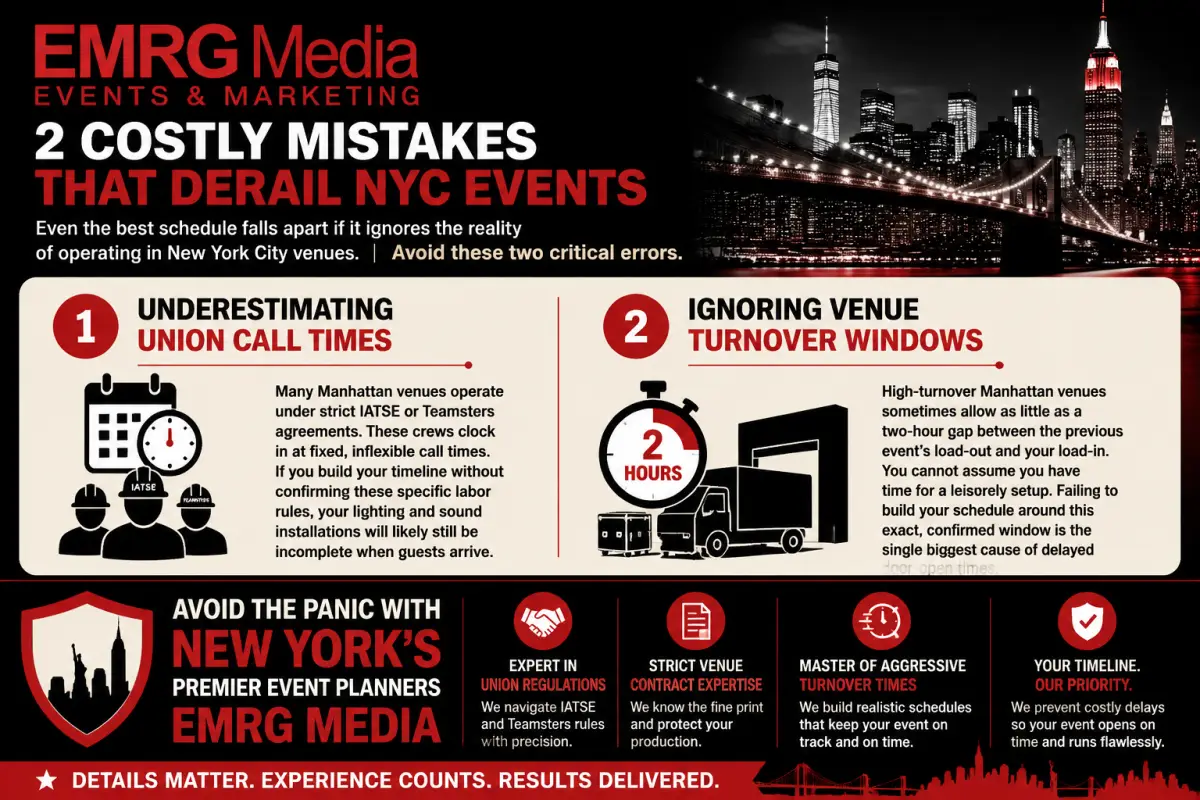
Even the best schedule falls apart if it ignores the reality of operating in New York City venues. Avoid these two critical errors:
Underestimating Union Call Times
Many Manhattan venues operate under strict IATSE or Teamsters agreements. These crews clock in at fixed, inflexible call times. If you build your timeline without confirming these specific labor rules, your lighting and sound installations will likely still be incomplete when guests arrive.
Ignoring Venue Turnover Windows
High-turnover Manhattan venues sometimes allow as little as a two-hour gap between the previous event’s load-out and your load-in. You cannot assume you have time for a leisurely setup. Failing to build your schedule around this exact, confirmed window is the single biggest cause of delayed door-open times.
Avoid the Panic with New York’s Premier Event Planners
At EMRG Media, we are recognized as the top event planners in New York precisely because we never leave these crucial details to chance. We know exactly how to navigate complex union regulations, strict venue contracts, and aggressive turnover times. When you partner with us to manage your production, we protect your timeline from these costly mistakes, ensuring your event opens exactly on schedule and runs flawlessly from start to finish.
How This Gets Executed on Show Day
When event day arrives, your run of show transforms from a static spreadsheet into a live-action script. Execution requires absolute precision from every department. The stage manager takes command over the headset, calling each cue with perfect timing. Simultaneously, the technicians managing your event’s technical framework; a concept covered deeply in our What Is Audio Visual guide execute lighting and sound triggers in exact sequence.
Every physical element must also align. The intricate production elements you mapped out during your Stage Design 101 phase will activate exactly on cue, creating a seamless experience for your audience.
At EMRG Media, our in-house experts build and call the run of show for every event we produce across New York City. We coordinate everything directly from our Manhattan office, applying the exact same rigorous production discipline whether your guest count is 50 or 1,500 attendees.
Frequently Asked Questions
Finalize the run of show at least 48 to 72 hours before your event, after a full technical rehearsal. Corporate conferences and galas typically need one working draft two weeks out, followed by a locked final version once AV, catering, and stage management have confirmed their cues.
Yes, but changes should route through the stage manager only. Adjustments happen live over the headset as timing shifts, while the written document stays fixed as the reference point, so every department reacts to the same baseline instead of conflicting verbal updates.
A shared spreadsheet, such as Google Sheets, works for most events because multiple departments can edit in real time. Larger productions sometimes use dedicated production software, but the format matters less than having one locked, printable version ready for show day.
Yes. A rehearsal version typically compresses timing and skips guest-facing segments like registration, focusing only on technical cues, transitions, and speaker walk-throughs. This lets the production team test lighting, sound, and video cues without running the full show length.
Every department lead needs a copy: stage manager, AV lead, catering captain, and client point of contact. Wider access beyond that group tends to create confusion, since only the stage manager should be calling live changes during the event.
Bringing Your Run of Show to Life with EMRG Media
A run of show is not paperwork produced to satisfy a client request. It is the single tool that separates a controlled, professional production from a scrambled one, and in a city where venue turnover windows and union call times leave zero room for guesswork, that document carries real weight. Whether you are producing a Midtown conference, a Tribeca gala, or a SoHo product reveal, build your run of show early, assign one owner, and test the cues before a single guest walks in.
EMRG Media has built and called the run of shows for more than 1,100 events across New York City since 2001. If you want a production team that treats show-day timing as seriously as you do, reach out to EMRG Media and let’s build your next run of shows together.