
Hybrid Conference Planning in NYC: The 2026 Expert Guide to Running Seamless In-Person + Virtual Events
Two Audiences. One Shot to Get It Right. Here's How to Master Hybrid Conference Planning in NYC
Hybrid conference planning in NYC is unlike anything else in the events industry. You’re not managing one room, you’re managing two realities simultaneously: a live audience at a Manhattan venue and a virtual audience logging in from across the country or the globe. In a city where corporate standards are shaped by Wall Street boardrooms and Fortune 500 brands, the margin for error is nonexistent.
Get it right, and your brand looks cutting-edge and genuinely inclusive. Get it wrong, and one audience almost always the virtual one feels like an expensive afterthought. That is exactly the problem this guide solves.
At EMRG Media, we’ve spent 25 years producing events that define the standard in New York City from intimate corporate gatherings to large-scale conferences and trade shows. Hybrid conferences are among the most technically demanding formats we execute, and the most powerful when every element clicks into place.
Ready to stop guessing and start building a hybrid conference that both your rooms will remember? Contact EMRG Media today, NYC’s most trusted event planning team and let’s get started.
Corporate Event Planner Inquiry
What Is a Hybrid Conference And Why NYC Is the Right City for One?

A hybrid conference is a live, in-person event that simultaneously broadcasts to a virtual audience in real time. Don’t let the simple definition fool you. Executing it well requires two entirely separate audience strategies, production setups, and engagement models running in perfect parallel.
The Dual-Audience Model Explained
The biggest mistake first-time hybrid planners make is treating virtual attendees like passive livestream viewers. A well-designed hybrid conference treats both groups as equally important participants. In-person attendees get the energy of the room, the handshakes, and the hallway conversations. Virtual attendees need interactive programming, real-time Q&A access, digital networking tools, and seamless streaming or they will disengage within the first 20 minutes.
Why Manhattan’s Corporate Market Is Driving Hybrid Demand in 2026
New York City, particularly the Financial District and Wall Street corridor is home to some of the most geographically distributed corporate teams in the world. Law firms, investment banks, media companies, and enterprise brands headquartered in Manhattan routinely manage remote teams across multiple time zones. For these organizations, hybrid conferences are not a passing trend; they are a permanent operational necessity.
According to the Professional Convention Management Association (PCMA), hybrid events now represent a significant and growing share of all corporate conferences globally, with no indication of demand slowing. NYC planners who genuinely understand the format, not just the technology behind it, remain among the most sought-after in the industry.
Choosing the Right NYC Venue for Professional Conference Event Planning
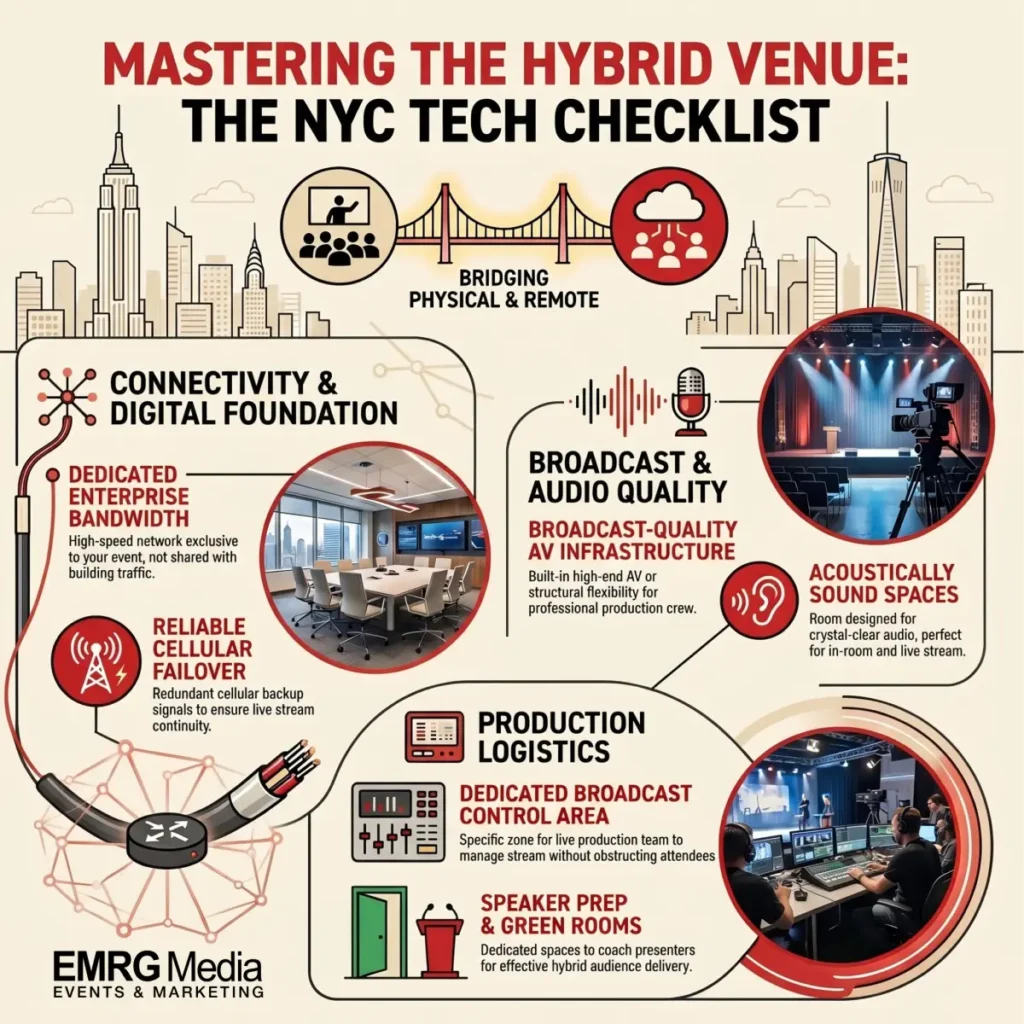
Venue selection for conference event planning in NYC‘s hybrid market is radically different from sourcing a traditional event space; you are no longer just evaluating square footage and catering menus, you are auditing technical infrastructure.
What to Look for in a Hybrid-Ready NYC Venue
Before you commit to a Midtown ballroom or a Lower Manhattan rooftop, run through this checklist:
- Dedicated enterprise-grade internet bandwidth — not shared with the building’s general network
- Broadcast-quality AV infrastructure or structural flexibility to bring in a professional production crew
- Acoustically sound spaces so speakers are crystal clear both in-room and on stream
- A dedicated broadcast control area for your live production team
- Reliable cellular backup signal for redundant streaming failover
- Green room or speaker prep space to coach presenters on hybrid-specific delivery
Neighborhood Spotlight: Financial District & Wall Street
The Financial District is one of Manhattan’s most underappreciated conference markets. Historic event spaces with original architecture sit steps from the New York Stock Exchange, while waterfront venues along the East River from the South Street Seaport area to the Pier 17 complex offer dramatic production backdrops that few neighborhoods anywhere in the U.S. can replicate.
While Midtown dominates the broader conversation, venues in and around Wall Street carry compelling advantages for corporate hybrid events: direct proximity to major financial and legal firms, premium architectural character with flexible production footprints, and often more competitive day rates than comparable Midtown properties. EMRG Media knows this market intimately, including which specific spaces carry the technical infrastructure to support a full hybrid broadcast production without costly day-of retrofitting.
Building Your Hybrid Conference Tech Stack
Technology is the backbone of every hybrid conference. Choosing the wrong tools or failing to properly integrate the right ones is the fastest way to lose your virtual audience entirely.
Streaming Platforms vs. Hybrid Event Platforms
A streaming platform such as YouTube Live or Zoom Webinar simply broadcasts your event. A hybrid event platform such as Hopin, vFairs, or Cvent creates a fully interactive environment where virtual attendees can network, engage with sponsor content, participate in live polls, and submit questions in real time. For a corporate-grade hybrid conference in New York City, a purpose-built event platform will almost always outperform a simple broadcast stream. Today’s corporate audiences expect far more than a talking head on a screen.
AV Production Requirements You Cannot Skimp On
Your in-room AV system and your broadcast production setup are two entirely distinct disciplines. Stage lighting that looks stunning in person can appear washed-out on camera. A properly executed hybrid conference in NYC requires:
- A dedicated live production director managing the broadcast independently from the in-room tech team
- Multi-camera setups for dynamic, broadcast-quality visuals
- Confidence monitors allowing speakers to view virtual Q&A in real time
- Redundant internet connections with automatic failover protocols
Content Note: If your event includes technical subject matter presented to audiences of mixed expertise levels, our guide on How to Design Tech Events That Engage Non-Technical Stakeholders delivers actionable strategies for bridging the knowledge gap, keeping every attendee, whether in-room or logged in remotely, genuinely engaged from the opening keynote to the final session.
Programming a Hybrid Conference for Two Audiences at Once
Great hybrid programming is not designed for one audience and then adapted for the other. It is built for both audiences simultaneously from day one. Integrating these requirements into your NYC conference planning timeline early ensures that neither the in-person nor the virtual experience feels like an afterthought.
Design Both Experiences in Parallel — Not Sequentially
The most common hybrid conference failure pattern: design the in-person program first, then bolt on a virtual layer at the end. That approach consistently produces a subpar online experience.
Keynote presentations should be structured for broadcast pacing: tighter, more visually driven, with deliberate pauses built in for virtual interaction. Panel discussions need a dedicated moderator to surface and incorporate online Q&A in real time. Networking sessions require a digital equivalent: virtual breakout rooms, attendee matchmaking tools that mirrors the energy of in-room conversations happening just a few feet away.
Hybrid Networking Strategies That Actually Work in 2026
In-person networking is organic. Virtual networking is not and that is a design problem, not a technology failure. The most effective hybrid conferences in 2026 build structured networking directly into the program itself: speed networking rotations with virtual breakout rooms, pre-conference attendee matchmaking through the event app, and gamified engagement leaderboards that reward in-person and virtual participants equally. When both audiences feel genuinely invested in the connections they are making, your event stops being two parallel experiences and becomes one unified occasion.
Hybrid Conference Budgeting in NYC: What to Realistically Expect
If you have budgeted for traditional conferences before, reset your expectations. A hybrid conference carries two distinct cost layers that must each be planned independently.
In-Person vs. Virtual Cost Components
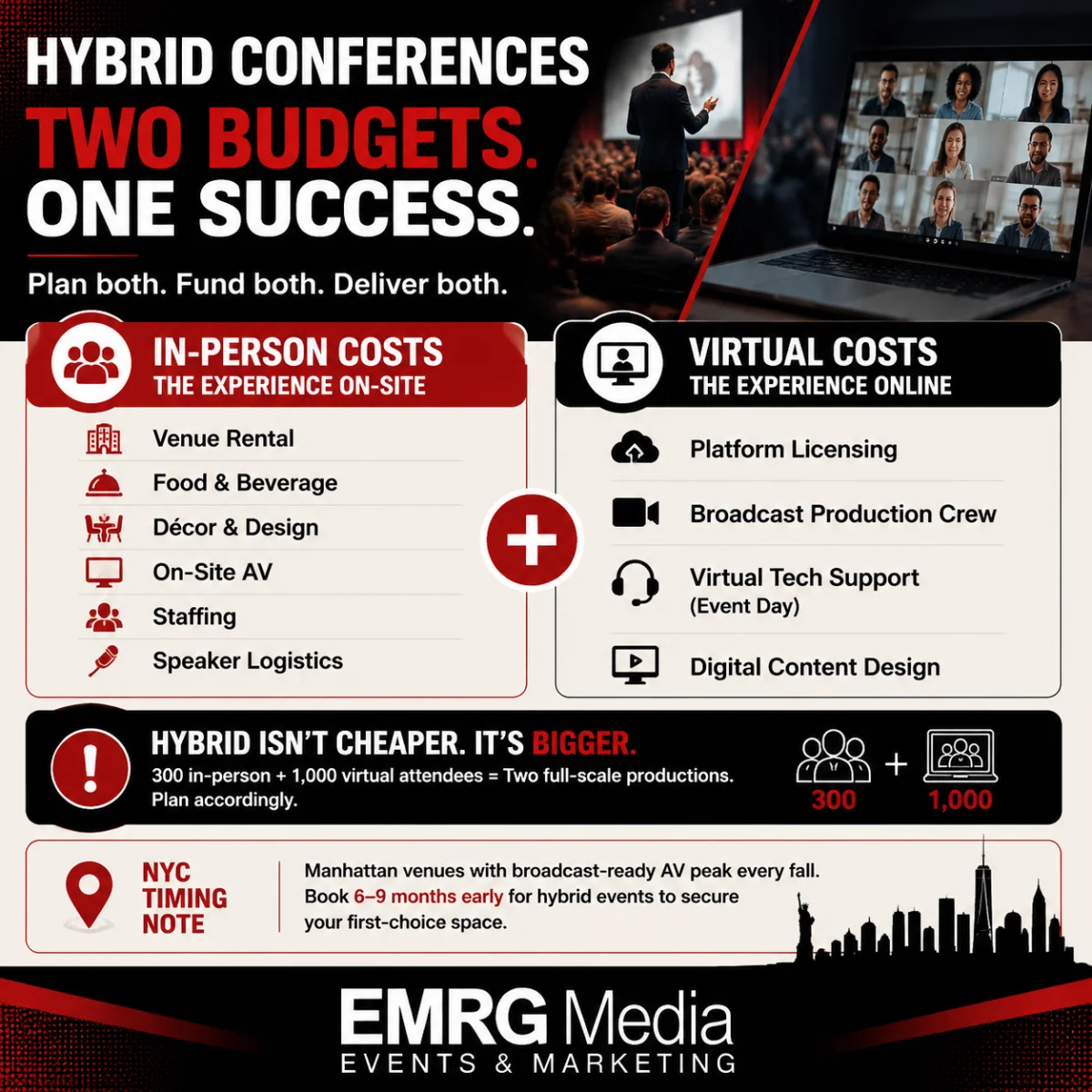
Your in-person budget covers familiar line items: venue rental, food and beverage, décor, on-site AV, staffing, and speaker logistics. Your virtual budget adds a separate, fully independent layer: platform licensing, broadcast production crew, virtual tech support on event day, and digital content design.
Many organizations assume hybrid conferences are cheaper because fewer people physically travel. That assumption leads directly to serious budget shortfalls. A 300-person in-person event with 1,000 virtual attendees is not cheaper than a 300-person traditional event; it is a fundamentally larger-scale production running on two tracks at once.
NYC Timing Note: Demand for Manhattan conference venues, particularly spaces with dedicated AV infrastructure capable of supporting a live broadcast, peaks every fall. This is when financial firms, tech companies, and industry associations converge on the city for Q4 planning events and annual conferences. For hybrid productions requiring specialized technical setups, securing your venue 6 to 9 months in advance is not just advisable; it is the difference between landing your first-choice space and settling for your fourth.
Maximizing ROI Across Both Audiences
The strongest ROI argument for hybrid conferences is content longevity. A well-produced hybrid event generates session recordings, highlight reels, and speaker clips that function as marketing assets long after the room clears. When you partner with a team that approaches conference planning services from a strategic standpoint, your event stops being a one-day cost center and becomes a months-long content engine for your brand.
Post-Conference Metrics: Measuring Real Hybrid Event Success
KPIs That Matter for Hybrid Events
Measuring hybrid success requires a split-lens approach.
- For in-person attendees: session attendance rates, net promoter score (NPS), and post-event survey responses.
- For virtual attendees: average watch time per session, interaction rate across polls and Q&A participation, and platform re-engagement after the event closes — meaning, did virtual attendees return to watch session replays?
Watch time is the single most revealing virtual metric. If your online audience’s average watch time falls below 40% of total session length, you have a programming design problem — not a technology failure. The fix starts in the planning room, not in the tech stack.
Turning Your Conference Into Evergreen Content
Post-conference content repurposing remains one of the most underutilized strategies in the NYC corporate market. Session recordings become gated lead-generation resources. Speaker clips become LinkedIn article series. Behavioral data from your event platform tells you precisely which topics drove the most engagement — giving you the intelligence to design your next hybrid conference with sharper, data-backed precision.
What Our Clients Say
“Erica Maurer and EMRG Media are certainly one of the leading event planners in New York City. Each event produced is a top-notch affair. Erica’s knowledge of New York City’s venues, both large and small, is superb, and her ability to match a client with a venue while negotiating the lowest cost possible goes unmatched in the event planning industry. Looking forward to working with you in the future.”
— Daniel Levy, Grandstand Sports & Memorabilia, Inc.
“EMRG Media was fantastic to work with. Erica and her team are pros! They know so many wonderful vendors and make sure to take care of every detail. They were able to take our ideas, amplify them and bring them to life.The team was pleasant to work with, responsive and brought their A-game on event day! I would highly recommend using EMRG for your event.”
—Melissa Kessler Bernstein
This kind of outcome is not accidental. It is the direct result of hybrid conference production being wired into our team’s operational DNA from the start — not treated as a service add-on. See more on the reviews of our clients on why they are satisfied with our service as event planners in NYC.
Why EMRG Media Is New York City's Go-To Hybrid Conference Planning Partner
Planning a hybrid conference in NYC demands more than a detailed checklist. It requires a team with the experience, vendor relationships, and technical fluency to execute two live events simultaneously without dropping the ball on either side.
At EMRG Media, we have produced conferences, galas, trade shows, and large-scale corporate events for some of Manhattan’s most recognized brands and institutions. Our team manages the complete scope: venue sourcing across neighborhoods from Wall Street to Hudson Yards, broadcast-quality AV production, virtual platform onboarding and management, on-site day-of coordination, and post-event reporting that gives you a clear picture of both audiences.
You bring the vision. We bring both rooms to life. Ready to start building your hybrid conference? Call (212) 254-3700 to speak with a specialist today.
Frequently Asked Questions
For a mid-to-large event with 200+ in-person attendees, begin planning at least 6–9 months out. Hybrid-ready Manhattan venues with proper AV infrastructure book quickly — particularly in the fall quarter — and virtual production planning needs to be underway well before event day, not treated as a last-minute layer.
Yes. The key is right-sizing your tech stack to your audience and budget. Not every hybrid event requires a full broadcast production crew. A skilled planner will help you identify the appropriate platform, staffing level, and virtual feature set that fits your event without overspending on capabilities you do not need.
Designing the in-person experience first and adding a virtual layer afterward. Hybrid conferences must be architected for both audiences simultaneously from day one. When the virtual experience is bolted on at the end, online attendees feel like they are watching through a window rather than actually participating and engagement data confirms it immediately.
Yes, for any hybrid event with a meaningful virtual audience, a dedicated virtual host is non-negotiable. This person manages live chat, surfaces audience Q&A for on-stage speakers, and maintains online engagement during session transitions. Your on-stage MC cannot perform this role simultaneously without compromising both.
End to end. We manage platform selection, onboarding, and configuration; coordinate closely with venue AV teams; and bring in dedicated live broadcast professionals to ensure your stream performs at broadcast quality — not just functional minimum. Our team owns the technical layer so your speakers and stakeholders can focus entirely on the content.