

Manhattan venues locked in Saturday dates up to a year ahead, and NYC Parks permits can carry processing windows of up to 90 days which means a host who starts thinking about logistics three months before a gala is already behind.
Anyone researching the event planning process usually learns the hard way that New York City punishes last-minute planning harder than almost any other market in the country.
The good news, the event planning process isn’t mysterious once it’s broken into stages.
From the first phone call to the final invoice reconciliation, most full-service NYC engagements run through seven connected steps, and understanding them upfront is what separates a controlled production from a scramble.
What Is the Event Planning Process, Really?
Before getting into the stages themselves, it helps to separate two terms people use interchangeably. Event planning is the strategic, pre-event work concept, budget, venue, vendors.
Event management is the operational execution of the day-of coordination that keeps a run-of-show on schedule.
A full New York event planning & management engagement covers both under one accountable team, which matters when budget and reputation are on the line.
The 7 Stages of the NYC Event Planning Process
For clients who want visibility into every decision point, it helps to separate the work into the 7 stages of event planning, each with its own deliverables and deadline pressure.
Stage 1: Discovery and Concept Development
The first conversation covers event type, guest count, date range, and budget parameters. A working concept comes out of this stage, not a template pulled off a shelf.
Stage 2: Budget and Timeline Scoping
Before any venue tour happens, the team maps how far in advance booking decisions need to be locked almost always earlier than clients expect in Manhattan.
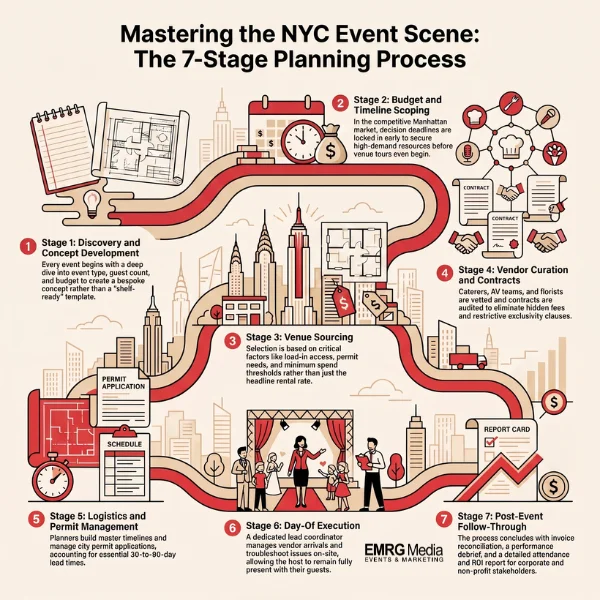
Stage 3: Venue Sourcing
Capacity, load-in access, minimum spend thresholds, and permit requirements get assessed here. These factors, not the headline rental rate, usually determine total cost.
Stage 4: Vendor Curation and Contracts
Photographers, caterers, florists, and AV teams get vetted and locked in. Every contract is reviewed before signature so exclusivity clauses and hidden fees surface early.
Stage 5: Logistics and Permit Management
Master timelines, run-of-show documents, and city permit applications get built out, with lead times of 30 to 90 days factored into the schedule.
Stage 6: Day-Of Execution
A lead coordinator runs the show on-site, manages vendor arrivals, and troubleshoots in real time so the host isn’t fielding a vendor call during their own event.
Stage 7: Post-Event Follow-Through
Invoice reconciliation, a debrief on what worked, and, for corporate or non-profit clients, an attendance and ROI report close out the engagement.
These event planning steps aren’t arbitrary, each one exists to catch a specific New York risk before it turns into a costly mistake.
Not sure which stage your event is stuck on? Get in touch with EMRG Media to pinpoint exactly what’s next.
Why NYC Adds Extra Friction to Every Stage
Each of these event planning phases carries more friction in New York than in most other cities, union labor rules under IATSE and Teamsters agreements affect crew scheduling at certain Manhattan venues.
Rooftop and outdoor spaces need Buildings Department and Parks permits stacked on top of the venue contract itself.
Older buildings in Midtown sometimes have Wi-Fi limitations that undermine hybrid streaming quality if nobody checks the infrastructure early.
None of this is complexity for its own sake, it’s the reason a realistic event planning timeline in NYC runs longer than almost anywhere else, with large events needing 9 to 12 months and even mid-scale events needing 6 to 9.
Planning a hybrid or multi-vendor event across boroughs? Talk through your event brief with EMRG Media before a single contract gets signed.
Where NYC Hosts Usually Lose Control
Most breakdowns in the event management process happen at the same two points: venue contracts signed before permits are confirmed, and vendors booked without a backup contact identified.
Building contingency plans into stage five, before stage six ever begins, is what keeps event day from turning into a scramble.
Want the full breakdown of what a planner is responsible for at every stage? Read What Does an Event Planner Do? for a complete look at full-service scope.
Key Take Aways
- The event planning process runs through seven connected stages: discovery, budget scoping, venue sourcing, vendor contracts, logistics/permits, day-of execution, and post-event follow-through.
- Large NYC events need 9–12 months of lead time; mid-scale events need 6–9 months; smaller gatherings can move in 3–4 months.
- NYC permits Parks, DOT, noise, liquor carry 30–90 day processing windows that must be built into the schedule early.
- Union labor rules at certain Manhattan venues affect crew scheduling and cost.
- Reviewing every vendor contract before signature prevents hidden fees and exclusivity clause surprises.
- A documented post-event debrief is what stops hosts from repeating the same mistakes the following year.
The Real Advantage Is Knowing What Comes Next
The event planning process isn’t complicated, it’s just unforgiving of skipped steps in a city where venues, vendors, and permits all move on their own clock.
Hosts who understand the seven stages going in make fewer costly decisions and spend less time reacting on event day.
That structure, more than any single vendor choice, is what actually protects a New York event’s budget and outcome.
Ready to map your event planning process from brief to final invoice? Reach out with EMRG Media now and follow along for real-time NYC venue updates on Facebook.

FAQs About Event Planning Process
How many stages does the event planning process include?
Most full-service NYC engagements break the work into seven stages: discovery, budget scoping, venue sourcing, vendor contracts, logistics/permits, day-of execution, and post-event follow-through. Skipping any stage typically adds cost or scheduling risk later.
What is the difference between event planning and event management?
Lorem ipsum dolor sit amet, consectetur adipiscing elit. Ut elit tellus, luctus nec ullamcorper mattis, pulvinar dapibus leo.
How long does the event planning process take in NYC?
Large NYC events typically need 9–12 months, mid-scale events need 6–9 months, and smaller gatherings can move in 3–4 months. Permits alone can add 30–90 days to the schedule.