
An event MC is the person who holds a room together when a lighting cue runs late, the keynote speaker stretches four minutes over, or a mic pack dies mid-toast. In New York City, where strict union load-out times and tight four-hour ballroom turnovers leave zero margin for dead air, an experienced emcee is never a mere nice-to-have. The right professional marks the clear line between a polished gathering and a program that feels haphazardly improvised before hundreds of high-profile guests.
Booking the right talent requires far more than finding someone comfortable behind a microphone. It demands someone who can safeguard your run of show, steer room energy, and protect your brand reputation in real time.
This comprehensive guide breaks down what an emcee actually delivers on stage, clarifies the essential differences between an emcee and a host, and shares the vetting blueprint we rely on at EMRG Media. Read on to master the hiring process, or connect with our production team today to secure the ideal voice for your next NYC stage.
Corporate Event Planner Inquiry
What Does an MC Do at an Event?
An MC, short for master of ceremonies, directs the pacing of a live program by introducing speakers, managing transitions, filling unscripted gaps, and keeping the room’s energy aligned with the event run of show. The role is part performer, part traffic controller.
A strong event MC does three things no written agenda can do on its own:
- Reads the room’s energy in real time. If a networking segment runs long, a trained emcee shortens their own transition instead of waiting for a producer to intervene.
- Recovers from technical failure without the audience noticing. A dead mic or a stalled video cue needs 15 to 30 seconds of natural, unscripted material to bridge the gap.
- Protects the client’s brand voice on stage. Every joke, aside, and transition line reflects on the company whose name is on the step-and-repeat.
The MC's Real Job: Owning the Run of Show
The emcee works directly from the production’s run of show document, not a loose agenda. Building this timeline requires precision, which is why many planners rely on the Ultimate Run of Show Template for Flawless NYC Events to get the structure right. That core document assigns the emcee specific cue points, scripted intros, and timing windows, often broken into 15-to-30-second increments around transitions. An MC who has never seen the run of show before walking on stage is the single most common cause of a program running long.
Where the Emcee's Role Ends, and Production Takes Over
The emcee calls the room, but a stage manager calls the cues. Lighting drops, mic activations, and video rolls are coordinated by the technical crew behind the scenes, a function covered in full under live event production in NYC. An emcee who tries to also run lighting and sound cues from the stage is set up to fail. The two roles are built to operate in parallel, not as one job.
Emcee vs. Host: What's the Actual Difference in a Corporate Setting?
The terms get used interchangeably, but on a professional run of show, an event emcee and an event host carry different scopes of responsibility.
Factor | Emcee | Host |
Primary function | Manages pacing, transitions, and technical cue recovery | Engages the audience, drives entertainment energy |
Script dependency | Works tightly from the run of show | Often improvises longer, personality-driven segments |
Typical event fit | Awards dinners, conferences, SKOs | Holiday parties, brand activations, product reveals |
Audience interaction | Brief, functional (intros, housekeeping) | Extended (games, Q&A, crowd work) |
NYC fee range (3-hour program) | $1,500 to $5,000 | $2,500 to $10,000+ |
A corporate awards dinner typically needs an emcee. A branded holiday party in Hudson Yards built around guest engagement typically needs a host. Many professionals do both, but booking the wrong label can set the wrong expectation with your production team before the contract is even signed.
What an Event MC Does Across NYC Event Formats
The role of an emcee shifts dramatically depending on the venue, the schedule, and the ultimate goal of the gathering. Here is how their responsibilities adapt across different corporate event styles in Manhattan:
- Awards Dinners Near Park Avenue and Bryant Park
A Midtown ballroom awards dinner typically runs a tight 60-to-75-minute ceremony inside a strict four-hour room turnover window. The emcee’s job is to keep 6 to 10 award categories moving without the room losing energy by the fourth presentation. To master this specific pacing challenge, read our complete guide on how to Plan a Powerful Corporate Gala in NYC. - Product Launches in SoHo and Hudson Yards
A press-facing product launch needs an emcee who can smoothly separate media-facing remarks from the general guest program, since editors often arrive on a staggered schedule. The emcee’s script here must be tighter and shorter because the room is operating around rigid photo and video capture windows. - Galas in Tribeca and the Financial District
A black-tie gala built around a live auction requires an emcee who can stretch or compress a transition on command. Because paddle-raise moments rarely land exactly on schedule, EMRG intentionally builds a floating buffer into the run of show specifically around auction segments.
A Case in Point: The Value of Technical Recovery
At a 400-guest awards dinner near Sutton Place last fall, the keynote speaker’s video package failed to load with guests waiting mid-course. The emcee, working from a pre-built contingency line in the run of show, seamlessly filled 90 seconds with a scripted anecdote about the honoree while the AV team reloaded the file from a backup. No guest flagged it as an error. That recovery moment is the entire argument for hiring a trained MC instead of asking a well-liked employee to “just introduce people.”
How to Hire a Corporate Emcee in NYC: Step by Step
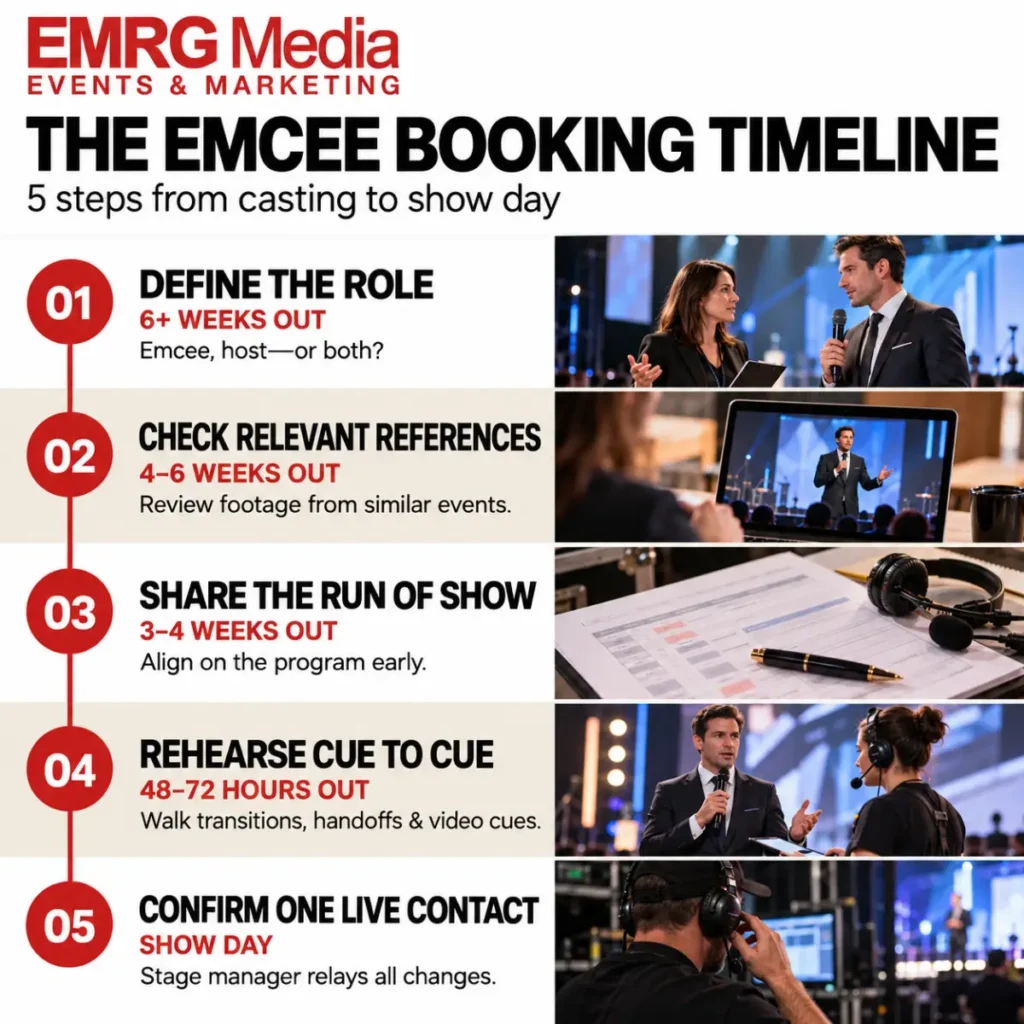 Securing the perfect talent requires a precise timeline, which is why EMRG Media follows this exact five-step process to cast and prepare emcees for high-stakes corporate events.
- Define the role scope (6+ weeks out). Decide whether you need an emcee, a host, or both. This single decision shapes your shortlist and your budget.
- Request references tied to your event format (4 to 6 weeks out). An emcee experienced in galas is not automatically strong at a product launch. Ask for footage from a similar room size and format.
- Share the draft run of show early (3 to 4 weeks out). The emcee needs the document before rehearsal, not on event day. This is non-negotiable for any program longer than 90 minutes.
- Schedule a cue-to-cue rehearsal (48 to 72 hours out). Walk every transition, mic handoff, and video cue with the emcee physically on site.
- Confirm a single point of contact for live changes. On show day, only the stage manager should be feeding real-time adjustments to the emcee’s earpiece.
How to Build an Emcee Script for a Corporate Event
An emcee script for a corporate event is not a word-for-word transcript. It is a cue-based framework with five fixed components:
- The open: A 60-to-90-second welcome that sets the tone and establishes the emcee’s authority in the room.
- Transitions: Short, 15-to-20-second bridges between segments, each tied to a specific cue in the run of show.
- Filler recovery lines: Pre-written material the emcee can deploy if a segment runs long or a technical cue fails.
- The close: A clear sign-off that cues the final lighting and music change.
- A contingency line: One flexible anecdote or talking point the emcee can stretch to 60 or 90 seconds without notes.
Writing these five sections before rehearsal, rather than improvising them live, is what separates a professional emcee script for a corporate event from a loose set of talking points.
Celebrity Host vs. Professional Emcee: When to Upgrade
A professional emcee runs the program. A celebrity host adds a layer of brand attention and press draw on top of it, and the two roles are frequently paired rather than used as substitutes for each other.
Factor | Professional Emcee | Celebrity Host |
Core function | Runs pacing and cues | Draws press, social buzz, brand prestige |
Booking lead time | 3 to 6 weeks | 3 to 6 months |
Rider complexity | Minimal | Travel, security, green room, usage rights |
Best fit | Internal programs, awards dinners | Press-facing launches, milestone galas |
Booking a recognizable name requires contract and rider negotiation, travel coordination, and on-site handling, a process covered in depth in our guide to celebrity wrangling in NYC. Many companies use a professional emcee to run the full program and bring in a celebrity for a shorter, scripted segment inside it.
How EMRG Media Runs Event MC and Host Staffing in NYC
EMRG Media has staffed and produced the emcee role for more than 1,100 events across New York City since 2001, from 50-guest executive dinners to 1,500-person conferences. Every booking runs through the same corporate event planning team that builds the run of show, so the emcee is never working from a document they saw for the first time on show day. According to the U.S. Bureau of Labor Statistics’ Entertainment and Sports Occupations data, demand for live event hosting and announcing roles has held steady as corporate programming continues to prioritize in-person engagement, a trend that matches what EMRG sees booking out Q4 dates across Manhattan.
Ready to book your event MC? Visit EMRG Media or call (212) 254-3700 to speak with a senior producer.
Frequently Asked Questions
An MC introduces speakers, manages transitions between program segments, and fills unscripted gaps caused by timing or technical delays. The role keeps a live program paced correctly against the run of show, protecting the event from dead air or awkward silences.
Build five fixed sections: an opening welcome, short transition lines, filler material for delays, a clear closing cue, and one flexible contingency story. Share the draft with your emcee at least three weeks before the event, not the morning of rehearsal.
Ask for footage from a similarly sized event, confirm their availability for a cue-to-cue rehearsal, clarify whether they’ll work from a written run of show, and ask how they’ve handled a live technical failure in the past.
Define whether you need an emcee or host, request references matched to your event format, share the run of show three to four weeks out, confirm a rehearsal 48 to 72 hours before the event, and designate one point of contact for live changes.
An emcee manages pacing and technical transitions from a tight script. A host drives audience engagement through longer, personality-led segments like games or crowd interaction. Many events use one person for both roles, depending on scope.
About Mario Stewart — Event Planning Expert & Author at EMRG Media
Your Trusted Source for NYC Event Planning, Production & Industry Insights
Mario Stewart is an event planning professional and published author at EMRG Media, a full-service event planning and production agency based in New York City. Mario shares valuable insights into corporate events, conferences, galas, product launches, and private celebrations, helping businesses and event organizers create successful and memorable experiences.
With over 1,100 events produced since 2001, EMRG Media has worked with leading organizations, including Google, JPMorgan, Netflix, and Condé Nast. Through EMRG Media’s educational content, Mario shares practical event planning tips, industry trends, and expert insights to help corporate planners make informed decisions, overcome challenges, and deliver exceptional events.