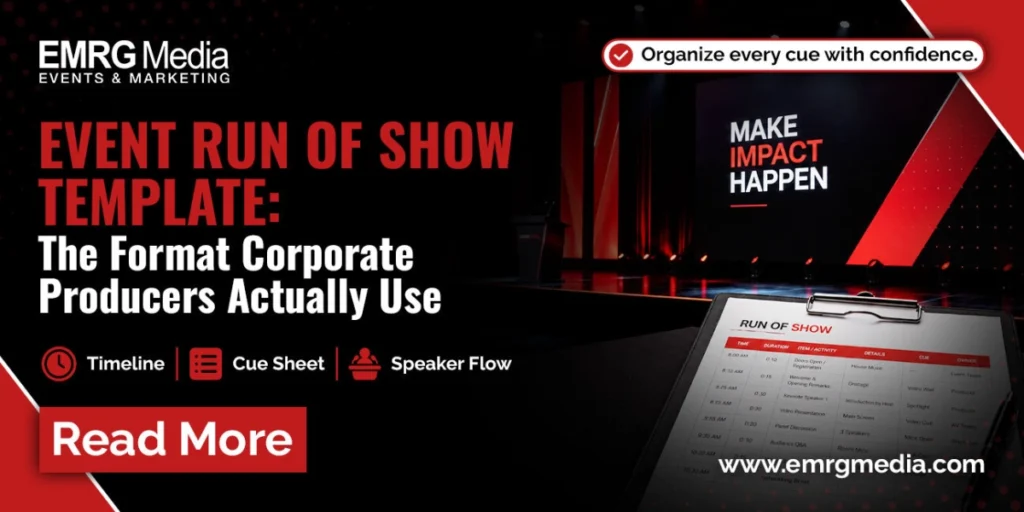

A Midtown hotel ballroom on 6th Avenue gives you a four-hour load-in window before doors open, and that window doesn’t move for a missing document.
In New York, the single page that keeps a 500-person product launch from falling apart inside that four-hour crunch is the event run of show template.
If you’re building one for the first time, the short answer is this, a working event run of show template runs on 5-to-15-minute increments, covers every segment from doors to close, and assigns a named owner to each line, not a department.
That’s the format. The rest of this guide breaks down why New York producers build it this way, what belongs on it, and where most teams get it wrong.
What a Run of Show Actually Tracks in a New York Production
A run of show is the minute-by-minute record of what happens on stage, backstage, and in the booth for the length of your program.
It’s not the same as an event timeline template excel sheet that tracks vendor load-in across a full week that’s a separate document, though the two connect at the load-in and rehearsal lines.
The show-flow document itself covers welcome remarks, speaker transitions, video cues, and the exact minute the bar closes for a toast.
In a Manhattan venue with a strict noise curfew, that last line item is the one that actually gets enforced.
The Column Format Corporate Producers Actually Use
Every reliable production run sheet used in New York follows the same five columns, regardless of venue:
- Time start and duration, not just a start time.
- Segment name.
- Who’s on stage or speaking.
- Technical cue lighting, audio, video.
- Owner of the person responsible, by name.
Here’s what that looks like on paper, using a sample opening block from a corporate awards dinner:
Time | Segment | Who’s On | Tech Cue | Owner |
6:30–6:45 PM | Doors open, seating | Ushers | House lights up, playlist live | Sarah (FOH) |
6:45–6:50 PM | Welcome remarks | CEO | Podium mic live, spot on | Marcus (SM) |
6:50–6:55 PM | Sponsor video | — | Video roll, house lights dim 50% | Dana (Video) |
6:55–7:10 PM | Keynote intro + speaker | Keynote speaker | Lav mic live, slides advance | Marcus (SM) |
This is the run of show example most production teams default to, because it survives last-minute change.
If a keynote runs four minutes long, whoever’s holding the document needs to see immediately what shifts downstream reception start time, vendor overtime, union crew breaks.
For any event running under IATSE or Teamsters crew rules at a Manhattan venue, that overtime line isn’t optional.
A late changeover that runs past a scheduled crew break can add four figures to your invoice before the night ends.
Turning a Blank Page Into a Working Document
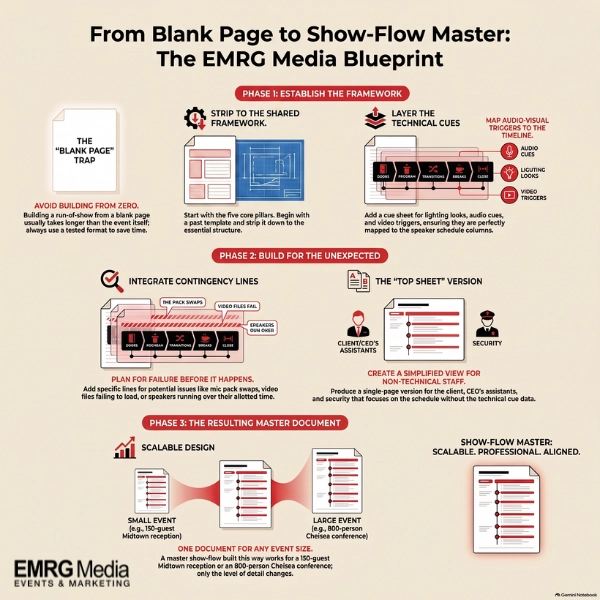
They pull a production schedule template from a past event and strip it down to a shared framework doors, program, transitions, breaks, close then layer in a cue sheet corporate program for AV lighting looks, audio cues, and video triggers mapped to the same time column as the speaking schedule.
From there, they add contingency lines for anything that’s failed before a mic pack swap, a video file that won’t load.
A speaker running long plus a single-page top sheet version for anyone not running technical cues the client, the CEO’s assistant, security at the door.
A show-flow master built this way holds up whether you’re running a 150-guest reception in Midtown or an 800-person hybrid conference in Chelsea. The document scales only the detail on each line changes.
Building your first run-of-show document from a blank page usually takes longer than producing the event itself. EMRG Media’s NYC Event Production team builds and calls the show from a tested format on every project reach out before your next event date locks in.
Who Actually Owns the Document on Show Day
This is where in-house teams get stuck, the planner typically drafts the first version during the event planning and management phase, since they hold the guest experience and client relationship.
But once rehearsal starts, ownership shifts. On show day, the person calling cues from the document is usually the stage manager or production lead, the same role covered in what is a stage manager not the planner.
The planner is managing the client and guests in the room. The stage manager is one page ahead of the live moment on headset, adjusting the event run of show template in real time as things shift.
How Precise the Timings Actually Need to Be
A common mistake is writing a run of a show in five-minute blocks and calling it finished, for the opening and close, that’s fine.
For transitions, a speaker walking off, a video starting, a band coming up, timings need to drop to 15-to-30-second increments.
This is closer to a minute by minute agenda than a loose schedule, and it’s the level of detail that prevents dead air on a stage where union load-out has a hard end time.
Key Takeaways
- A working event run of show template uses five columns time, segment, who's on, technical cue, and named owner.
- Ownership shifts from planner to stage manager once rehearsal begins.
- Transition points need 15-to-30-second timing, not five-minute blocks.
- New York venues with union crews or strict curfews turn a loose run of show into a real financial risk.
Why the Right Document Is Cheaper Than the Wrong One
A run of show isn’t paperwork, it’s the difference between a Midtown gala that closes on time and one that bleeds into overtime crew charges.
Producers who build this document well aren’t smarter, they’ve just run it enough times to know exactly where a program breaks. Get the format right once, and every event after it moves faster and costs less to fix.
Ready to stop rebuilding your event run of show template from scratch every event? Follow EMRG Media on Facebook for behind-the-scenes looks at how NYC’s top productions actually run, or reach out directly to have a producer build yours.

FAQs About Event Run of Show Template
What is an event run of show template?
A run of show is the minute-by-minute document listing every segment, speaker, and technical cue for a live program, from doors opening to final close. It’s the single reference every crew member, speaker, and planner follows during the event itself.
What should be included in an event run of show template?
It should list exact start times and durations, segment names, who’s on stage, technical cues for lighting/audio/video, and a named owner for each line. Contingency notes for known risks, like mic swaps or late speakers, belong on the same page.
Who owns the run of the show, the planner or the AV team?
The planner typically drafts it during pre-production, but ownership shifts to the stage manager or production lead once rehearsal begins. On show day, one person should hold final authority to avoid conflicting calls.