Guide to event liability insurance covering GL limits, host liquor liability, and additional insureds for NYC

Event Liability Insurance: GL Limits, Host Liquor and Additional Insureds

Anyone who’s tried booking a rooftop venue in Chelsea or a ballroom near Bryant Park in 2026 knows the drill: no COI, no keys. New York City venues now hand over contracts with insurance riders longer than the event itself, and organizers who skip this step get locked out days before doors open.

Event liability insurance typically runs on limits between $1 million per occurrence and $2 million aggregate for most mid-sized NYC gatherings, though the exact figure depends on guest count, alcohol service, and venue type.

If you’re planning anything from a Midtown corporate mixer to a Brooklyn warehouse launch party, understanding this coverage isn’t optional paperwork, it’s the difference between an event happening and a venue manager turning you away at the door.

Why NYC Event Organizers Can’t Skip Event Liability Insurance

New York venues face constant foot traffic, tight fire codes, and dense neighboring properties, which makes risk exposure higher than in most other markets. A slip on wet flooring at a Hudson Yards reception or a minor injury during a Queens outdoor festival can trigger claims that venues refuse to absorb alone.

That’s why nearly every commercial space in the five boroughs, from small SoHo galleries to large Javits Center-adjacent halls, requires proof of event liability insurance before signing a rental agreement. Without it, you simply don’t get access to the space.

Breaking Down the Coverage Limits Venues Actually Require

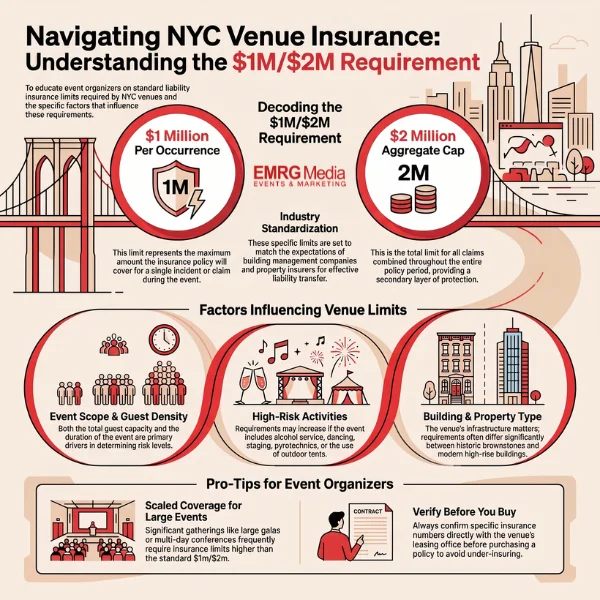
Most NYC venue contracts specify a $1m/$2m limits venue requirement, meaning $1 million covers a single incident and $2 million caps total claims across the policy period.

This isn’t arbitrary, it matches what property insurers and building management companies expect for liability transfer.

Here’s what typically factors into the limit a venue demands:

  • Guest capacity and event duration.
  • Whether alcohol is served.
  • Type of activity (dancing, staging, pyrotechnics, outdoor tents).
  • Building type (historic brownstone vs. modern high-rise).
Infographic explaining event liability insurance limits, coverage requirements, and risk factors for NYC venues

Larger galas or multi-day conferences sometimes require even higher limits, so always confirm numbers directly with the venue’s leasing office before purchasing a policy.

Host Liquor Liability in NYC, When It Becomes Mandatory

If alcohol touches your guest list, standard event liability insurance usually isn’t enough on its own. Host liquor liability in NYC coverage protects organizers if a guest becomes intoxicated at the event and causes injury or property damage afterward, a scenario NYC venues take seriously given the city’s dense nightlife corridors.

This add-on typically applies when:

  • The host is providing alcohol free of charge (not a licensed bar selling drinks).
  • The event includes an open bar or drink tickets.
  • A private venue requires proof of liquor coverage as a lease condition.

It’s worth noting that host liquor liability only applies when alcohol is complimentary. If you’re running a cash bar or otherwise selling drinks directly to guests, you’ll need standard Liquor Liability coverage instead, since that shifts you into the role of an alcohol vendor rather than a host.

Skipping the correct endorsement is one of the most common reasons NYC event certificates get rejected at final review.

If you want to avoid last-minute insurance scrambles, it helps to have an experienced partner. The Event Planning And Management team at EMRG Media helps NYC organizers coordinate coverage timelines alongside vendor contracts, so nothing holds up your event date.

Additional Insured Endorsements, Who Actually Needs One

An additional insured endorsement adds the venue, building owner, or sometimes the property management company onto your policy, extending protection to them if a claim arises from your event. NYC landlords request this constantly because it shields their own liability coverage from being the first line of defense.

Common parties requesting additional insured status include:

  • The venue itself.
  • Building ownership groups.
  • Event production companies.
  • Catering or bar service vendors.

Certificates without this endorsement are one of the top reasons NYC venue coordinators send contracts back for revision.

Corporate Indemnity Clauses and Subrogation Waivers Explained

Corporate bookings in NYC often include a corporate event indemnity clause, which legally shifts responsibility for certain damages back to the organizer rather than the venue. Paired with this, many contracts also require a waiver of subrogation, preventing your insurer from later pursuing the venue’s insurer to recover claim costs.

Both clauses protect the venue’s long-term relationship with their own carrier, and NYC properties increasingly refuse bookings without them signed and attached to the certificate.

General Liability for Events, What NYC Venues Check First

Before approving any contract, NYC venue managers scan the Certificate of Insurance (COI) for a few non-negotiables tied to general liability for events. Reviewers typically look for:

  • Correct legal entity name matching the contract.
  • Effective dates covering the full event window, including load-in and load-out.
  • Confirmed limits matching the $1m/$2m requirement.
  • Additional insured language naming the venue specifically.

Missing even one of these details on the COI can delay approval by days, a serious problem in a market where venue calendars book out months in advance.

Not sure which clauses your target venue actually enforces? The Venue Selection And Booking specialists at EMRG Media can review contract language before you sign, catching insurance gaps early.

Confirming Requirements Before You Sign Anything

Every NYC borough handles permitting and licensing slightly differently, and insurance requirements often tie directly into local licensing rules. Before finalizing any contract, check current NYC Venue Licensing guidance, since some venue types (rooftops, outdoor parks, historic landmarks) carry additional insurance stipulations beyond the standard COI.

Key Takeaways

Getting Your Event Approved Without the Last-Minute Scramble

Securing the right event liability insurance isn’t just about checking a box for the venue, it’s what keeps your event on schedule and your organization protected if something goes wrong. NYC’s venue market moves fast, and contracts with unclear or incomplete insurance terms are the number one reason bookings fall through weeks before the event date.

Getting ahead of COI requirements, endorsement language, and liquor liability questions early gives you room to negotiate rather than react.

When you’re ready for a second set of eyes on your event contract, contact EMRG Media to review venue requirements and coordinate your insurance timeline alongside your full event plan.

For more planning resources, visit EMRG Media directly.

Further Reading on NYC Event Compliance

For official city guidelines on permitting, outdoor staging, and municipal insurance mandates, you can review the current requirements published by the NYC Mayor’s Office of Citywide Event Coordination and Management (CECM).

Large NYC corporate event protected by event liability insurance, planned by EMRG Media event professionals

FAQs About Event Liability Insurance

How much liability insurance does an event need?

Most NYC venues require $1 million per occurrence and $2 million aggregate, though larger events or those serving alcohol may need higher limits depending on guest count and venue type.

Host liquor liability covers injury or damage caused by an intoxicated guest when alcohol is served free of charge. A cash bar requires standard Liquor Liability instead.

It extends your policy’s protection to the venue or building owner, shielding them from claims tied to your event. Most NYC contracts won’t approve a COI without this endorsement included.