
Rockefeller Center’s tree lighting alone pulls in over 125,000 visitors to Midtown each December, and that same six-week stretch pushes New York event contract volume to its annual peak. Between Thanksgiving and New Year’s Eve, Manhattan venues juggle back-to-back holiday parties, corporate galas, and year-end client dinners, often with only hours between load-outs.
When a venue coordinator slides an agreement across the table during this rush, the pressure to sign fast and hold your date can override the instinct to actually read it.
Before you commit to any Q4 date in New York City, your event contract needs five things settled in writing: the deposit schedule, the food and beverage minimum, the cancellation terms, the indemnification language, and the force majeure provisions.
Skipping any one of these can turn a routine holiday party into a costly dispute. This guide walks through exactly what to confirm before your signature goes on the page.
Why Q4 Event Contracts in NYC Carry Extra Risk
New York’s Q4 calendar compresses months of demand into eight weeks. Between early November and December 31, venues from Midtown ballrooms to Brooklyn lofts run at or near capacity, and that scarcity changes how the agreement gets negotiated.
- Compressed booking windows: Many Manhattan venues confirm Q4 holiday dates 6 to 9 months ahead, leaving little room to renegotiate terms once a hold becomes a signed contract.
- Weather-driven risk: December averages under five hours of daily sunlight and regular snow, making clear language critical for any outdoor extension or tented rooftop.
- Overlapping bookings: Back-to-back events mean less flexibility on load-in changes, so the document should lock exact hours, not “TBD” windows.
- Holiday staffing surcharges: Many venues add overtime or holiday labor rates directly into the event contract that never appear on the initial proposal.
The Core Clauses Every NYC Event Contract Must Address
A signed event contract is only as strong as its weakest clause. Here are the sections that deserve line-by-line attention before your Q4 date is locked.
Deposit and Payment Schedule
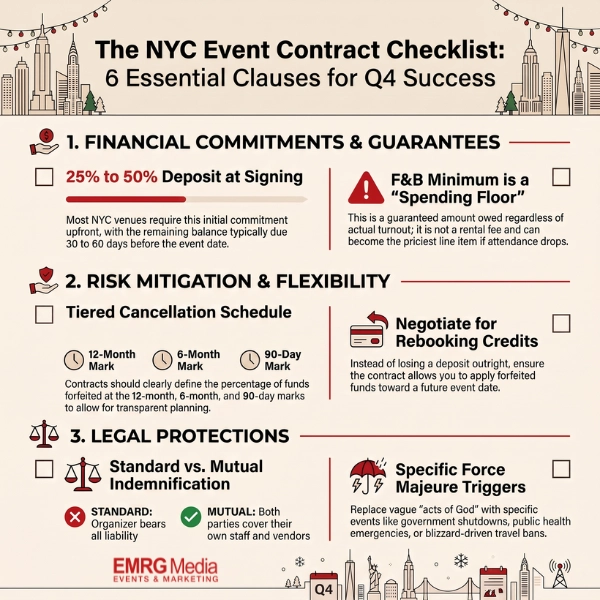
Most NYC venues require 25% to 50% of total contracted value at signing, with the balance due 30 to 60 days before the event. Confirm the exact deposit and payment schedule in writing, including what happens if a payment arrives late during the holiday crunch.
Food and Beverage Minimum
A food and beverage minimum is a spending floor, not a rental fee, and most agreements treat it as a guarantee owed regardless of turnout.
A December client dinner with a sizable minimum for 60 guests can quietly become the priciest line item if attendance drops due to a snowstorm.
Cancellation Schedule
Ask the venue to spell out the cancellation schedule in writing: what percentage is forfeited at 12 months, six months, and 90 days out. A well-drafted event contract lets you rebook a forfeited deposit toward a future date instead of losing it outright.
Indemnification Language
Standard indemnification clause events language places liability for property damage and injury entirely on the organizer. Push for mutual indemnification so each party covers its own staff and vendors.
Force Majeure Provisions
A force majeure event contract clause should name specific triggers, government shutdowns, declared public health emergencies, and severe weather, rather than vague “acts of God” phrasing. Confirm whether a blizzard-driven travel ban qualifies before you need to invoke it.
Venue Contract Clauses That Shift By NYC Neighborhood
Venue contract clauses rarely read the same twice across New York City, because each neighborhood layers its own compliance rules onto the standard template.
- Tribeca venues require written sound mitigation documentation before the community board signs off, a clause that belongs inside the agreement, not a side email.
- Hudson Yards properties expect DOT and Parks permit applications 10 to 12 weeks ahead, so your timeline should build in that lead time.
- Midtown flagship venues near Rockefeller Center typically require $2 million in general liability coverage as a signing condition.
- Brooklyn waterfront rooftops often need Temporary Place of Assembly certification confirmed before the contract is finalized.
For a full neighborhood breakdown of capacity, cost, and compliance, see our NYC Corporate Event Venues By Type guide.
Sourcing a Q4 venue on a tight deadline? Our Venue Selection And Booking team can fast-track a contract-ready shortlist before the season fills up.
What an Unread Event Contract Costs You in December
Skipping a clause review during Q4 rarely shows up until the final invoice lands. A missed overtime rate, a vague guest-count adjustment window, or an F&B minimum treated as a guarantee instead of a floor can add real cost to a single holiday party.
- A missing guest-count adjustment deadline can lock you into paying for no-shows.
- An unclear noise curfew clause can trigger $500 to $1,500 in overtime penalties per half hour.
- A one-sided indemnification clause can leave your company covering a vendor’s mistake.
Reviewing dense contract language is easier with a second set of eyes; our Corporate Event Planner team reviews these terms as standard practice on every engagement.
How EMRG Media Handles Event Contract Review
EMRG Media reviews every material clause, from deposit terms to cancellation thresholds, before a client signs. We negotiate on your behalf so the terms protect your budget as thoroughly as the venue’s legal team protects theirs.
Explore EMRG Media’s full range of New York event planning services before your next Q4 date goes to contract.
Key Takeaways
- Every NYC event contract should settle five clauses: deposit schedule, F&B minimum, cancellation terms, indemnification, and force majeure.
- Q4 dates carry extra risk from compressed booking windows, winter weather, and holiday labor surcharges.
- Venue contract clauses differ by neighborhood, from Tribeca sound mitigation to Hudson Yards permit lead times.
- An unread agreement can turn a routine holiday party into a costly dispute.
Your Signature Is the Last Line of Defense
A Q4 date in New York City is hard to secure and even harder to walk back once the paperwork is signed. Treat the clause review as part of the booking process, not an afterthought squeezed in after the venue tour.
The organizers who read the fine print before December are the ones who aren’t renegotiating in January.
Ready to lock in your Q4 date without the contract risk? Contact EMRG Media today for a full event contract review and a fully loaded proposal built for your event.
External Resources
For further reading on standard contract law and legal definitions:
To understand the precise legal boundaries of severe weather and emergency cancellations, review Cornell Law School’s Legal Information Institute guide to Force Majeure clauses. Ensure your contract’s wording aligns with these standard legal definitions to fully protect your organization.

FAQs About Event Contract
What should be in an event contract?
An event contract should include the deposit and payment schedule, food and beverage minimum, cancellation terms, indemnification language, and force majeure provisions. It should also confirm guest-count adjustment deadlines, insurance requirements, and exact load-in and load-out hours.
What is a force majeure clause in an event contract?
A force majeure clause lists specific triggers, government shutdowns, declared emergencies, or severe weather, that excuse both parties from performance. Confirm named triggers in writing rather than accepting vague “acts of God” language before signing.
How do cancellation penalties usually work?
Cancellation penalties typically scale with timing: forfeiture of the first deposit 12 months out, 50 to 75 percent within six months, and 100 percent inside 90 days. Always negotiate these thresholds before signing.