
A free coffee sample handed to someone walking down Spring Street looks effortless. It isn’t. Experiential sampling in New York City sits directly at the intersection of marketing strategy and municipal law. The gap between a sampling moment that runs smoothly and one that gets shut down by a city inspector often comes down to a handful of specific rules that most marketing teams never check until it’s too late.
This resource walks through what the City of New York actually requires for a product distribution program, what each permit tier costs in 2026, and how to build a timeline that protects your launch date. We will break down exactly when a permit is triggered, the surprising difference between walking and stationary distribution, and how to coordinate with multiple city agencies.
Navigating NYC’s bureaucracy doesn’t have to stall your launch. Let EMRG Media’s expert team handle the permits and production so you can focus on the product. Contact EMRG Media today to make your next activation unforgettable.
Corporate Event Planner Inquiry
What Counts as "Experiential Sampling" vs. a Standard Brand Activation
Not every experiential sampling moment carries the same legal weight, and the distinction hinges on one factor: whether anything touches the ground.
The Legal Line: Handing Out vs. Setting Up
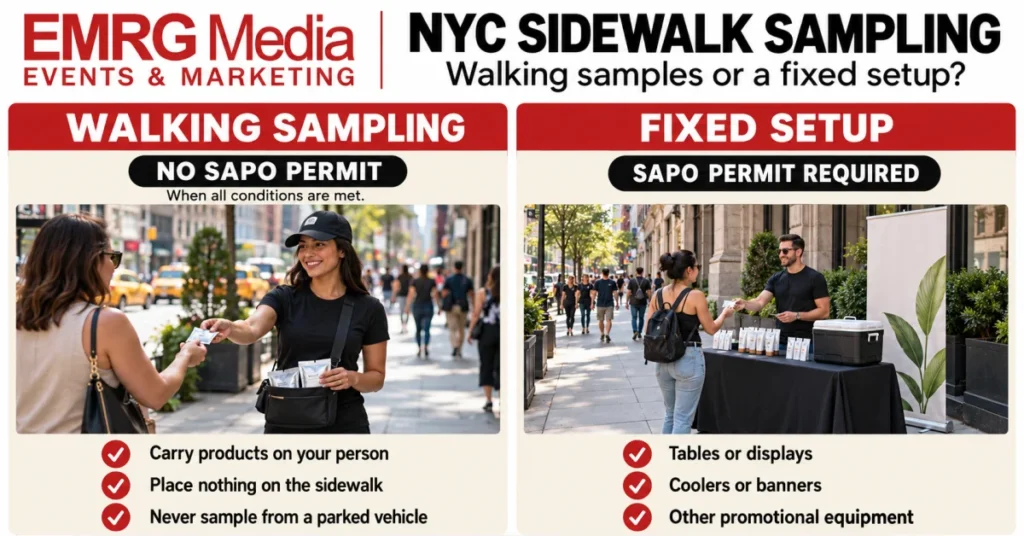
According to New York City’s own Street Activity Permit Office (SAPO), a product sampling program needs no permit at all if the items stay on the staffer’s person and nothing, no table, no cooler, no branded bag rack, touches the sidewalk or street. The moment a single prop lands on public property, the activation legally becomes a Street Event, and a different set of rules applies entirely.
Why This Distinction Changes Your Permit Requirement
A four-person team walking a three-block radius handing out protein bars from branded tote bags needs zero city paperwork. The same team standing behind a six-foot table with the same bars needs a Street Event permit, insurance documentation, and a minimum 10-day filing window. This single structural choice is the biggest cost and timeline variable in any sampling campaign, and it’s one most in-house teams discover only after a vendor contract is already signed. This is also the core difference between pure experiential sampling and broader brand activation events in NYC, which typically include signage, structures, or staffed booths that trigger permitting by default.
If your setup crosses this structural threshold, reviewing our comprehensive guide on NYC Corporate Event Permitting: Avoid 2026 Shutdown is a critical next step to ensure your campaign remains compliant.
Do You Need a Permit to Sample Products on an NYC Sidewalk?
Here’s the direct answer, confirmed by the city’s own permitting office: no permit is required for walking sampling, provided three conditions are met simultaneously.
Walking Sampling: The No-Permit Scenario
Staff must carry the product on their person, nothing can be placed on the sidewalk or curb lane, and sampling cannot be conducted from the back of a parked vehicle, which NYC explicitly prohibits regardless of permit status. This is the fastest, lowest-cost way to run a product sampling event in high-traffic corridors like Fifth Avenue or the Flatiron District.
The Moment a Table or Setup Triggers SAPO Jurisdiction
Introducing any physical element like a promotional display, tent, cooler, or banner instantly shifts your activation into the Street Event category. Once this happens, you must obtain official authorization from the municipal agency that manages public street regulations. This strict rule holds true even if you only set up one basic folding table on a quiet block in SoHo. New York City bases these requirements purely on the presence of physical objects rather than the number of expected attendees or the overall square footage of your footprint.
NYC Street Activity Permit Tiers for Sampling Campaigns: Cost & Lead Time
Once a sampling activation involves any fixed setup, it falls into one of five SAPO permit tiers. Each carries its own fee, lead time, and trigger condition, and misreading which tier applies is the most common budgeting mistake brands make.
(Note: The fees listed below represent the standard commercial rates for 2026; civic or charitable events may be subject to a discounted fee rate.)
Permit Tier | Trigger | 2026 Cost | Lead Time | Best For |
Production Event (curb/sidewalk only) | Small branded footprint, no street closure | $290/day (capped at $1,000 past 3 days) | 10 days | Single-table sampling station |
Production Event (curb + sidewalk) | Footprint spans both zones | $700/day | 10 days | Mobile sampling with a staging table |
Street Event, Small | Minor pedestrian impact, light promotional setup | $3,100 flat | 14 days | Branded cart or small kiosk |
Street Event, Medium | Tent, canopy, or structure needing DOB coordination | $11,000 per location/day | 30 days | Multi-staffer sampling booth |
Street Event, Large | Significant pedestrian/vehicular impact | $25,000 per location/day | 45 days | Multi-day sampling activation |
Street Event, Extra Large | Multiple locations or full plaza use | Up to $66,000 per location/day | Up to 60 days | Citywide sampling campaign |
Every application also carries a flat $25 non-refundable processing fee regardless of tier, per the NYC Street Activity Permit Office’s official permitting guidelines.
Key takeaway: a one-table sampling event in a curb lane can cost as little as $290 for a single day, while the same activation scaled to a full city block with a tent jumps to $11,000 or more. The structure of your setup, not the number of samples distributed, determines your fee.
Mobile Truck & Mobile Unit Sampling Activations in NYC
A branded sampling truck adds a layer most teams don’t anticipate: parking and DOT routing coordination sit on top of whatever SAPO permit applies to the sampling activity itself. A truck parked at a fixed curb location for a multi-hour sampling event typically needs a Production Event or Street Event permit matched to its footprint, plus a separate conversation with NYC DOT about loading zone use, since standard commercial parking rules still apply even when a city event permit is active. Routing a truck between multiple NYC neighborhoods in one day multiplies this coordination, since each stop may fall under a different precinct’s enforcement discretion.
Generators, Sound & Food: Do They Need Separate Permits?
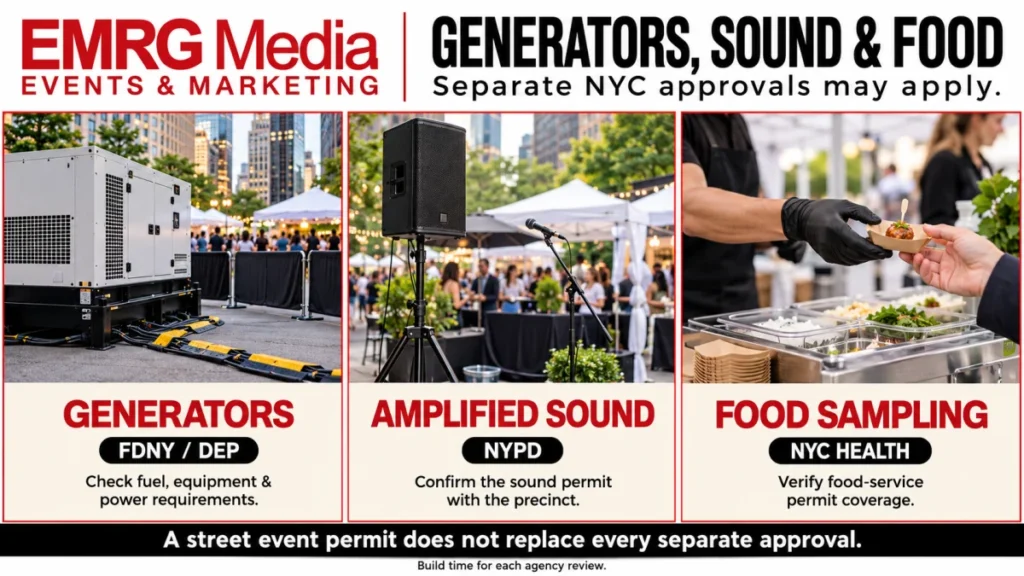 Distributing food or beverages often adds layers of regulatory complexity to your campaign. If you use a generator to keep a cold sampling station running, you will generally need clearance from the FDNY once the power output surpasses a specific limit. Furthermore, using any form of amplified audio requires you to secure a distinct sound permit issued by the local police precinct. This authorization from the NYPD is a completely separate requirement from your standard SAPO street clearance, applying even to compact speakers playing background music.
Finally, serving items that are prepped or portioned at the event location mandates a Temporary Food Service Establishment Permit from the NYC Department of Health. It is standard practice to juggle approvals from three different city agencies for a single activation. Seasoned experiential marketing events NYC producers always allocate dedicated buffer time to secure each specific authorization instead of expecting the primary street event permit to blanket the entire operation.
Where Sampling Campaigns Perform Best Across NYC Neighborhoods
SoHo & the Flatiron District remain the highest-traffic corridors for walking sampling, with foot traffic density around Prince Street and the Flatiron Plaza pedestrian islands supporting high-volume, no-permit distribution during midday hours.
Hudson Yards & the High Line offer premium visibility but carry heavier permitting weight. Any fixed sampling structure near the Vessel or along the High Line’s elevated walkway typically needs Parks Department coordination layered onto a Street Event permit, with a submission window of 10 to 12 weeks during spring demand season.
Williamsburg & DUMBO draw weekend foot traffic through markets like Smorgasburg, where sampling programs benefit from built-in audience density, though vendors still need to confirm whether a market’s existing permit covers additional branded sampling activity or whether a separate filing is required.
A Realistic NYC Sampling Case Study
Consider a cold brew coffee brand launching a three-day sampling campaign in SoHo during the October product-sampling surge, a seasonal window when search demand for sampling activations climbs roughly 56% above the yearly average as holiday retail planning accelerates.
The brand sets up a single six-foot table on the curb lane outside a Spring Street retail partner, which immediately triggers Production Event classification rather than walking sampling. The team files for a curb-lane-only permit at $290 per day, totaling $870 for three days plus the $25 processing fee, submitted 10 days ahead of the activation per SAPO’s standard lead time. Four brand ambassadors staff the table in rotating two-hour shifts, each handling roughly 60 to 80 sample interactions per hour.
Across a six-hour daily window, that’s approximately 1,440 total samples distributed over the three-day run, with a QR code on each cup driving app downloads tracked against a pre-set conversion goal. Total permit cost: under $900. Total samples distributed: over 1,400. That ratio is only possible because the brand correctly identified its tier before filing, rather than defaulting to a more expensive Street Event permit it didn’t actually need.
How EMRG Media Runs Sampling Programs Inside a Brand Activation
A sampling program rarely stands alone. It typically functions as one component inside a larger brand activation strategy, paired with digital promotion, staffing, and measurement frameworks. EMRG Media’s in-house team handles the full stack: identifying the correct permit tier before a budget is finalized, staffing trained brand ambassadors who understand sampling pace and compliance boundaries, and coordinating FDNY, DOH, and NYPD sign-offs when a sampling day involves food, sound, or power.
When your sampling initiative grows from a standalone street activation into a larger, immersive footprint, a unified strategy is essential. By exploring our comprehensive approach to Experiential Marketing in NYC: Brand Events That Convert, you can see exactly how product distribution, expert staffing, and compelling brand storytelling seamlessly integrate under the direction of a single production team.
Frequently Asked Questions
No, as long as the samples stay on the staffer’s body and nothing (no table, cooler, or bag rack) is placed on the sidewalk or curb. Add any fixed object, and the activity becomes a permitted Street Event under NYC’s Street Activity Permit Office.
Whenever you place a promotional structure on public property, you must secure either a Production Event or a Street Event clearance through the Street Activity Permit Office. Your specific classification is dictated by the physical space your activation occupies. Daily rates start at a baseline of $290 for a basic single-table setup and can reach up to $66,000 for massive operations spanning multiple city locations.
A baseline lead time of ten days is mandatory for compact production setups. Standard street events ranging in size from small to large necessitate at least a thirty-day advance filing. Massive campaigns utilizing various public plazas or citywide spots demand up to a sixty-day preparation window. Therefore, it is crucial to submit your paperwork the moment your physical layout is finalized.
Yes, but a mobile truck needs both a street-level permit matching its footprint and separate NYC DOT parking or loading zone coordination. Sampling directly from the back of a parked vehicle is prohibited citywide regardless of permit status.
Yes. You must secure FDNY clearance for generators exceeding baseline wattage limits, and any amplified audio mandates a distinct sound permit issued by the local police precinct. Additionally, if your event involves preparing or dividing food on location, you are required to obtain a temporary food service authorization directly from local city health officials.
Your Next Step Before Booking a Sampling Campaign
The difference between an experiential sampling activation that runs smoothly and one that gets shut down mid-day almost always comes down to one decision made weeks earlier: correctly identifying whether your setup qualifies as permit-free walking sampling or a structured Street Event. Get that call wrong, and you either overpay for a permit tier you did not need or underfile for one you did.
If you’re planning a product sampling agency partnership or building a sampling event into a broader NYC activation calendar, our team can audit your footprint before you file a single application. Visit our team on Google Maps or reach out directly EMRG Media, and let’s make sure your next sampling campaign launches on time, on budget, and fully compliant.
About Mario Stewart — Event Planning Expert & Author at EMRG Media
Your Trusted Source for NYC Event Planning, Production & Industry Insights
Mario Stewart is an event planning professional and published author at EMRG Media, a full-service event planning and production agency based in New York City. Mario shares valuable insights into corporate events, conferences, galas, product launches, and private celebrations, helping businesses and event organizers create successful and memorable experiences.
With over 1,100 events produced since 2001, EMRG Media has worked with leading organizations, including Google, JPMorgan, Netflix, and Condé Nast. Through EMRG Media’s educational content, Mario shares practical event planning tips, industry trends, and expert insights to help corporate planners make informed decisions, overcome challenges, and deliver exceptional events.