
The 2026 NYC Event Insurance Trap: Secure Your Venue and Protect Your Budget
Event insurance is the exact line item that dictates whether your venue contract gets signed or rejected. If you are securing a Manhattan ballroom, a Brooklyn warehouse, or a rooftop space, legal teams require proof of coverage before confirming your date.
Without it, property managers will legally block your load-in access. Event planners immediately need to know what this policy covers and what it costs. A short-term liability policy protects you against bodily injury and property damage claims. Standard 2026 NYC premiums range from $150 to $2,000, depending heavily on guest headcount and alcohol service.
Whether you are a corporate director managing a summit or a homeowner transforming a private estate for a lavish celebration, navigating strict COI limits and vendor compliance is stressful. Stop chasing paperwork and risking massive financial liability. Let our seasoned production experts seamlessly manage every compliance hurdle. Request a customized 2026 event proposal from EMRG Media today to lock in your fully protected, unforgettable NYC experience.
Corporate Event Planner Inquiry
Why Manhattan Venues Demand Event Insurance Before Handing Over the Keys
Event insurance is a highly specialized, short-term liability policy strictly designed for a single gathering. It explicitly covers property damage, bodily injury, and any related claims that might arise during the setup, execution, and breakdown phases of your activation.
Many planners mistakenly assume their standard corporate coverage is enough. However, a standard commercial general liability (CGL) policy only protects your day-to-day business operations. It does not cover the unique risks of a one-night activation hosted at a third-party property.
Here are the critical requirements you must meet before booking an NYC venue:
- Strict Carrier Compliance: Every policy must be issued by a carrier fully licensed by the New York State Department of Financial Services, the regulatory body overseeing liability products in the state.
- Additional Insured Clauses: Nearly all New York City venue leases include a strict insurance rider. You must provide proof of liability coverage that specifically names both the property owner and the management company as additional insureds.
- Zero Exceptions on Event Day: Building management will legally deny your load-in access if this exact documentation is missing, regardless of your production schedule.
Do I Need Event Insurance for a Corporate Event in NYC?
Yes. Whether hosting 40 executives in a private dining room or 400 guests in a Hudson Yards ballroom, nearly every venue lease and permit application in New York City demands proof of event insurance before granting access.
When It Is Contractually Mandatory
A Manhattan hotel or loft operator won’t release freight elevator access or confirm your final booking without a Certificate of Insurance (COI) naming the building owner and management company as additional insureds. Furthermore, any outdoor activations tied to a nyc corporate event permitting application carry the exact same requirement. City agencies, like SAPO or the Parks Department, strictly mandate a minimum of $1 million in liability coverage, requiring the City of New York to be listed as an additional insured.
When It Is Optional but Essential
Private events on your company’s leased office floor may not trigger a venue rider. Even so, a single injury claim from a vendor can cost significantly more than a short-term premium. Securing coverage is standard among experienced planners.
One Day Event Insurance: Coverage for a Single Night Activation
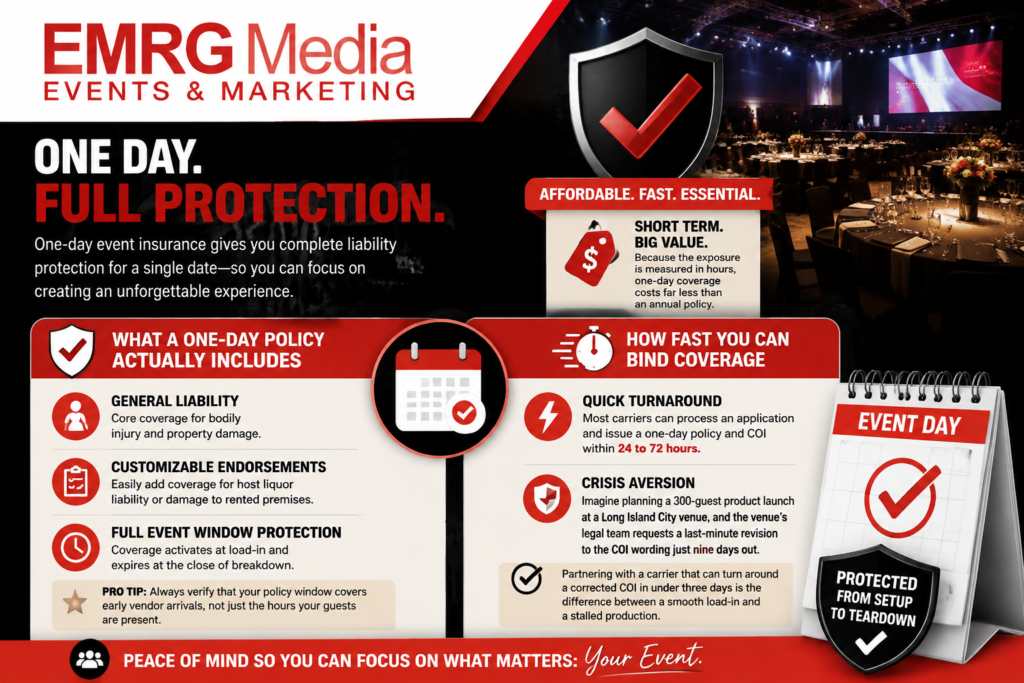 One-day event insurance is a short-term liability policy designed specifically for a single date. Because the risk exposure is measured in hours rather than months, it typically costs significantly less than a standard annual CGL policy.
What a One-Day Policy Actually Includes
A standard one-day policy protects you from the moment setup begins until the last vendor leaves. Key features include:
- General Liability: Core coverage for bodily injury and property damage.
- Customizable Endorsements: The ability to easily add coverage for host liquor liability or damage to the rented premises.
- Full Event Window Protection: Coverage activates at load-in and expires at the close of breakdown. Pro Tip: Always verify that your policy window covers early vendor arrivals, not just the hours your guests are present.
How Fast You Can Bind Coverage Before Load-In
Securing insurance doesn’t have to be a bottleneck in your planning timeline:
- Quick Turnaround: Most insurance carriers can process an application and issue a one-day policy and COI within 24 to 72 hours.
- Crisis Aversion: Imagine planning a 300-guest product launch at a Long Island City venue, and the venue’s legal team requests a last-minute revision to the COI wording just nine days out. Partnering with a carrier capable of turning around a corrected COI in under three days is the difference between a smooth load-in and a stalled production.
Certificate of Insurance for Events: What It Proves and Who Must Be Named
A certificate of insurance (COI) is a one-page document issued by your insurer that summarizes your policy’s coverage types, limits, and effective dates. It serves as your official proof of coverage—not the full policy itself. Venues, permit agencies, and vendors will each require their own copy before moving forward with your production.
Reading a COI Line by Line Before You File It
Before submitting your document, always verify these three critical fields:
- The Named Insured: This should explicitly list your company.
- The Certificate Holder: The specific venue or agency requesting the document.
- The Policy Period: This timeframe must cover your entire event window, strictly including early setup and final breakdown hours. A COI with an incorrect date range is functionally useless to a property manager.
The Additional Insured Endorsement
This specific line item is what actually protects the landlord. An additional insured endorsement extends your policy’s protection to a third party—typically the venue owner and the management company. If a claim arises from your event, it is defended under your policy rather than theirs. Cornell Law School’s Legal Information Institute defines this as a standard contractual mechanism for shifting liability exposure, and most Manhattan properties will outright refuse to finalize a booking without it.
General Liability Limits NYC Venues Require
Standard general liability limits venue requires in New York City run $1 million per occurrence and $2 million aggregate for most mid-size properties. Premium Midtown and Hudson Yards venues frequently raise that floor to $2 million per occurrence and $5 million aggregate, with the venue named as an additional insured on the policy.
Venue Type | Typical Per-Occurrence | Typical Aggregate | Additional Insured Required |
Brooklyn warehouse or DUMBO loft | $1 million | $2 million | Yes |
Standard Midtown hotel ballroom | $1 million | $2 million | Yes |
High-profile Midtown or Hudson Yards venue | $2 million | $5 million | Yes, often with higher named limits |
Outdoor activation (DOT or Parks permit area) | $1 million | $2 million | Yes, city agency may also require naming |
Per Occurrence vs. Aggregate, Why the Difference Matters at Renewal
Per-occurrence caps what a single claim can pay. Aggregate caps the total payout across every claim during the policy period. On a one-day policy, this distinction functionally applies to a single date, but on an annual CGL policy running multiple events, a heavy claim early in the year can erode the aggregate available for events later that same term.
Host Liquor Liability: Insuring Alcohol Service at Your Event
Host liquor liability covers claims arising from alcohol served at your event when your company, not a licensed caterer or bar vendor, is technically the one serving it. This applies most often to open bar receptions where staff pour drinks under your event’s name rather than a licensed vendor’s liquor license.
Host Liquor Liability vs. a Licensed Caterer’s Own Policy
If a licensed catering company with its own SLA catering authorization is pouring and serving, their own liquor liability policy typically covers the exposure, and you should request their COI to confirm it. If your own staff, or staff hired directly rather than through a licensed vendor, are serving, host liquor liability under your event policy is the coverage that applies instead.
Event Vendor Insurance: Why Your Caterer, AV Crew, and Florist Each Need Independent Coverage
Event vendor insurance is separate coverage that every vendor working your event, including caterers, AV crews, florists, and entertainment acts, must carry independently. A single uninsured vendor creates liability exposure that flows directly back to your company, even when your own event policy is fully in place.
Collecting and Verifying Vendor COIs Before Move-In Day
Request a COI from every vendor at contract signing, not the week of the event, and confirm each one lists your company and the venue as additional insureds where applicable. Our NYC Event Compliance guide covers the full vendor verification workflow we run on every engagement.
Does the Venue's Own Policy Cover My Company's Event?
No. A venue’s baseline insurance policy is strictly designed to protect the landlord and property management company—not your organization, your guests, or your third-party vendors.
To understand the gap in coverage, it helps to look at exactly what each policy is built to do:
- The Venue’s Policy: This protects the building owner and management. It strictly covers the year-round physical property, structural maintenance, and baseline building operations.
- Your Event Policy: This protects your company and the event host. It explicitly covers accidental guest injuries, venue property damage, and vendor mishaps that occur during your specific setup, run, and breakdown window.
Even when booking a location with an active NYC venue licensing file and a confirmed SLA liquor license, building management will legally require your company to hold an independent policy naming them as an additional insured before granting access on event day.
How Much Does Event Insurance Cost for a NYC Corporate Event?
One day event insurance for a standard corporate event in New York City typically runs $150 to $500 for a $1 million/$2 million general liability policy, depending on guest count, venue type, and whether alcohol is served. Adding host liquor liability typically adds $50 to $150 to that premium. Please note that these figures are estimated baselines provided for general planning purposes only. Final premiums will vary based on your specific event details, chosen carrier, and current market rates.
Event Profile | Estimated Premium |
Under 100 guests, no alcohol | $150 to $250 |
100 to 300 guests, alcohol served | $300 to $600 |
300+ guests, outdoor or permitted component | $750 to $2,000 |
Larger productions with elevated limits, outdoor components, or structural builds tied to a permit filing sit at the top of that range.
How EMRG Media Manages Event Insurance Compliance So You Never Chase a COI
At EMRG Media, insurance verification is built into our planning process from the first discovery call, not added after the venue contract is signed. Our team requests, reviews, and files COIs for every vendor, confirms additional insured endorsements are correctly worded, and cross-checks general liability limits against each venue’s specific rider before your event date is locked in. This is the same discipline behind our full event planning and management process across all five boroughs.
Confirm our track record directly through our Google Business Profile, or call us now to start with an insurance audit of your upcoming event.
Frequently Asked Questions
The event host, typically your company, purchases and holds the event liability policy. Venues require proof of coverage before granting access but do not provide it themselves. Full-service planners often include the premium within the overall production budget.
Yes. Outdoor activations tied to a DOT or Parks permit require the same event liability coverage as an indoor venue, often with the issuing city agency added as an additional insured. Confirm this requirement before filing your permit application.
Event liability insurance is a short-term policy written for a single date and location. Your company’s general business policy covers ongoing operations year-round and rarely extends automatically to a one-night activation at a third-party venue.
Most carriers can issue a policy and COI within 24 to 72 hours, but request it two to three weeks out. This gives the venue time to review the document and flag any wording corrections before your event date.
No. Standard event liability insurance covers bodily injury and property damage claims, not cancellation losses. Event cancellation insurance is a separate policy type and must be purchased independently if weather or vendor risk is a concern.
Secure Your NYC Event with Complete Compliance Confidence
Navigating NYC event insurance requirements shouldn’t stand between you and a flawless corporate event. From deciphering complex venue riders to ensuring every vendor submits a compliant COI before load-in, managing liability requires absolute precision. A single missing endorsement or overlooked date range can halt your entire production on event day. Partnering with an experienced event management team eliminates compliance stress, keeping your timeline intact and your corporate reputation protected.
At EMRG Media, we handle the entire insurance verification workflow—cross-checking limits, managing vendor coverage, and coordinating directly with venue legal teams across all five NYC boroughs. Don’t leave your load-in access or company budget to chance. Reach out to EMRG Media today for a comprehensive event insurance audit and tailored 2026 production proposal to ensure your next corporate gathering runs seamlessly.