Booking a venue at Cipriani 42nd Street or Gotham Hall in 2026 runs $8,000–$30,000 per day before catering or speakers. With investment at that scale, NYC corporate teams can’t afford to assume an event worked.
Corporate event ROI measurement is now a boardroom expectation for organizations from Midtown to the Financial District.
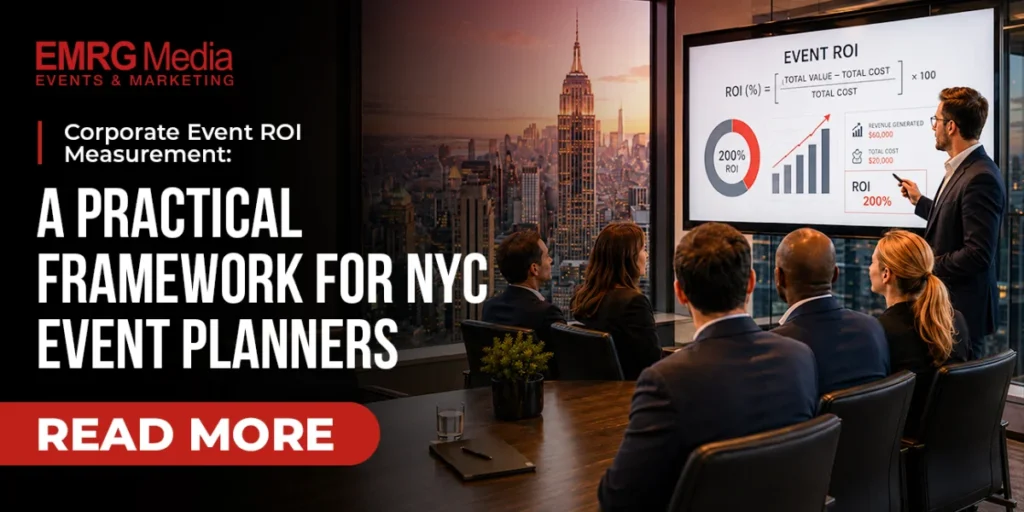
The formula is straightforward: subtract total cost from total value, divide by total cost, multiply by 100. But effective corporate event ROI measurement demands a full system not just math.
This guide walks New York event planners through the exact steps to track, prove, and improve event performance in 2026.
Why NYC Corporate Teams Skip ROI Measurement and Pay for It Later
Most teams pour all energy into execution. How to measure event success rarely gets its own planning session. When budget review season arrives with no performance data, the next event budget is always at risk.
Corporate event ROI measurement done right changes the conversation. It turns your event from a hard-to-defend expense into a documented business investment that leadership can see and support.
Build Your Measurement Baseline Before Event Day
The single biggest mistake in corporate event ROI measurement is waiting until after the event to start measuring. Baseline data disappears once the room clears.
Before event day, lock in:
- Set a specific primary goal: lead capture, team alignment, or client retention.
- Assign dollar values to outcomes: a new client worth $20,000 counts directly in your event ROI calculation.
- Choose your tracking tools: CRM platforms, event apps, or registration software.
EMRG Media’s 2026 corporate event planning guide covers how to align corporate event KPIs with business goals from day one, the step most NYC planners skip entirely.
The Event ROI Calculation That Actually Works
The standard event ROI calculation formula:
ROI (%) = [(Total Event Value – Total Event Cost) ÷ Total Event Cost] × 100
A $20,000 NYC event generating $60,000 in attributed revenue and pipeline delivers 200% ROI.
Strong corporate event ROI measurement always accounts for soft returns:
- Qualified leads scored and handed to sales.
- Employee retention value replacing one NYC employee costs $15,000–$25,000.
- Media coverage equivalent and brand impressions.
Ignoring soft value is the most common error in measuring event impact. See how strategic planning for impactful corporate events builds these metrics into the process from the start.
Build your next event around proven ROI from day one. Connect with EMRG Media and start planning today a specialist responds within 24 hours.
5 Corporate Event KPIs Every NYC Planner Should Track
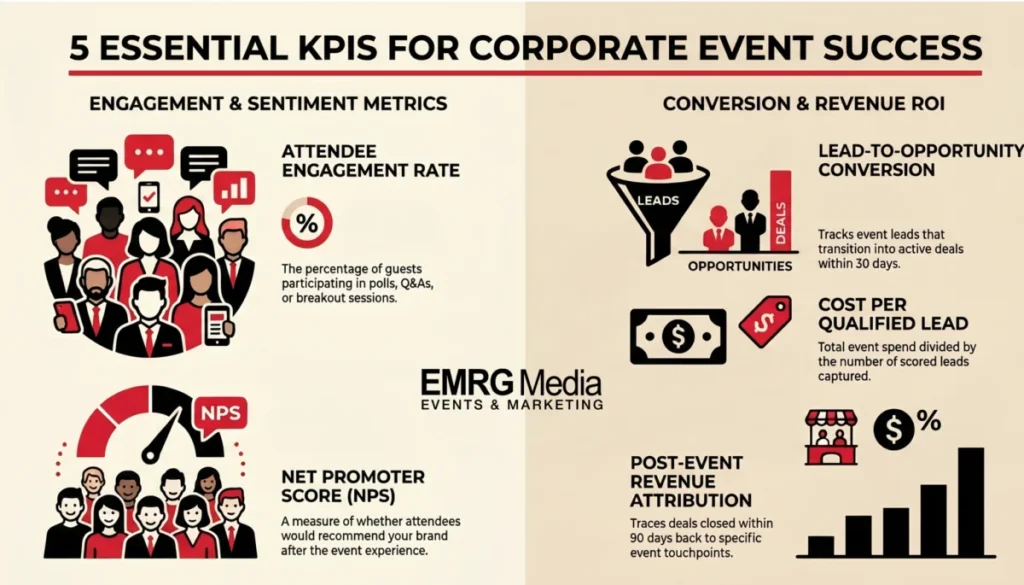
These five corporate event success metrics give your leadership team real, actionable data:
- Attendee Engagement Rate: The percentage who joined polls, Q&As, or breakout sessions.
- Lead-to-Opportunity Conversion Rate: Event leads that became active deals within 30 days.
- Net Promoter Score (NPS): Would attendees recommend your brand after the event?.
- Cost Per Qualified Lead: Total event spend ÷ number of scored leads captured.
- Post-Event Revenue Attribution: Deals closed within 90 days traced to event touchpoints.
These corporate event KPIs cover immediate wins and long-term event marketing ROI. For the tactics that drive each of these numbers, explore 7 proven engagement insights from EMRG Media.
Post-Event Surveys: Your Fastest Source of Soft ROI Data
Post-event survey best practices in 2026: send within 24 hours, cap at five questions, and include one open-ended response.
NYC professionals in finance and tech won’t complete lengthy forms the morning after an event.
The strongest questions for corporate event ROI measurement:
- How likely are you to do business with us after today?
- What moment created the most value for you?
- Would you attend this event again next year?
Segment responses by attendee type clients, prospects, and internal staff all define value differently. This is where measuring event impact goes beyond data and captures the sentiment leadership actually cares about.
Want attendees who engage long after the event ends? See how EMRG Media solves NYC’s toughest corporate event planning challenges.
Presenting Event ROI to Leadership Without Pushback
Event marketing ROI reports succeed when they speak leadership’s language. Lead with revenue impact not attendance counts. Structure your report this way:
- Business goal: The event was designed to achieve.
- Total cost breakdown: By category.
- Value generated: Revenue, leads, and retention impact.
- ROI percentage: The single number decision-makers remember.
- Recommendations: To improve the next event.
Consistent corporate event ROI measurement starts with intentional planning. An experienced NYC event team ensures your numbers reflect strategy, not guesswork.
Key Takeaways
- Corporate event ROI measurement must start before event day baseline data disappears afterward.
- Use the formula: [(Value – Cost) ÷ Cost] × 100 for a clean event ROI calculation.
- Track five corporate event KPIs: engagement rate, conversion, NPS, cost per lead, and 90-day revenue attribution.
- Apply post-event survey best practices: 24-hour send window, five questions maximum.
- Soft value retention and brand equity belongs in every measuring event impact framework.
- Event marketing ROI reports win leadership approval when they lead with business outcomes.
Stop Guessing and Start Proving: Your 2026 NYC Event ROI Action Plan
Events at Hudson Yards, Tribeca lofts, and Midtown’s premier conference centers aren’t judged solely on production value, they’re judged on what they actually delivered.
Corporate event ROI measurement is how smart NYC organizations protect event budgets and earn the leadership confidence to keep investing.
When your next event is anchored in clear goals and disciplined post-event survey best practices, the ROI report practically writes itself and a seasoned planning team ensures the data is clean from day one.
EMRG Media has spent 20+ years executing corporate events across New York City from Midtown product launches to Financial District gala evenings.
Their strategy, vendor network, and post-event reporting framework transform events into documented business wins that leadership trusts.
Make your next event your most measurable yet. Follow EMRG Media on Facebook and connect with NYC’s top corporate event planning team today.
FAQs About Corporate Event ROI Measurement
How do you calculate ROI for a corporate event?
ROI equals (Total Event Value – Total Event Cost) ÷ Total Event Cost × 100. Assign dollar values to both hard returns, closed revenue and new deals and soft returns like retention savings and brand impressions before the event begins. Pre-assigning those values produces the most accurate and defensible final measurement.
What KPIs should I track after a corporate event in NYC?
In NYC, where per-head event costs run 30–40% above the national average, prioritize cost per qualified lead and 90-day revenue attribution first.
Capture engagement rate and NPS within 48 hours post-event, while attendee impressions are still fresh and response rates remain high enough to generate statistically meaningful data.
How do I justify the cost of a corporate event to leadership?
Frame event spend as an acquisition investment, not overhead. Compare total event cost against the lifetime value of one new client won through the event.
Citing the global events market’s projected value of $2.1 trillion by 2032 also signals that events deliver consistent, industry-validated business returns to skeptical stakeholders.