
From Vendor Chaos to Flawless Execution: What Does an Event Planner Do in NYC?
Planning an unforgettable event in New York City’s competitive landscape can quickly overwhelm even the most organized teams. What does an event planner do to alleviate this stress? An event planner manages every operational and creative layer of an event, from the initial strategy session through post-event reporting.
In New York City, that scope is wider than it sounds. A senior NYC planner simultaneously oversees 15 to 50 vendors, a six or seven-figure budget, and an audience that may include your CEO, your largest clients, or national press. For full-service event planning in NYC, one person or one team owns all of it, encompassing strategy, design, logistics, compliance, and execution under a single contract.
At EMRG Media, we have produced more than 1,000 corporate events across New York City since 2001 for clients including Google, Netflix, Wieden+Kennedy, Barclays, and Bloomberg. This guide explains precisely what a full-service event planner does, why the New York market demands a different standard, and what to look for before you hire one.
Stop juggling contracts and vendor emergencies. Partner with the seasoned professionals at EMRG Media to transform your vision into a flawless reality.
Corporate Event Planner Inquiry
The 7 Core Responsibilities of a Full-Service NYC Event Planner
The U.S. Bureau of Labor Statistics defines event planners as professionals who “arrange all aspects of events and professional gatherings,” including logistics, finances, and on-site coordination. In practice, a full-service firm in New York covers seven distinct responsibility areas.
1. Event Strategy and Creative Concept Development
Every engagement starts with a discovery session, not a venue list. A planner aligns the event’s format, theme, audience, and measurable success metrics with your business objectives. EMRG Media’s discovery call, for example, runs 30 minutes and produces a written creative brief before any financial commitments are made. This phase eliminates the most common and expensive mistake in corporate event planning: booking a venue before defining what the event needs to accomplish.
2. Venue Sourcing Across Manhattan, Brooklyn, and Queens
A full-service NYC planner maintains active relationships with venues that never appear on public listing platforms. EMRG Media sources across 200 plus corporate event venues in NYC, from Tribeca rooftops and Wall Street ballrooms to DUMBO warehouse conversions and Long Island City event spaces with direct Manhattan skyline sightlines. Venue selection drives every subsequent budget decision. Minimum food and beverage spends at Midtown hotel properties frequently range from $50,000 to $150,000, separate from the room rental rate. Knowing those numbers before signing a contract is the job.
3. Full Budget Management and Vendor Negotiation
A senior planner builds a line-itemized budget you can defend to your CFO and then manages every vendor invoice against that figure. EMRG Media operates on a flat planning fee or a percentage of the total event budget, typically 10 to 20 percent, and passes all vendor invoices through at cost. No markups are hidden in line items. This financial discipline is what separates a professional planning firm from a freelance coordinator assembling quotes for the first time.
4. Production Design: AV, Lighting, and Staging
Production quality determines whether your event feels like a brand moment or a conference room with catering. A full-service planner engineers the technical specification for AV systems, lighting rigs, stage sets, LED walls, and projection mapping. At certain Manhattan venues operating under IATSE and Teamsters union labor agreements, production scheduling and crew composition require experienced oversight. An in-house production team, like the one at EMRG Media, eliminates the subcontractor communication gap that causes most on-site failures.
5. Run-of-Show Development and On-Site Execution
The run-of-show is a minute-by-minute event script distributed to every vendor and venue staff member in advance. The planner owns it from the first load-in call to post-event breakdown. During the Wieden+Kennedy 40th Anniversary event, EMRG Media coordinated three simultaneous venue spaces for 600 guests across Lower Manhattan while managing custom installations, talent, and a live press presence, all running off a single run-of-show. You should not be fielding a vendor call during your own event.
6. Compliance, Insurance, and NYC Corporate Event Permitting
New York events frequently require NYC Parks special events permits, NYC Department of Transportation street closure permits, FDNY assembly permits, and alcohol licenses. Permit lead times run 30 to 90 days for most categories. EMRG Media handles all NYC corporate event permitting and provides certificates of insurance to venues, building management, and corporate procurement teams as standard scope. This is not an add-on service. It is a prerequisite for any public or outdoor event in New York City.
7. Post-Event Reporting and ROI Analysis
A planner’s job does not end at load-out. Vendor payment reconciliation, attendee feedback collection, and a formal post-event debrief ensure that the event’s performance against its stated objectives is documented and delivered within two weeks. For EMRG Media’s Google Acceleration Launch event, post-event reporting captured 22 press placements across trade and consumer publications, giving the client measurable data to justify the production investment internally.
What a Full-Service NYC Event Planning Company Does Differently
The distinction between a solo event coordinator and a full-service event planning company in NYC is operational, not cosmetic.
Capability | Full-Service Company | Solo Coordinator |
In-house AV and production team | Yes | No — subcontracted |
Vendor accountability | Single contract, single POC | Multiple contracts |
Permit management | Included as standard | Typically excluded |
Budget transparency | Line-itemized, cost-pass-through | Variable |
Contingency planning | Backup vendors identified in advance | Reactive |
Post-event ROI reporting | Included | Rarely offered |
NYC union labor expertise | Built-in experience | Case by case |
When something breaks at 6:47 p.m. on event night, whether a catering supplier does not show, an AV feed drops, or a key vendor is unreachable, the person fixing it at EMRG Media is a salaried employee who has solved that problem 200 times. That is the operational difference that a full-service team provides.
How Full-Service Event Planning Works in NYC: The 5-Phase Process
Understanding the event planning process removes anxiety about who is responsible for what and when critical decisions must be locked in. Here is how EMRG Media structures every engagement.
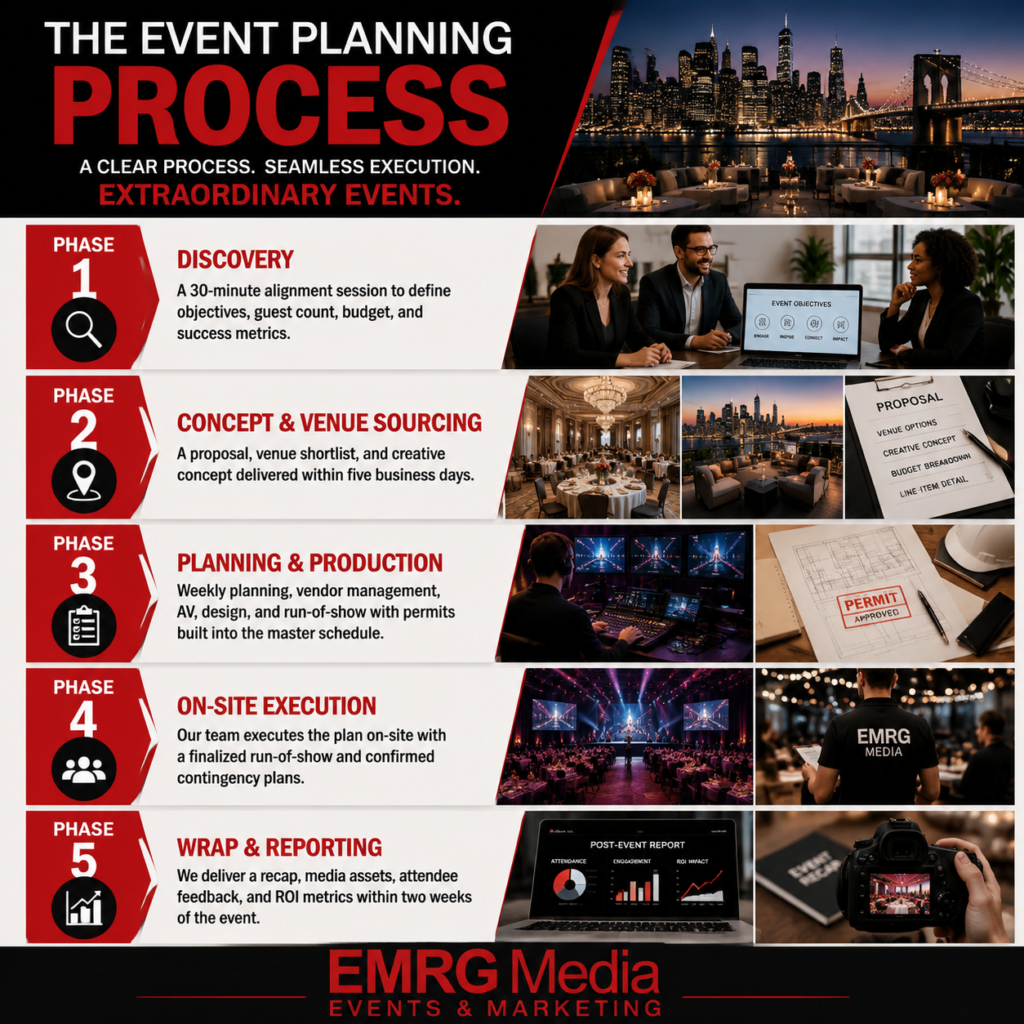
Phase 1: Discovery. A 30-minute alignment session covering objectives, guest count, budget parameters, and success metrics. NYC-specific constraints, including permit lead times, venue availability windows, and seasonal demand, are identified in writing before any dollar is spent.
Phase 2: Concept and Venue Sourcing. A line-itemized proposal, venue shortlist, and creative concept are delivered within five business days. Manhattan’s top venues book Saturday dates 9 to 18 months in advance, which means this phase has a hard deadline that most first-time buyers underestimate. Refer to our event planning timeline guide for a borough-by-borough breakdown of booking windows.
Phase 3: Planning and Production. Weekly status calls, vendor contract management, AV engineering, design development, and run-of-show construction run simultaneously. All NYC permit applications are submitted with lead times built into the master event schedule.
Phase 4: On-Site Execution. A lead coordinator and support team arrive for load-in with the finalized run-of-show. Backup contingency contacts for high-risk vendor categories are confirmed before event day, not after a failure.
Phase 5: Wrap and Reporting. Post-event recap, photo and video asset delivery, attendee feedback, and ROI metrics tied to Phase 1 success measures are delivered within two weeks of event close.
NYC-Specific Realities That Raise the Stakes
Planning events in New York City carries operational complexity that most other markets do not impose. These are not edge cases, they are standard conditions a professional event planner accounts for from day one.
Venue minimum spends at Midtown hotel properties are separate from and often exceed the room rental rate. A client who signs a venue contract without understanding the food and beverage minimum is committing to a cost they did not budget for.
Union labor requirements at specific Manhattan venues under IATSE agreements affect both production crew composition and scheduling. Load-in windows at high-turnover venues can be as narrow as two to four hours. EMRG Media surfaces both of these constraints in Phase 2, not during load-in.
Outdoor and rooftop events in locations from the Financial District waterfront to Williamsburg piers require NYC Buildings Department permits alongside noise ordinance compliance and weather contingency written into the venue contract before booking.
EMRG Media serves Manhattan, Brooklyn, Queens, Long Island City, Hoboken, Jersey City, Westchester, and the Hamptons, and travels nationally and internationally with clients. Our New York event planning & management protocols are calibrated to the city’s requirements specifically — not adapted from another market.
What to Look for When Hiring an Event Planning Company in NYC
Before signing any contract, use these four questions as your vetting standard. For a complete list, see our event planning consultation checklist.
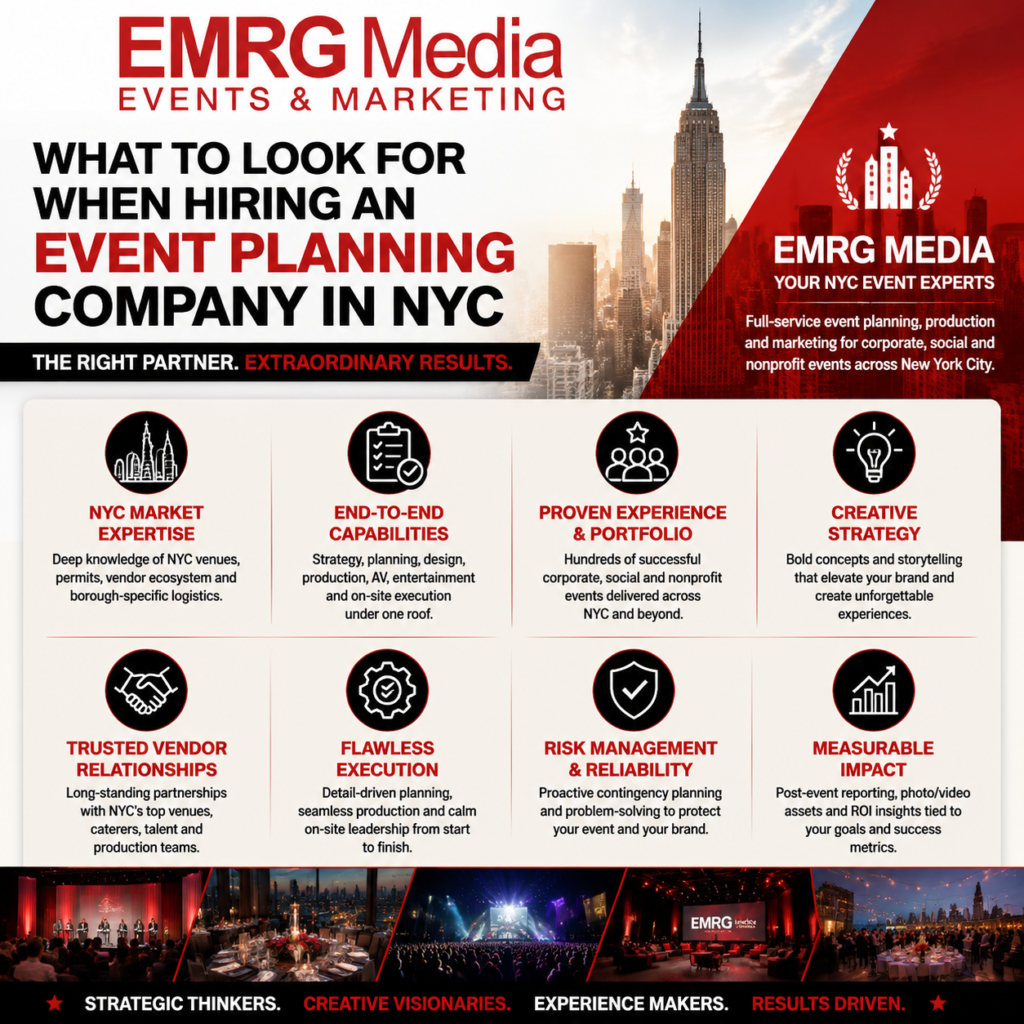
- Is the team in-house or subcontracted? An in-house production, design, and AV team means accountability lives under one contract. A subcontracted model means you inherit someone else’s vendor relationships and their failure points.
- Does the proposal show line-item cost transparency? A reputable firm separates its planning fee from vendor costs and passes all vendor invoices through at cost. Bundled or opaque proposals make budget reconciliation impossible.
- Does a single senior planner own your event from kickoff to wrap? Hand-offs between a sales team, a planning team, and an on-site team are where critical details fall. One point of contact is non-negotiable.
- Can they demonstrate ROI reporting? If the event is meant to generate press coverage, drive sales lift, or raise donor revenue, the planning firm should be able to document results against those objectives after the event closes.
EMRG Media earns a 5.0 average across 133 verified Google reviews, with repeat clients including Sony Music, W Magazine, and LVMH. For more on what firms charge and how to evaluate pricing, see our guide on how much an event planner costs in NYC.
To see how EMRG Media compares to other firms in the market, visit our best event planners in NYC guide for an independent breakdown.
Frequently Asked Questions
An event planner manages every phase of an event: strategy, venue sourcing, vendor negotiation, production design, permitting, on-site execution, and post-event reporting. In NYC, a full-service planner serves as the single accountable point of contact across 15 to 50 vendors and a multi-six-figure budget.
The seven stages are: brief and objectives, creative concept, venue and vendor selection, logistics and permitting, design and production development, on-site execution, and post-event reporting. Timelines for each stage vary significantly in New York City, where venue booking windows alone run 9 to 18 months for premium spaces.
The 5 C’s are Concept, Coordination, Control, Culmination, and Closeout. They represent the lifecycle of any event from initial idea through post-event evaluation. In a full-service engagement, a professional planning firm owns all five stages, rather than handing off between departments or contractors.
A planner manages the entire event lifecycle from strategy through reporting. An event coordinator steps in during the final weeks to execute a plan that is already built. For high-stakes corporate events with complex vendor ecosystems and NYC permit requirements, a full-service planner is the appropriate engagement — not day-of coordination.
Yes, particularly in New York. Employment of meeting, convention, and event planners is projected to grow 5 percent from 2024 to 2034, faster than the average for all occupations — a reflection of how much value professional planning delivers. In NYC, where venue contracts, union labor rules, and permit processes carry significant financial and operational risk, professional planning consistently prevents budget overruns that internal teams absorb without recognizing the cause.
Ready to See What EMRG Media Does for Your NYC Event?
When you finally ask what does an event planner do, the answer goes far beyond booking venues. A true professional absorbs the immense operational pressure of New York City, acting as your financial guardian, creative director, and crisis manager. The difference between a standard corporate gathering and a brand defining milestone lies entirely in flawless execution.
EMRG Media plans, designs, and produces elite events for Fortune 500 companies. Led by Erica Maurer, the #1 Most Influential Event Planner in NYC for 2026, our in-house team has executed over 1,000 flawless events since 2001. We know exactly how to protect your budget and elevate your vision. Stop risking your company’s reputation on unpredictable vendors. Secure your ideal venue date and let our seasoned experts build your unforgettable event from the ground up today.