A Midtown Manhattan gala booked 12 months out can still fall apart in week three if the contract signed on day one never defines who owns a vendor overage. New York’s event market runs on six-figure budgets, 15 to 50 vendors per event, and executives who expect a flawless night, which is exactly why an event planner contract template matters more here than in almost any other city.
A solid event planner contract template spells out scope, fees, deliverables, and exit terms before a deposit changes hands, and it should read like a risk map for your specific event, not boilerplate.
If you’re scoping a corporate event in NYC, this document is the one your legal and finance teams will scrutinize hardest. Below is what a corporate-grade event planning agreement needs to cover, section by section, and where New York-specific clauses, union labor, permitting, venue exclusivity, change the standard template entirely.
Why NYC Contracts Can’t Run on a Generic Template
A contract built for a suburban conference center won’t survive contact with a Manhattan hotel ballroom. NYC venues carry F&B minimums separate from room rental, union labor rules affecting load-in scheduling, and permit lead times running 30 to 90 days through NYC Parks or the Mayor’s Office of Media and Entertainment.
A corporate event contract used in this market has to name these variables directly, not bury them under “additional costs may apply.”
- Union Labor Clauses: Specific rules for load-in schedules and crew fees at venues requiring IATSE or Teamsters labor.
- Permit Responsibility: A named party for who files, who pays, and who absorbs costs if a permit delay pushes the timeline.
- Venue Exclusivity Disclosures: Preferred-vendor lock-in terms spelled out before the venue contract is signed, not discovered afterward.
- Force Majeure Language: Coverage for NYC-specific disruptions like transit shutdowns, extreme weather, or building closures.
The Core Sections Every Contract Should Contain
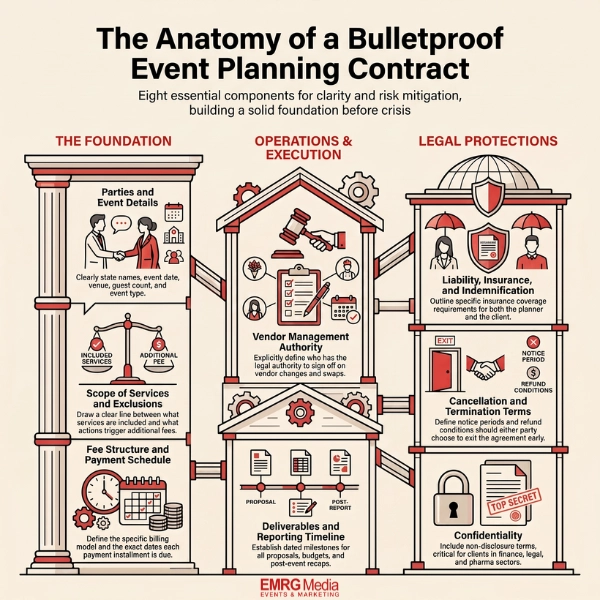
Every serious planner agreement, corporate, gala, or conference, needs the same skeleton before city-specific detail gets layered in.
- Parties and Event Details: Names, event date, venue, guest count, and event type stated in the opening section.
- Scope of Services and Exclusions: A clear line between what’s included and what triggers an added fee.
- Fee Structure and Payment Schedule: The billing model and the dates each installment is due.
- Vendor Management Authority: Who can sign off on vendor changes and swaps.
- Liability, Insurance, and Indemnification: Coverage requirements for both planner and client.
- Cancellation and Termination Terms: Notice periods and refund conditions if either side exits early.
- Deliverables and Reporting Timeline: Dated milestones for proposals, budgets, and post-event recaps.
- Confidentiality: Non-disclosure terms, critical for finance, legal, and pharma clients.
Miss one of these in your event planner contract template and you’ll be negotiating it mid-crisis instead of on day one.
Defining Scope So Nobody Guesses Later
The most disputed clause in any vendor management contract is scope. A vague “full-service planning” line invites disagreement the moment a client requests a fourth venue walkthrough or a same-week vendor swap.
The planner agreement scope of work should list every deliverable by name, with a stated number of revision rounds and site visits included:
- Venue sourcing.
- Budget management.
- Vendor negotiation.
- AV oversight.
- On-site staffing.
- Post-event reporting.
Fee Models Your Contract Should Spell Out
New York planners typically bill one of three ways, and your event planning agreement needs to state which applies and how it’s calculated.
- Flat Planning Fee: A fixed amount regardless of the final event cost.
- Percentage of Budget: A defined range applied against total event spend.
- Hybrid Model: A reduced flat fee paired with a smaller percentage on top.
The contract should separate management fee vs commission language clearly, since a planner earning a percentage of vendor spend carries a different incentive structure than one on a flat fee. Payment milestones belong here too: deposit at signing, a second payment once the venue and major vendors are locked, and final payment tied to event completion rather than an arbitrary calendar date.
Need help with your NYC event? A senior Corporate Event Planner team can review your scope before you sign anything. Reach out through EMRG Media’s contact page to get started.
Liability, Insurance, and What Happens If the Event Doesn’t Happen
Every corporate event contract needs a clause covering what happens when something outside anyone’s control derails the date. The liability and insurance clause should specify certificate-of-insurance requirements, who carries general liability coverage, and how liquor liability is assigned when alcohol service is involved.
The termination clause matters just as much. It should define notice periods, refund conditions on the deposit, and what happens to vendor contracts already signed on the client’s behalf if either party walks away before event day.
Skip this, and a canceled gala turns into a multi-vendor legal mess.
Deliverables Timeline: The Section Most Templates Skip
A deliverables schedule turns vague promises into dated commitments. Your event planner contract template should list when the venue shortlist arrives, when the line-item budget is due, when the run-of-show gets finalized, and when post-event reporting, photos, video, ROI metrics, lands in your inbox.
Most corporate clients expect this within two weeks of event close; if your template doesn’t say so, you have no ground to stand on when it slips to six.
Not sure your current contract accounts for New York’s permitting and union labor requirements? Review our Event Planning And Management process to see how a five-phase framework maps directly to contract deliverables.
Red Flags That Belong on No Planner Agreement
- Vague Fee Language: Phrasing like “additional fees may apply” with no defined categories.
- No Named Contact: Missing escalation path if the primary planner is unavailable.
- Marked-Up Invoices: Vendor costs passed through without at-cost transparency.
- Unlimited Revisions Clause Missing: No stated cap on concept or proposal revisions.
- One-Sided Cancellation Terms: Terms that protect only the planner if the event is canceled.
If your event planner contract template contains any of these, send it back before signing.
Key Takeaways
- A corporate event contract for NYC events must name union labor, permitting, and venue exclusivity explicitly.
- Scope of work should list deliverables by name, not general phrases.
- Fee structure and payment milestones need to be stated in dollar or percentage terms.
- Liability, insurance, and termination clauses protect both sides if an event is delayed or canceled.
- A dated deliverables schedule prevents disputes over reporting and follow-through.
Get the Contract Right Before the Deposit Clears
A well-built event planner contract template isn’t paperwork; it’s the document that decides who’s accountable when a vendor cancels three weeks out or a venue changes its load-in window without notice.
New York’s corporate events run on tight timelines and tighter budgets, and the agreement you sign on day one should already account for both. Review every clause against your actual event, not a boilerplate found online, and you’ll walk into planning with far fewer surprises.
Ready to work from a contract built around New York’s actual venue and vendor landscape? Hire A Planner and get a proposal with every clause spelled out in plain terms or visit EMRG Media to see our full scope of work.
Additional Resource for Event Contracts
For a deeper legal understanding of how to properly structure your cancellation and liability clauses, especially in unpredictable markets like New York, we recommend reviewing Cornell Law School’s Legal Information Institute guide on Force Majeure. Understanding the strict legal definition of these terms ensures your agreement holds up when it matters most.
FAQs About Event Planner Contract Template
What should an event planner contract include?
An event planner contract template should include scope of work, fee structure, payment milestones, liability and insurance terms, cancellation and termination clauses, and a dated deliverables schedule. Each section should name specifics rather than general language to prevent disputes.
How are planner fees structured in a contract?
Planner fees are typically structured as a flat fee, a percentage of the total event budget, or a hybrid of both. The contract should state which model applies, how it’s calculated, and when each payment milestone is due.
Who owns the vendor relationships under the agreement?
Vendor relationships are typically owned by the client, with the planner negotiating and managing contracts on the client’s behalf. The agreement should specify who holds final contract authority and who absorbs costs if a vendor is replaced.