Plan a flawless Fall 2026 NYC event using this reliable conference agenda template and schedule guide.

Conference Agenda Templates: Building a Fall 2026 NYC Programme That Survives Day One

Manhattan’s Fall 2026 conference season runs directly into the UN General Assembly’s mid-to-late September closures, and Midtown ballrooms are already booking 9 to 12 months out for that window. A conference agenda template built without accounting for those pinch points falls apart by 10 a.m. on day one, when a keynote runs long and the whole afternoon slides.

A workable event schedule for a two-day, 300-attendee New York programme typically blocks 45 to 60 minutes per keynote, 30 to 40 minutes per breakout session, and at least 20 minutes of transition time between every room change. Get that math wrong once, and every session after it drifts.

What a Solid Conference Agenda Template Needs to Cover

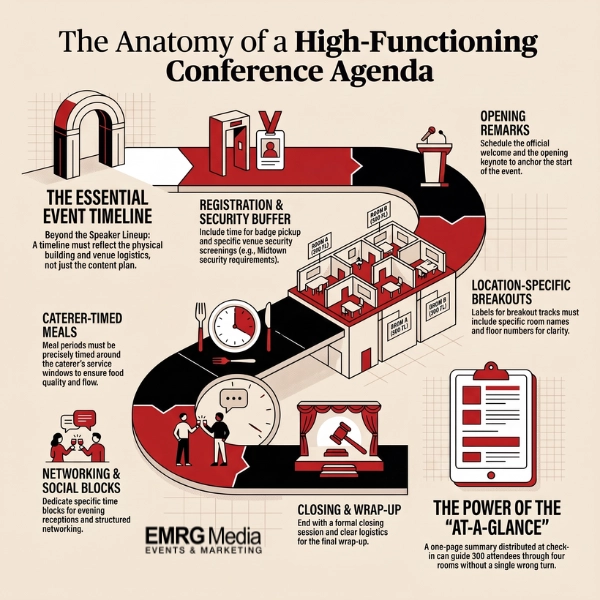
Every event timeline worth using accounts for more than just the speaker lineup. It has to reflect the physical building, not just the content plan.

At minimum, a New York conference programme should map:

  • Registration and badge pickup, with buffer for Midtown security screening.
  • Opening keynote and welcome remarks.
  • Breakout tracks, labeled by room and floor.
  • Meal periods, timed around your caterer’s service windows.
  • Networking blocks and evening receptions.
  • Closing session and wrap logistics.

A one-page programme-at-a-glance summary, distributed at check-in, keeps 300 attendees moving through four rooms without a single wrong turn.

Infographic showing a high-functioning conference agenda template timeline with breakout sessions and meals

Matching Your Event Schedule to the Room You Booked

The venue dictates the template, not the other way around. A three-track breakout day needs four rooms with dedicated AV, not one ballroom split by a curtain.

Before finalizing your daily agenda, confirm room capacity against seating style. A space rated for 400 theater-style may only hold 220 in rounds, which changes your breakout math entirely. For a full breakdown of capacity ratios and layout logic across Manhattan properties, review Conference Venues NYC before you lock a single time slot.

Fall dates near Grand Central and Penn Station also carry heavier foot traffic during evening rush, so build extra transition time into any late-afternoon session block.

If you are ready to build a Fall 2026 agenda that survives contact with a real venue, our senior producers at EMRG Media can help map your programme to the room you have actually booked. Request a proposal with EMRG Media.

Keynote and Breakout Timing That Actually Holds

Timing is where most agenda templates quietly fail. A CEO keynote scheduled for 30 minutes almost never runs 30 minutes; build 45 minutes as the floor.

Keynote slot timing should include 5 minutes for stage transition and Q&A wrap, not just the talk itself. For breakout session planning, plan 35 minutes of content plus 10 minutes for room turnover if attendees are moving floors.

A dependable daily schedule for multi-track days also builds in:

  • A 15-minute cushion after every general session.
  • Staggered breakouts start times if tracks share a hallway.
  • No more than three consecutive 45-minute blocks before a break.

Our team at Conferences has run multi-track programmes across Midtown, Brooklyn, and Long Island City, and the pattern holds everywhere: tight timing on paper always needs real-world padding.

Agenda Template vs. Run-of-Show: Know the Difference

An agenda vs. run-of-show confusion causes more day-one chaos than any speaker cancellation. The agenda is the attendee-facing document; the run-of-show is the internal, minute-by-minute production script your AV team and stage manager follow.

A conference agenda template tells guests where to be. A run-of-show tells your production crew when the mic goes live, when the lights cue, and when the next slide loads. Confusing the two means your attendees see a polished schedule while your crew works from guesswork backstage.

For a full month-by-month build sequence that separates these two documents properly, the NYC Conference Planning Timeline walks through when each one gets finalized. Multi-day programmes also benefit from reviewing the full Conference Event Planning in NYC guide before locking a multi-day agenda format across venues.

Building Buffer into a Fall 2026 Conference Schedule Template

New York’s compressed Fall calendar means your event schedule needs a contingency time baked in from the first draft. Weather delays, transit disruptions, and late arrivals from out-of-town attendees are routine in September and October.

A resilient conference timeline includes:

  • A 30-minute grace window before the first keynote.
  • Flexible afternoon breakout slots that can absorb a 15-minute slip.
  • A clearly marked “hard stop” time for evening receptions with venue curfews.

Building this cushion into your plan from the start avoids the domino effect where one late speaker collapses three sessions behind it.

If you are building a Fall 2026 programme with multiple tracks and a hard venue curfew, our team at EMRG Media can help scope your agenda around real load-in and load-out windows before you publish a single time slot. Contact EMRG Media today.

Key Takeaways

The Agenda Is the First Impression Your Conference Makes

A conference programme is not paperwork; it’s the first proof point attendees get that your event is organized. A schedule that runs on time signals a team that has its production under control before the first keynote even starts.

New York’s Fall 2026 calendar rewards planners who build their daily agenda around the venue’s real constraints, not an idealized version of the day. Get the timing right, and the room, the speakers, and the audience all move together instead of against each other.

EMRG Media has built agendas and run-of-show documents for programmes ranging from 100-attendee summits to 2,000-attendee flagships across every major Manhattan submarket. If your Fall 2026 programme needs a schedule built around a real venue, real union call times, and a real transit map, our senior conference producers are here to help. Request a proposal with EMRG Media this week.

Industry Resources for NYC Planners

When building a timeline around complex city-wide events like the UN General Assembly, staying informed on city infrastructure is critical. For official updates on transit patterns, neighborhood capacities, and city-wide event alerts, we recommend consulting the meeting planner resources at New York City Tourism + Conventions, the official destination marketing organization for the five boroughs.

EMRG Media executing a flawless corporate event, brought to life by a precise conference agenda template

FAQs About Conference Agenda Template

What should a conference agenda include?

A conference agenda should include registration, keynotes, breakout sessions, meal periods, networking blocks, and a closing session, each labeled with room and time. It should also flag transition windows so attendees know exactly how long they have to move between sessions.

Keynotes should run 45 to 60 minutes including Q&A, and breakout sessions should run 30 to 40 minutes. Anything longer risks attendee attention drift; anything shorter rarely allows enough depth for a working professional audience to engage fully.

Build at least 15 minutes between sessions and 20 minutes for any breakout requiring a room or floor change. Multi-day programmes should also add a 30-minute buffer before the first morning session to absorb late arrivals and transit delays.