
Midtown ballrooms with 12-foot drop ceilings and Hudson Yards atriums with soaring glass walls create two completely different challenges for anyone booking an LED video wall rental in New York City.
A screen that looks stunning at the Javits Center can overwhelm a room at a Fifth Avenue hotel, and freight elevator dimensions at older Manhattan properties can stall a build before it starts.
If you’re pricing out LED display hire for a 2026 event, expect to pay between $35 and $75 per square foot per day, with a standard 20-foot by 12-foot setup running $8,000 to $18,000 including crew and rigging.
That range swings based on pixel pitch, load-in access, and how many days your team needs on-site.
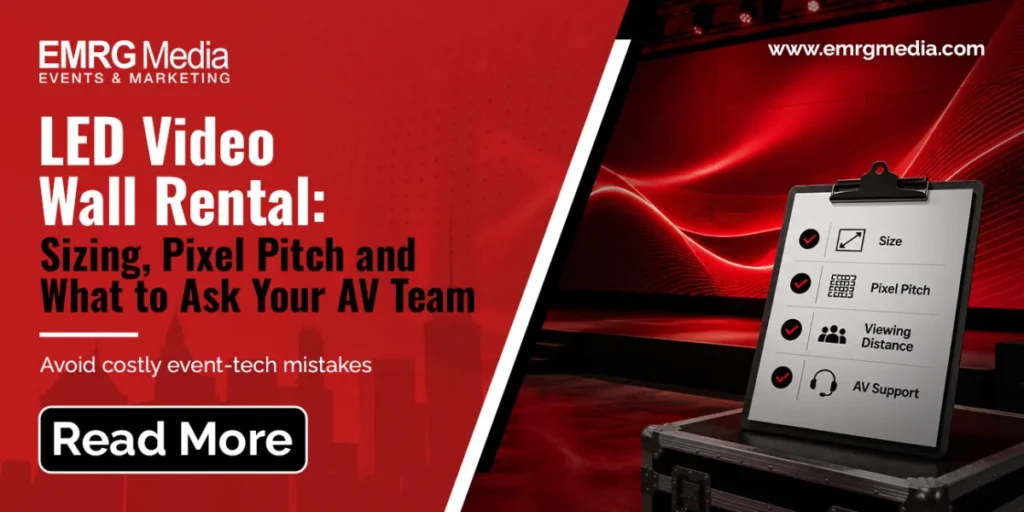
Before you sign a quote, you need to know the size your room actually supports, the pixel pitch your closest seat needs, and what’s included beyond the panels themselves.
Why Video Wall Setups Cost So Much in Manhattan Ballrooms
Every screen rental quote in this city gets shaped by the same three variables, panel resolution, square footage, and labor.
A ballroom with a loading dock two floors below street level costs more to rig than a ground-floor space in Chelsea, because crews need extra hands and extra hours.
Vendors calculate video wall pricing per square foot to account for this variability, then add technician day-rates on top.
Winter events add another wrinkle, panels moving from a heated truck into a cold loading dock need time to acclimate before power-up, or condensation can form inside the modules.
A vendor who skips this step on a January gala is the same vendor who’ll have a dead panel by the second speaker.
Pixel Pitch Explained for Corporate Stage Screens
Pixel pitch is simply the space between the tiny light dots on a screen.
- Smaller number: The dots are packed tightly together, making the picture super clear up close.
- Larger number: The dots are spaced farther apart, which looks fine from far away but blurry up close.
Picking the wrong number is the main reason screens end up looking cheap or grainy on camera.
The Rule Most Vendors Skip Explaining
Pixel pitch and screen size answer two different questions, and mixing them up leads to bad quotes, base your pixel pitch on your closest seat, since that’s the distance at which individual diodes become visible and the image starts to look grainy.
Base your overall screen size on your farthest seat, since that’s what determines whether the back row can actually read a slide or see a face clearly.
For a front-row guest sitting 10 feet from the stage at a product launch in a SoHo loft, you need something in the 1.9mm to 2.6mm range or the diode grid will be distracting.
For a 300-person ballroom where the closest table still sits 15 feet back, 3.9mm to 5.9mm panels deliver plenty of clarity at a lower rental cost, freeing up budget to go wider instead of sharper.
Sizing Your Display for the Room You Actually Booked
Size decisions should start with your farthest seat, not your favorite reference photo.
A wall too large for a room with an 11-foot ceiling forces an awkward crop or a tilted top edge that reads unprofessional in photos, that’s stage backdrop screen hire done backward form before function.
The 300-Person Ballroom Benchmark
A 300-person ballroom in Midtown, roughly 60 feet deep, typically supports a 16-foot-wide by 9-foot-tall video wall setup as a centered backdrop, leaving room for drape and sightline clearance on both sides.
Rooms with lower ceilings, common in pre-war properties below 34th Street, often need to go wider and shorter instead of taller.
Getting this ratio right before you book your LED video wall rental prevents change orders during load-in.
Not sure what size fits your room? EMRG Media walks Manhattan venues with clients before a single panel ships reach out and we’ll map your stage before you sign anything.
What to Ask Your AV Team Before You Sign
A vendor quote for an LED display should answer more than how much, ask about redundancy, what happens if a processor fails mid-show? Ask specifically about av rental for corporate stages, since a vendor built for concerts may not carry the quieter, content-switching gear a keynote needs.
If you’re comparing led video wall rental nyc quotes, ask each vendor for their load-in window, their power draw requirements, and whether the price includes a site visit.
A quote missing any of these three items usually means surprises show up on the invoice later, not before.
Get a written technical outline, not just a number. Request a scoped video wall proposal from EMRG Media’s production team, with one point of contact managing the process and vendors directly.
Technicians, Content Playback and the Hidden Line Items
Panels are only half the rental, every serious LED screen booking should include a dedicated technician for the full event window, not just for load-in and strike.
That technician runs the media server, manages content playback, and handles live switching between slides, video, and camera feeds during the run of the show.
This kind of coordination is exactly what separates full-service NYC event production from a simple panel drop-off, and it’s why the technical and creative sides of a stage need holistic stage design planning rather than gear bolted on after the fact.
If your event blends in-person and remote viewers, your screen setup also needs to sync with your streaming and camera systems so remote attendees see the same clean feed as the room, a level of integration most full AV production teams build in from day one.
Key Takeaways
- LED video wall rental costs in NYC run $35 to $75 per square foot per day, a 300-person ballroom setup typically lands between $8,000 and $18,000.
- Pixel pitch should match your closest seat to avoid a grainy image screen size should match your farthest seat to keep the back row readable.
- A complete video wall quote includes technicians, content playback support, and a pre-event site visit, not just panels.
Getting It Right the First Time
An LED video wall rental is one of the few production elements your entire audience stares at for the whole event, so there’s no room to guess on size or pitch.
The right pixel density, matched to a display sized for your actual ceiling and sightlines, is what makes a stage look intentional instead of improvised.
When the technical planning happens before the quote, not after, your event runs the way it looked in the pitch deck.
Ready to plan your stage the right way? Reach out to EMRG Media for a full LED video wall rental proposal, backed by 25 years of NYC event production experience see our recent work on Facebook.
FAQs About Led Video Wall Rental
How much does it cost to rent an LED video wall?
LED video wall rental in New York City typically costs $35 to $75 per square foot per day. A standard 20×12-foot wall for a corporate stage runs $8,000 to $18,000 including crew, rigging, and a technician for the event window.
What pixel pitch do I need for a corporate stage?
Most corporate stages need 2.6mm to 3.9mm pixel pitch for closest seats between 15 and 40 feet away. Larger ballrooms where the nearest guest sits 50+ feet back can use 4.8mm to 5.9mm panels without any visible loss in sharpness.
How large should an LED wall be for a 300-person ballroom?
A 300-person ballroom typically supports a 16-foot-wide by 9-foot-tall LED wall as a centered backdrop. This size leaves sightline clearance on both sides and fits most Midtown ceiling heights without cropping the image.