
Planning a corporate event in New York City requires more than just booking a venue and finalizing a guest list. A critical and often misunderstood component is event security. Whether you are organizing a high-profile product launch, a corporate gala, or a massive networking summit, understanding the precise security requirements for your specific gathering is nonnegotiable.
Event security in NYC means matching the right tier of trained personnel to your guest count, venue type, and alcohol service. It is never a flat-rate add-on. The legal requirements shift dramatically depending on your location in the city and the number of attendees in the room. You must navigate unarmed guards, armed personnel, NFPA-certified crowd managers, and off-duty NYPD officers to stay compliant.
EMRG Media handles these complexities daily for top-tier corporate clients. Read on to discover exactly how to build a compliant security plan, or contact our NYC event production team today to manage your next event from end to end.
Corporate Event Planner Inquiry
What Does "Event Security" Actually Mean for a Corporate Event?
“Event security” is an umbrella term that covers three distinct, non-interchangeable roles. When handling corporate event planning in NYC, confusing these roles is the most common mistake first-time planners make when budgeting.
Security Guards vs. Crowd Managers vs. Off-Duty NYPD: The Three Tiers
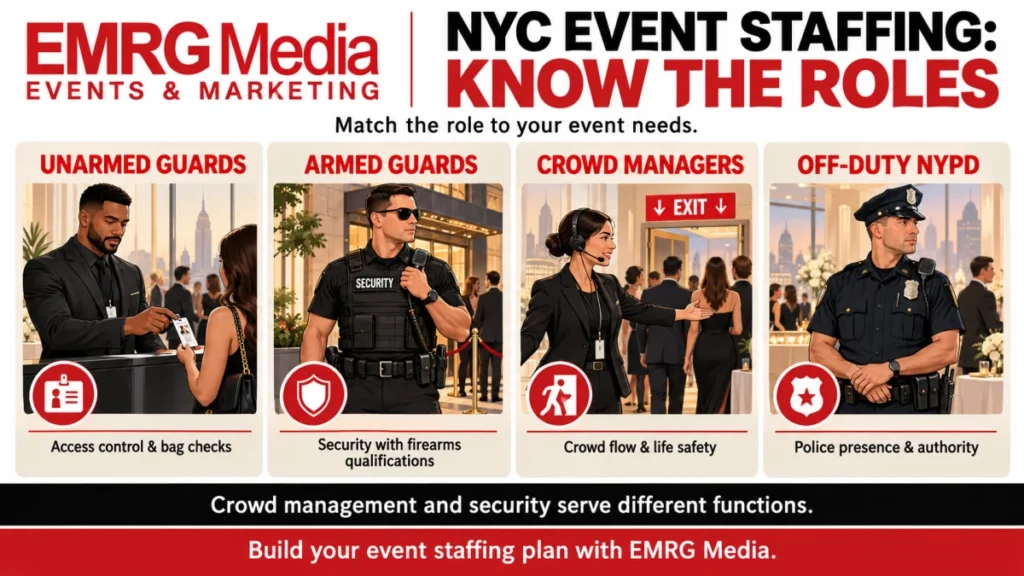
- Unarmed security guards handle access control, bag checks, and general presence. They are registered with the state but carry no weapon and no arrest authority beyond what any private citizen has.
- Armed security guards are licensed for the same duties but have completed additional firearms certification and annual renewal training. Most corporate events, including galas and product launches, never need this tier.
- Crowd managers are a life-safety role, not a security role. NFPA 101 requires at least one trained crowd manager in any assembly space holding 50 or more people, with additional managers added as the headcount grows.
- Off-duty NYPD officers, booked through a precinct’s Paid Detail Unit, carry full police authority, including arrest power, and are typically reserved for events with high-profile attendees, large alcohol service, or elevated risk profiles.
Who Is Legally Allowed to Work Security at an NYC Event
Every unarmed and armed guard working in New York State must be registered with the NYS Department of State and complete an 8-hour pre-assignment training course through a DCJS-approved school before stepping onto your event floor. Armed guards face an added annual 8-hour firearms recertification requirement. If your venue or vendor cannot produce a current registration number on request, that is a red flag worth escalating before contracts are signed.
Do You Legally Need Security for Your NYC Event?
The honest answer is: it depends on three separate triggers, and corporate planners often only discover one of them.
When a Venue Contract Mandates It
Many Midtown hotel ballrooms and Hudson Yards event spaces write minimum security staffing into their rental contracts, regardless of what the law technically requires. This is a liability decision by the venue, not a city mandate, so it varies property to property and should be confirmed during event venue sourcing in NYC, not the week before load-in.
When NFPA Crowd Manager Ratios Kick In
Once your assembly space hits 250 occupants, NFPA 101 requires one trained crowd manager for every additional 250 attendees on top of the baseline manager. An outdoor event reaching 1,000 guests needs five certified crowd managers, with one more added for every 250 beyond that. This is a fire and life-safety code requirement, independent of whatever security staffing your venue contract separately demands.
When FDNY's Temporary Place of Assembly Rule Applies
If your event brings 75 or more guests indoors, or 200 or more outdoors, for a gathering lasting under 30 days, the NYC Department of Buildings requires a Temporary Place of Assembly Certificate of Operation. This permit is separate from your security staffing plan but gets reviewed alongside it, which is why EMRG handles both in the same compliance pass rather than treating them as two unrelated checklists.
The Staffing Ratio Formula: How Many Guards Does Your Event Need?
This is the single most-searched question among corporate planners, and the honest answer involves two different ratios that often get conflated.
NFPA crowd manager counts are a legal minimum tied to occupant load. Practical security staffing is a planning decision tied to risk, not a fixed law. Here is how the two compare at common corporate event sizes—a baseline metric any experienced event production company in NYC uses when building out a show flow:
Guest Count | NFPA Crowd Managers Required | Practical Security Staff (Guards) |
50–100 | 1 | 2 |
100–250 | 1 | 3–4 |
250–500 | 2 | 5–8 |
500–1,000 | 4 | 8–12 |
1,000+ | 5, plus 1 per additional 250 | 12+, custom plan required |
Four factors push the practical guard number above this baseline: open bar service, VIP or executive attendance, multiple building entrances, and events running past 10 p.m. in dense neighborhoods like Chelsea or the Flatiron District.
How Much Does Event Security Cost in NYC in 2026?
Disclaimer: The hourly rates provided below are industry averages for the NYC market as of Q4 2026. Actual costs may vary based on your specific venue requirements, union labor rules, and last-minute booking premiums. Always request a custom quote during your initial venue sourcing phase.
Unarmed vs. Armed vs. Off-Duty Police Rates
Security Tier | Typical 2026 Hourly Rate | Best Suited For |
Unarmed Guard | $35–$50/hr | Access control, bag checks, general corporate events |
Armed Guard | $55–$75/hr | High-value asset protection, elevated risk events |
Off-Duty NYPD (Paid Detail) | $70–$100+/hr | High-profile guests, street closures, large-scale galas |
Most vendors apply a four-hour minimum booking, regardless of your actual event length, so a two-hour cocktail reception still gets billed as four.
What Drives the Price Up in 2026
Headcount and alcohol service are the two biggest cost multipliers, but there is a regulatory shift worth planning around now. NYC Local Law 61 of 2026 establishes a dedicated minimum wage schedule for security guards starting January 1, 2027, setting unarmed guard pay as high as $22.20 per hour and armed guard pay at $33.70 per hour during the initial rollout period. If you are planning a Q1 2027 event in late 2026, budget for this increase now rather than being surprised by a vendor quote adjustment closer to your date.
Building an Event Security Plan: The Core Components
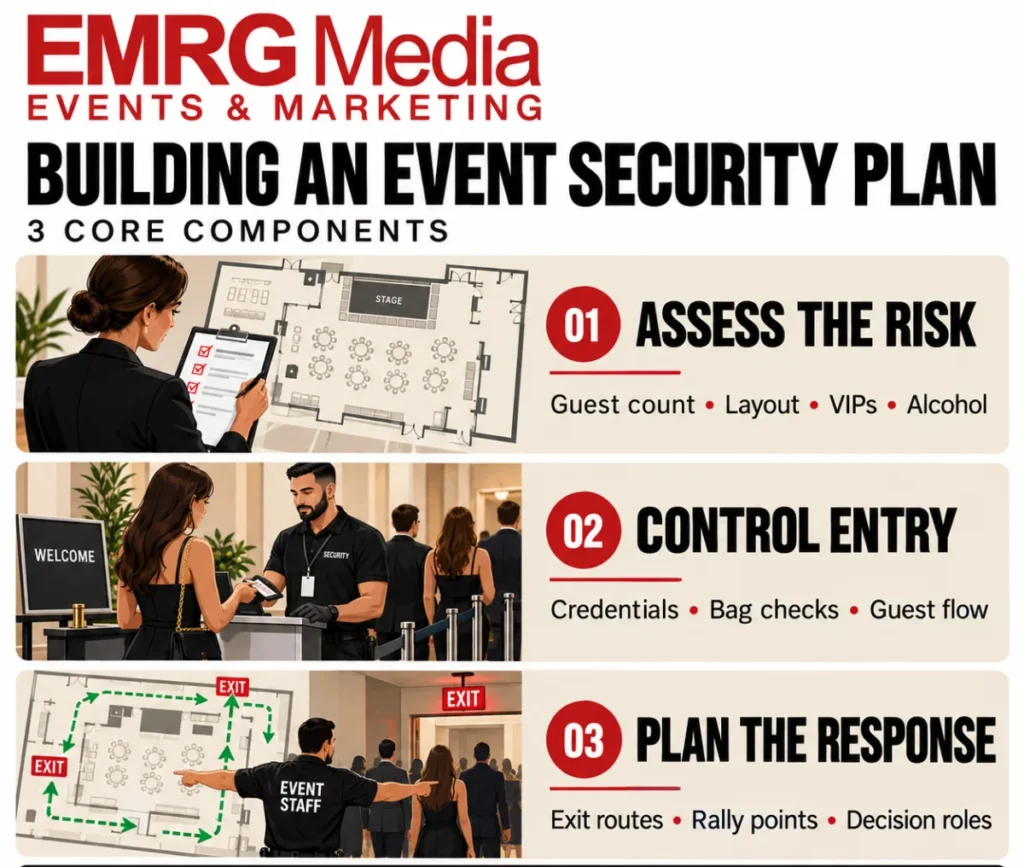
A security plan is not a staffing headcount. It is a written document covering four areas, and venues increasingly ask to see it before finalizing a contract.
The Risk Assessment
This identifies guest count, venue layout, VIP presence, and alcohol service level, then assigns a risk tier (low, moderate, elevated) that determines which guard tier and ratio apply.
Access Control, Bag Checks & Entry Flow
This covers how guests move from the street into the venue: which doors are staffed, whether bags are checked, and how credential or RSVP verification happens at the entrance. The Cybersecurity and Infrastructure Security Agency publishes a public venue bag-search framework that most professional NYC security vendors now follow as a baseline standard, even for private corporate events.
Emergency Response & Exit Protocols
This defines evacuation routes, rally points, and who has authority to call an early event shutdown if conditions require it, details that should be reviewed with the venue’s own fire safety director, not assumed.
Event Security by NYC Venue Type and Neighborhood
Hudson Yards and Midtown ballrooms typically require the most formal paperwork, since many of these venues sit inside large commercial towers with their own building security teams that your event security plan must coordinate with, not duplicate.
Tribeca and SoHo lofts often have narrower, single-entry layouts, which actually simplifies access control but makes crowd flow during a fire alarm or evacuation a bigger planning priority.
Brooklyn warehouse venues in Williamsburg and DUMBO often sit in converted industrial buildings with fewer built-in life-safety systems, so the FDNY scrutinizes TPA permit review and crowd manager requirements more closely during inspection. Navigating these requirements alongside city agencies is critical, so review NYC Corporate Event Permitting: Avoid 2026 Shutdowns before locking in raw or converted spaces.
A short example: a 220-guest product launch planned for a Hudson Yards event space in Q2 2026 falls under the NFPA single crowd manager minimum, but the venue’s own contract required four guards due to its single-elevator-bank guest arrival flow. EMRG’s team identified this during venue sourcing, three weeks before the date, avoiding a last-minute staffing scramble that would have cost the client a rush fee.
How EMRG Media Coordinates Event Security Without the Guesswork
EMRG Media does not supply guards directly. Instead, our corporate event planning team coordinates licensed security vendors and verifies NYS DOS registration before anyone steps on-site. We align your staffing plan with the same schedule we manage for NYPD and FDNY permitting, along with complex vendor insurance requirements. Navigating venue policies is critical, which is why we consult the Event Liability Insurance: NYC Venue Guide during the sourcing phase to prevent contract delays.
This is the exact single-point-of-contact approach our production team uses when calling the room during show day. Security, permitting, and production all run on one shared timeline rather than three disconnected ones. We integrate security check-ins directly into the ultimate run of show template for flawless NYC events, ensuring no operational gaps. Our proven track record across more than 1,100 NYC events is reflected directly in our client reviews on Google.
Frequently Asked Questions
Most Manhattan venues require a Certificate of Insurance naming the venue as additional insured, an NYPD Special Event Permit if the event affects public space, and an FDNY Temporary Place of Assembly permit for gatherings over 75 people indoors. Full requirements vary by venue and headcount.
EMRG Media is a NYC-based full-service event planning and production agency that coordinates catering, AV production, and event security staffing under one project team. This single-vendor model removes the need to manage separate contracts for each service individually.
EMRG Media manages guest-flow logistics, including entry sequencing and access control, as part of its event security planning process, while transportation coordination is handled as a separate but integrated service within the same overall event timeline and project team.
Yes, if your event brings 75 or more guests indoors or 200 or more outdoors for under 30 days. This permit comes from the NYC Department of Buildings and is separate from security staffing requirements, though both are typically reviewed together.
A complete event security plan includes a risk assessment based on guest count and venue type, a staffing ratio for guards and crowd managers, an access control and entry flow strategy, and a documented emergency response and evacuation protocol reviewed with the venue in advance.
Ready to Secure Your Next NYC Event?
Event security in New York City is complex, but managing it shouldn’t fall entirely on your shoulders. From navigating FDNY permits in Brooklyn warehouses to managing off-duty NYPD details for Midtown galas, the right preparation protects your guests, your budget, and your brand. Call EMRG Media today to discuss your 2026 event timeline and let our team build a compliance-first plan tailored to your exact needs.
About Mario Stewart — Event Planning Expert & Author at EMRG Media
Your Trusted Source for NYC Event Planning, Production & Industry Insights
Mario Stewart is an event planning professional and published author at EMRG Media, a full-service event planning and production agency based in New York City. Mario shares valuable insights into corporate events, conferences, galas, product launches, and private celebrations, helping businesses and event organizers create successful and memorable experiences.
With over 1,100 events produced since 2001, EMRG Media has worked with leading organizations, including Google, JPMorgan, Netflix, and Condé Nast. Through EMRG Media’s educational content, Mario shares practical event planning tips, industry trends, and expert insights to help corporate planners make informed decisions, overcome challenges, and deliver exceptional events.