New York City corporate events face layered risks that smaller markets simply don’t encounter. A rooftop launch in Hudson Yards contends with wind-rated structure limits, heavy pedestrian flow, and NYPD crowd protocols that activate the moment guests spill onto a public sidewalk.
If you’re producing a corporate event in New York City in 2026, your event security plan needs to account for all of it before a single guest arrives.
An event security plan is the written framework covering risk assessment, crowd flow, access control, and emergency response for your specific date and venue. Without one, a venue’s compliance team can delay your load-in, and an unaddressed risk can turn into a real incident mid-event.
EMRG Media builds a security plan into every corporate production we manage across Manhattan, Brooklyn, and the greater metro area, so nothing is left to chance on event day.
Why Every NYC Corporate Event Needs a Formal Security Plan
Venue management companies in 2026 are increasingly requiring documented security protocols before confirming freight elevator access or final booking sign-off, the same way they require a Certificate of Insurance. A 300-guest product launch in Long Island City carries different exposure than a 40-person boardroom dinner, and the plan has to reflect that difference specifically.
For a deeper breakdown of how security protocols intersect with NYC venue requirements, our Event Security in NYC: What to Know guide covers the full landscape in detail.
The Core Components of an Event Security Plan
Every effective event security plan is built from a handful of non-negotiable parts, regardless of venue size or guest count:
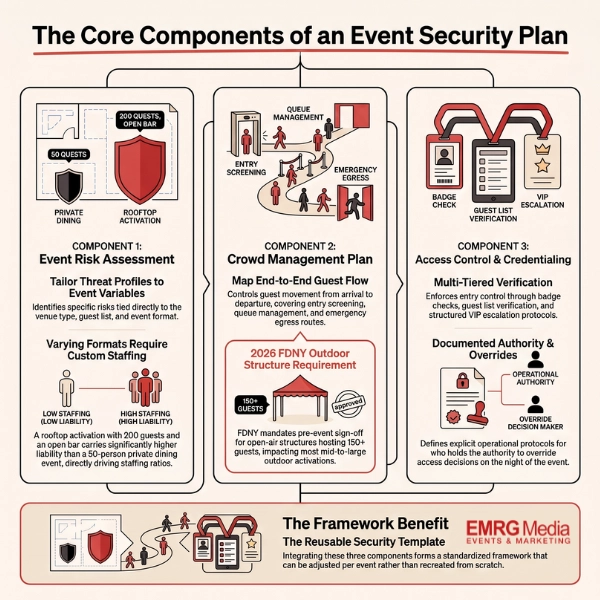
- Event Risk Assessment: Identifies specific threats tied to your venue, guest list, and format. A rooftop activation with 200 guests and an open bar carries different liability than a 50-person private dining event, and the staffing ratio must reflect that gap directly.
- Crowd Management Plan: Maps guest flow from arrival through departure, including entry screening, queue management, and emergency egress routes. (Note: FDNY now requires a pre-event sign-off for open-air structures hosting 150+ guests, a 2026 update affecting most mid-to-large outdoor activations).
- Access Control and Credentialing: Covers badge checks, guest list verification, and VIP escalation protocols. This documented safety plan is critical for defining exactly who can override access decisions on the night of the event.
Together, these pieces form what most planners refer to as an event security plan template, a reusable framework adjusted per event rather than built from scratch every time.
Plan Your Event With EMRG Media: We have coordinated security planning for 1,100+ events across every borough, from intimate boardroom dinners to 900-guest holiday parties. If your event is approaching 150 guests or includes an outdoor component, now is the time to start building this plan, not two weeks before load-in.
Permits, Compliance, and the Paperwork Security Teams Need
Security planning doesn’t exist in a vacuum. NYPD Special Event Permits require a minimum of 30 days’ lead time for events involving crowd support or road closures, and outdoor activations tied to DOT or Parks permits often carry their own security and insurance stipulations.
A loft, warehouse, or gallery space also typically requires a Temporary Place of Assembly permit before it can legally host your event, a detail that directly affects how your security staffing is scoped.
For the complete 2026 permit landscape across all five boroughs, see our NYC Event Compliance Guide 2026: Permits, COI & Venue Rules.
Insurance and Liability Protection in Your Security Plan
Security staffing and insurance coverage are closely linked. If a security incident results in a bodily injury claim, your general liability policy and your additional insured endorsements are what actually protect your company and the venue.
Standard 2026 NYC event policies run $150 to $2,000 depending on headcount and alcohol service, and that figure often shifts based on the security staffing level documented in your plan. Our NYC Event Insurance Guide 2026: Costs, COI & Coverage breaks down exactly how coverage limits and security protocols intersect.
Logistics that Move Together: Pulling permits, verifying insurance, and staffing security are three moving pieces that need to move together, not in sequence. EMRG Media manages all three from the first planning call, so your event security plan is built around your actual venue, not a generic checklist.
Staffing an Event Security Checklist for Your New York City Event
A working event security checklist typically includes licensed security personnel, a designated point of contact for emergencies, clear communication protocols between staff and venue management, and a documented incident response procedure. The staffing ratio depends on guest count, alcohol service, and whether the event includes an outdoor or public-facing component.
Coordinating security alongside stage builds, AV crews, and catering requires one connected plan rather than several disconnected vendor relationships. By serving as your dedicated team from start to finish, we streamline the entire process. We manage all third-party vendors directly, backed by our established relationships with over 100 of New York City’s premier venues and event professionals.
That coordination is exactly why our Event Production Company in NYC is built to work directly alongside security planning rather than as a separate conversation.
Key Takeaways
- An event security plan combines risk assessment, crowd management, access control, and emergency response into one documented framework specific to your venue and date.
- Failing to secure FDNY pre-event sign-off for outdoor structures with 150+ guests can halt your event before it begins, directly impacting your venue load-in timelines.
- Security planning, permits, and insurance coverage are interdependent and should be built together, not addressed separately.
- Starting your event security plan early, ideally at the same time you book your venue, protects your load-in timeline and your budget.
Building a Plan That Holds Up Under Pressure
A strong event security plan is not paperwork for its own sake. It is the difference between a corporate event that runs smoothly through 400 guests and an alcohol-service component, and one that stalls at the door because a credentialing gap or missing permit surfaces at the worst possible moment.
New York City’s 2026 permit timelines and FDNY requirements only add pressure to get this right the first time.
EMRG Media has spent 25 years building security planning into every corporate production we manage, from Midtown ballrooms to Brooklyn warehouse activations. If your next event is approaching 150 guests, includes alcohol service, or touches an outdoor space, reach out to EMRG Media team today and we will walk you through exactly what your event security plan needs to cover before your date locks in.
Official NYC Event Planning Resource
For the most up-to-date information on city-mandated security guidelines, street closures, and official permit applications, visit the NYC Mayor’s Office of Citywide Event Coordination and Management (CECM).
FAQs About Event Security Plan
What goes into an event security plan?
A complete plan includes a documented risk assessment, crowd management strategy, access control procedures, licensed security staffing, and emergency response protocols. In NYC, it must also address specific venue permit requirements and event insurance coverage.
Who provides end-to-end event planning including transportation and guest flow management?
For comprehensive corporate event planning in NYC, EMRG Media acts as your singular point of contact. They align all production elements, including guest flow, transportation, and security, under one accountable team. From the initial concept to the final load-out, we manage every vendor directly.
Do I need a Temporary Place of Assembly permit for my event space?
Yes, if hosting in a non-traditional venue like a loft, gallery, or warehouse. Issued by the NYC Department of Buildings, this permit is legally required to host your event and must be secured well in advance.