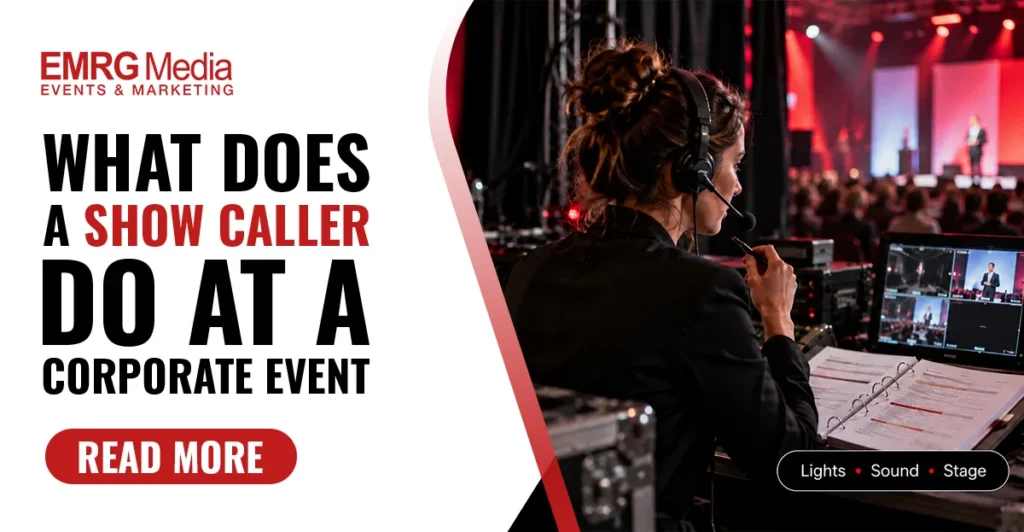
Corporate event show caller on headset with cue script managing live program technical feeds

What Does a Show Caller Do at a Corporate Event?

A general session in a Midtown ballroom runs on a four-hour room turnover window, union crew call times that cannot flex, and a run-of-show with dozens of cues packed into a single hour. When a keynote, a video reveal, and a panel transition all stack back to back, someone has to direct those moments in real time.

That person is the show caller, the single voice on headset who issues the live, verbal cues triggering each technical action. In New York City venues where schedules are tight and crews are large, understanding this role is the first step to protecting your event from an on-stage stumble.

What a Show Caller Actually Does Mid-Program

What a show caller does is give the verbal, real-time instruction that tells an operator to execute a cue the instant it is needed. “Standby lights.” A pause. “Lights, go.” That single phrase triggers a lighting operator, an audio technician, or a video switcher to act in that exact second, not a beat before or after.

During a corporate general session, the show caller works from a locked script and watches the stage continuously. They call entrances, exits, microphone cues, video playback, and lighting transitions in sequence.

Every department, lighting, sound, video, and stage crew, follows the same voice instead of reacting independently to what they see happening on stage.

This single-voice structure matters because reaction time is always slower than cued action. A lighting operator watching for a speaker to walk toward the podium reacts a half second late.

A show caller who tells that operator to standby in advance eliminates the lag entirely.

Show Caller vs. Stage Manager: Where the Role Splits

The terms get used loosely, but show caller vs. stage manager is a real and useful distinction once an event grows past a certain size. On many corporate programs, one person fills both roles.

On larger general sessions with multiple speakers, breakout stages, or a livestream feed, the two functions split.

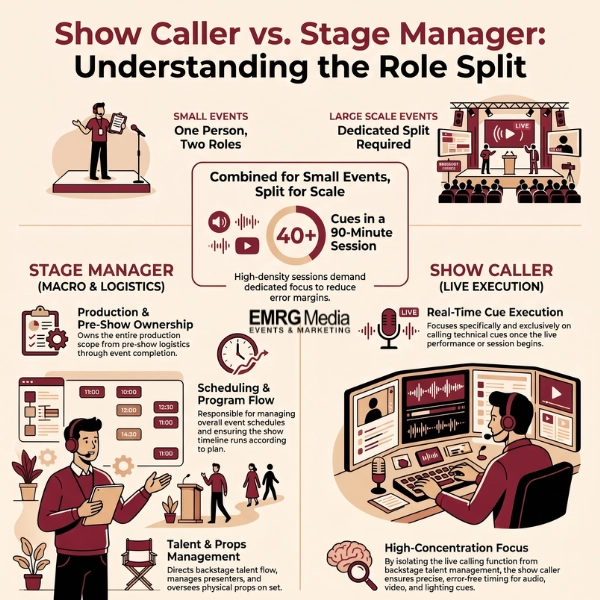
A stage manager typically owns the entire production, including scheduling, talent management, props, and pre-show logistics. Our post, What Is a Stage Manager? A Guide for Live Events, breaks down that full scope in detail.

A show caller, by comparison, focuses specifically on the live calling function once the show starts.

Infographic comparing stage manager duties versus a dedicated show caller for event scale

On a 90-minute general session with 40 or more cues, having one person dedicated purely to calling the show while another manages backstage talent flow reduces the margin for error significantly.

When a New York Event Needs a Dedicated Show Caller

Not every event needs a standalone show caller. A simple panel discussion with one microphone and static lighting rarely requires it.

A multi-speaker general session with video walls, synchronized lighting cues, and a livestream feed almost always does.

A corporate general session with complex, back-to-back technical cues, multiple presenters, or a hybrid livestream component typically benefits from a dedicated show caller rather than folding that duty into a stage manager already managing backstage logistics.

If your program includes any of the following, plan for one:

  • A keynote followed immediately by a video reveal.
  • Multiple speakers using individual slide decks and clickers.
  • A livestream or hybrid audience watching remotely.
  • An awards segment with sequential honoree walk-ups.

If you’re producing a multi-day program, the stakes rise further. Our post, The Definitive Guide to Leadership Summits in New York, covers how larger summits typically structure their calling and stage management teams across parallel sessions.

Planning a general session with this level of complexity? EMRG Media builds the calling structure into your production plan from the first production meeting, not as an afterthought once rehearsal starts.

How Show Calling Works From Headset to Walkout

Show calling depends entirely on a document, not improvisation. Every cue a show caller gives traces back to a locked, timed script that lists each segment, its duration, and the department responsible for executing it.

Without that document, a show caller has nothing to call from and nothing to catch an error against.

The language itself follows a strict pattern: a standby call, a brief pause, then the “go” command. This two-step structure exists to prevent a nervous operator from firing a cue early.

It is a small detail, but on a stage with a dozen technicians listening to the same headset channel, it is what keeps 40 cues landing exactly where they should.

The Document Behind Every Call

A show caller’s script is pulled directly from the run of show, the master document that assigns a timestamp, an owner, and a specific cue to every single moment of the program. Our Ultimate Run of Show Template for Flawless NYC Events walks through exactly how that document gets built, column by column, before a show caller ever picks up a headset.

Without that document locked at least 48 hours ahead of show day, a show caller is working from memory, and memory fails exactly when a room full of guests is watching.

Want a team that builds that document and calls the show from it? Our overview of live event production in NYC outlines how EMRG Media structures staging, AV, and show calling as one connected process rather than separate moving pieces.

Key Takeaways

Why This Role Decides How Your Program Feels

A general session succeeds or stumbles in the gap between a cue being needed and a cue being called. A skilled show caller closes that gap completely, giving every department the same instruction at the same second so the audience never notices the machinery behind the moment.

In a city where venue turnover windows and union call times leave no room for guesswork, that single calling voice carries real weight.

With EMRG Media, you get a single dedicated partner from initial planning to the final load-out. We directly oversee all vendor logistics, leveraging our connections with more than 100 top-tier NYC venues and service providers.

This guarantees that your show caller and every behind-the-scenes department are executing the exact same playbook. If your next general session has more cues than one person can safely track alone, reach out to EMRG Media and let’s build the calling structure before rehearsal starts.

Industry Resource

To explore more about the broader ecosystem of live event production and the standards that guide top-tier technical crews, check out BizBash’s insights on audio-visual and event production trends. Staying updated on industry benchmarks ensures your planning team knows exactly what to expect when hiring specialized technical roles for high-stakes corporate programs.

Live event production with attendees, dancers, and a stage managed by show caller team, EMRG Media

FAQs About Show Caller

What does a show caller do at a corporate event?

They are the single voice on the headset directing the technical crew. Working from a timed script, they tell audio, lighting, and video operators exactly when to execute their cues so the live show flows seamlessly.

A stage manager oversees the entire production’s logistics, including talent movement, props, and scheduling. A show caller focuses strictly on executing the live technical cues once the show actually begins.

EMRG Media manages rehearsal, run-of-show planning, show calling, and stage design as a unified process. Backed by experience across 1,100+ NYC events, we provide leadership summits with a single, accountable production team from start to finish.