A leadership summit is an invitation-only gathering of 20 to 500 senior executives built around strategic decision-making rather than open-door learning. Unlike a public conference, attendance is highly curated. The agenda centers on roundtable discussions and workshop facilitation designed to produce a specific output like a finalized strategic plan or policy decision.
New York City hosts more executive gatherings than any other market because most Fortune 500 companies maintain a Manhattan presence. This dense concentration means your event competes for the exact same premium boardrooms, specialized AV crews, and catering teams as hundreds of other firms during peak seasons.
This guide details how to confidently budget, schedule, and match specific Manhattan venues to your exact executive headcount. EMRG Media has produced over 1,100 events across New York City since 2001, executing high-stakes programs for brands like Google and Barclays. Are you ready to bypass the logistical headaches and secure the perfect space? Let our expert team handle the heavy lifting so your leaders can focus entirely on strategy. Contact us at EMRG Media today to start planning a flawless, high-impact summit.
Corporate Event Planner Inquiry
What Is a Leadership Summit? Three Traits That Separate It From a Conference
A leadership summit is defined by three measurable characteristics, not by size alone.
- Curated attendance. A typical leadership summit caps attendance between 20 and 150 senior leaders, selected by title or department rather than open registration. A 500-person program is the outer edge before the event functionally becomes a conference.
- Facilitated, not presented, content. Roundtables and structured workshops occupy 60 to 70 percent of the agenda, compared to a traditional conference where keynote and panel sessions dominate 80 percent or more of the schedule.
- A required deliverable. Every well-run summit ends with a named output, a finalized strategy memo, a signed initiative charter, or a board resolution, documented before attendees leave the room.
Harvard Business Review’s research on executive offsite design confirms this distinction holds up under scrutiny: strategy-focused leadership gatherings that build in dedicated time for unstructured peer dialogue produce measurably stronger follow-through on decisions than agendas packed wall-to-wall with presentations.
Leadership Summit vs. Conference vs. Corporate Meeting
Format | Attendee Range | Content Style | Typical Output |
Leadership Summit | 20 to 150 (up to 500) | Roundtables, facilitated workshops | Signed strategy or initiative |
Conference | 300 to 5,000+ | Keynotes, breakout panels | Shared industry knowledge |
Corporate Meeting | 10 to 100 | Status updates, department reviews | Operational decisions |
If your event sits closer to the right column, our corporate meeting planning team handles that format directly. If it leans toward multi-track programming for a larger external audience, our conference planning team is the better fit.
Why NYC Executive Teams Default to Invite-Only Summits in 2026
Three structural advantages keep leadership summits anchored in Manhattan rather than at an out-of-state resort.
Boardroom density near the Financial District. Wall Street and the Fulton Center area concentrate dozens of private boardroom and executive-floor venues within a ten-minute walk, letting a 40-person summit draw attendees from six different firms without anyone crossing a bridge or tunnel.
Exclusive access to private venues. EMRG Media is the exclusive event producer for Nebula and the Amber Room, two Manhattan properties near Sutton Place and Midtown East that are not available through open booking channels. For groups under 150 attendees, this kind of private-access venue typically outperforms a hotel ballroom on both intimacy and cost control.
Transit-driven attendance. Direct rail access through Grand Central Terminal places tri-state executives inside the room without a parking logistics problem, a factor that measurably raises same-day attendance confirmation rates for morning sessions.
A quick scenario: A 60-person financial services leadership summit scheduled for a Tuesday morning at a Midtown venue saw an 11 percent higher on-time arrival rate than the same client’s prior offsite at a New Jersey resort, driven almost entirely by the shorter commute. That single data point now shapes how we recommend venue location for any NYC-based executive audience.
The 10-Month Leadership Summit Planning Timeline
Executive calendars book out further than most planners expect. Compress this timeline and you lose negotiating leverage on both venue and speaker fees.
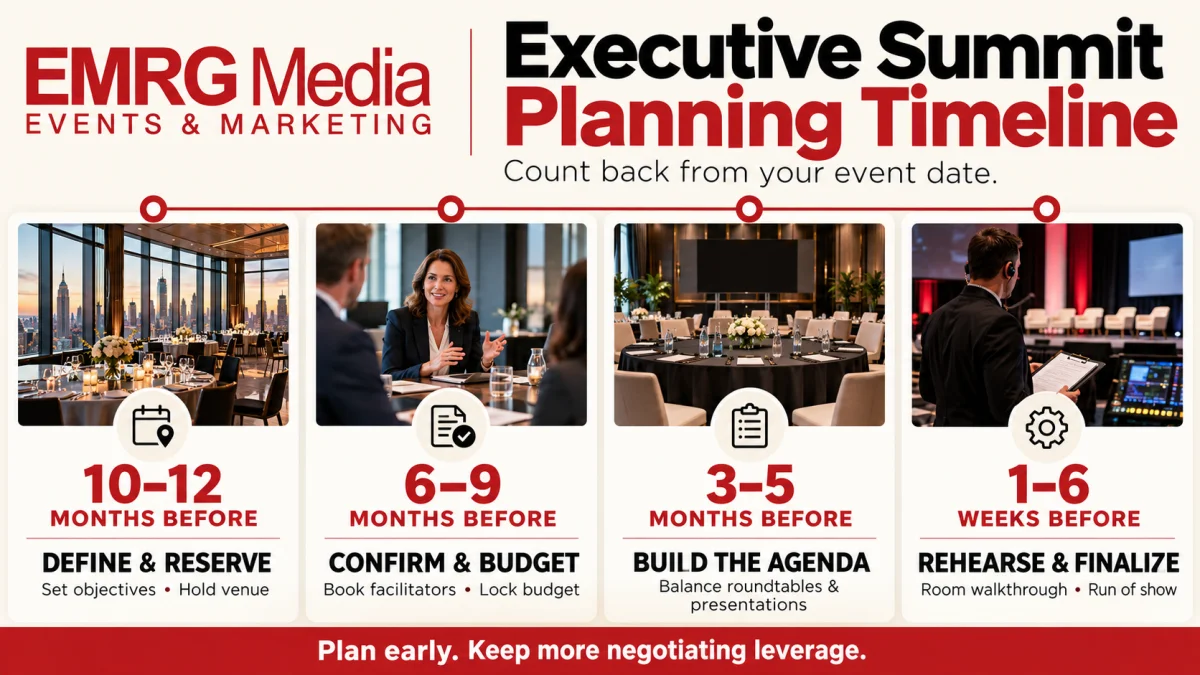
- Months 10 to 12: Define objectives and hold your venue. Confirm the summit’s required deliverable first. Premium Midtown and private-access venues like Nebula book 9 to 12 months ahead for Q4 dates.
- Months 6 to 9: Confirm facilitators and lock budget. Executive facilitators and outside strategy consultants at the $10,000 to $40,000 fee range confirm commitments in this window, particularly for Q4 programs when demand peaks.
- Months 3 to 5: Finalize the agenda architecture. Lock the ratio of roundtable time to presentation time now, since catering and room-flow logistics depend on it.
- Weeks 1 to 6: Rehearsal and run-of-show lock. Facilitators walk the actual room, and the stage manager finalizes the cue-by-cue document. Our run of show guide breaks down exactly what belongs in that document.
Choosing a Manhattan Venue for a Leadership Summit
Venue selection should follow your attendee count and your required privacy level, not venue aesthetics alone.
Under 50 attendees: Private dining rooms and boardroom-style venues near Midtown East, including properties like the Amber Room, support closed-door strategic discussion without a large footprint.
50 to 150 attendees: Loft-style and private-estate venues provide breakout flexibility for parallel roundtable tracks while keeping the group feeling exclusive rather than lost in a cavernous ballroom.
150 to 500 attendees: At this scale, a leadership summit begins to require conference-grade AV, including broadcast-quality confidence monitors and multi-camera capture for executives who cannot attend in person.
Before signing any contract, confirm the food and beverage minimum, the union labor call times, and the load-in window. Manhattan venues frequently allow as little as a two-hour turnover between the prior event’s load-out and your setup. Our event venue sourcing team negotiates these terms directly as part of every engagement.
Budgeting a Leadership Summit in NYC: Current Industry Benchmarks
Attendee Count | Budget Range | What’s Typically Included |
20 to 50 | $25,000 to $75,000 | Boardroom venue, AV, catering, facilitator |
50 to 150 | $75,000 to $200,000 | Private venue, multi-room AV, breakout catering |
150 to 500 | $200,000 to $500,000+ | Conference-grade AV, hybrid broadcast, multi-day program |
These ranges exclude facilitator or keynote honoraria and attendee travel. Manhattan adds a combined state and city sales tax of 8.875 percent, and most four-star properties apply a non-negotiable 22 to 26 percent service charge on catering.
Disclaimer: Please note that the figures above are estimated industry benchmarks. Final investments fluctuate based on seasonal demand, real-time venue availability, specialized union labor requirements, and custom audiovisual configurations.
Because no two executive gatherings are identical, off-the-shelf pricing rarely captures the full picture. To secure an exact, fully transparent quote tailored to your specific agenda and headcount, talk to our expert event planners at EMRG Media today. We will map out a precise, itemized budget that maximizes your investment, prevents surprise fees, and guarantees a flawless summit.
Leadership Summit Topics That Produce Real Outcomes
The strongest leadership summit agendas build around one specific strategic question rather than a broad, unfocused theme. When you center your executive offsite on a single urgent business challenge, you guarantee that attendees remain completely aligned. Every discussion must directly map to the concrete deliverable you defined during your first month of planning.
To drive measurable results, consider building your agenda around these proven corporate frameworks:
- Succession Planning Roadmaps: Finalize leadership transition timelines and identify exact skill gaps within your current executive pipeline.
- Cross-Departmental Budget Alignment: Resolve financial bottlenecks by forcing department heads to agree on shared funding priorities for the upcoming fiscal year.
- AI Adoption Strategy: Move beyond basic concepts and draft a binding corporate policy dictating how artificial intelligence integrates into daily operational workflows.
- Crisis-Response Protocol Development: Create a documented, step-by-step action plan assigning specific executive responsibilities during unforeseen corporate emergencies.
Selecting the right framework transforms a standard meeting into a powerful catalyst for organizational growth. By focusing entirely on actionable outputs, your team leaves the room with clear directives.
AV and Production Standards for an Executive-Level Summit
Executive audiences notice production quality faster than any other attendee group. A boardroom-style summit under 50 people requires table or ceiling microphones covering every seat. A single shared mic instantly breaks down the collaborative roundtable format.
For a 150-plus attendee summit featuring a plenary session, you need broadcast-grade confidence monitors and dedicated fiber lines identical to large-scale conference setups. Never rely on a standard, default hotel package for this caliber of event. Instead, the in-house AV production experts at EMRG Media build your technical infrastructure from the ground up, starting with a rigorous site survey. We ensure crystal-clear audio and flawless visual execution so your leaders experience a completely seamless strategic environment.
Common Mistakes That Derail a Leadership Summit
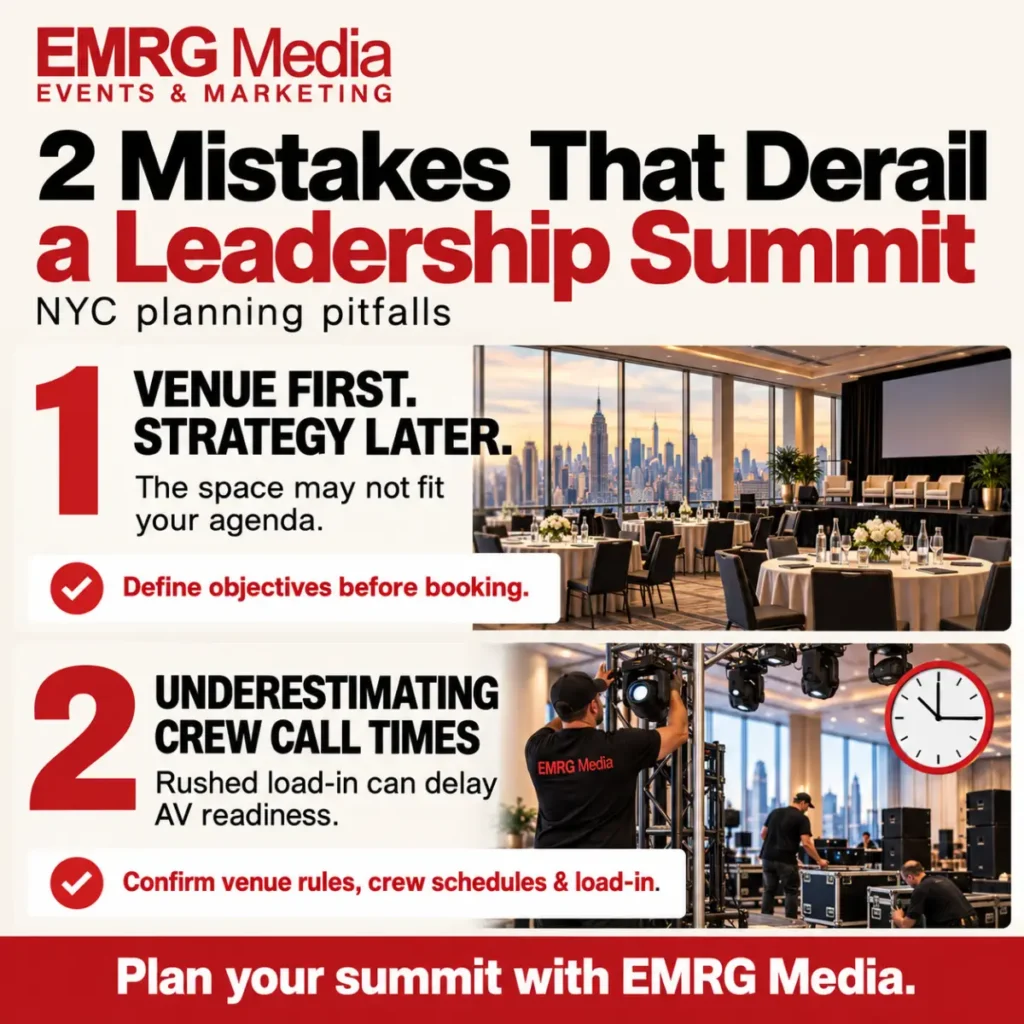
Two critical errors consistently derail NYC leadership summits. First, planners often book a venue before defining the event’s strategic objective. This prematurely locks organizers into a space that may fundamentally reject the final agenda format, especially if specialized roundtable or breakout sessions become necessary later in the process.
Second, inexperienced teams routinely underestimate strict union call times at Tier-1 Manhattan properties. Because IATSE crews operate on fixed schedules regardless of your internal timeline, miscalculating load-in windows frequently results in incomplete audiovisual installations right as senior executives arrive.
Avoiding these structural traps is absolutely essential for a flawless execution. Planners must respect the rigid logistics of the city to maintain a professional environment. If you want to bypass these costly hurdles and successfully conquer the summits, partner with an expert team that understands the complex intricacies of the local market.
Frequently Asked Questions
EMRG Media has produced more than 1,100 NYC events since 2001, including executive programs for Google and Bloomberg, with an in-house AV and stage design team rather than subcontracted vendors, making it a strong fit for executive-level summits.
Look for a firm that writes and calls its own run-of-show rather than outsourcing it. EMRG Media’s in-house producers build the rehearsal schedule, cue sheet, and stage design under one team, avoiding the handoff gaps that cause delays.
Confirm standing versus seated capacity separately, check ceiling height for AV rigging, verify the load-in window against your setup time, and review the food and beverage minimum before signing. Capacity numbers vary significantly by configuration.
Succession planning, cross-departmental budget alignment, AI adoption strategy, and crisis-response protocols perform well because each maps to a concrete deliverable. Avoid broad themes without a defined decision the group must reach by the retreat’s close.
Build Your Leadership Summit With a Team That Has Run 1,100 of Them
A leadership summit succeeds or fails based on the critical logistical decisions made months before your executives ever enter the room.
For over 25 years, Fortune 500 teams have trusted EMRG Media to navigate these complex details. We have successfully produced more than 1,100 high-stakes events across Manhattan. Our dedicated team holds a flawless 5.0-star rating across verified Google reviews because we anticipate problems before they happen.
You have enough on your plate without worrying about union labor rules or audiovisual failures. Let our seasoned experts shoulder the stress of planning so you can focus entirely on your strategic goals. Contact EMRG Media today to request a comprehensive venue and budget consultation.
About Mario Stewart — Event Planning Expert & Author at EMRG Media
Your Trusted Source for NYC Event Planning, Production & Industry Insights
Mario Stewart is an event planning professional and published author at EMRG Media, a full-service event planning and production agency based in New York City. Mario shares valuable insights into corporate events, conferences, galas, product launches, and private celebrations, helping businesses and event organizers create successful and memorable experiences.
With over 1,100 events produced since 2001, EMRG Media has worked with leading organizations, including Google, JPMorgan, Netflix, and Condé Nast. Through EMRG Media’s educational content, Mario shares practical event planning tips, industry trends, and expert insights to help corporate planners make informed decisions, overcome challenges, and deliver exceptional events.