
If you are staffing a corporate event in New York, NY and searching for event planner vs event manager, you are probably staring at three vendor proposals with three different titles and no clear sense of who actually does what.
In a market where a mid-size event can involve 15 to 50 vendors, hiring the wrong role costs you time, budget, and control long before the event date arrives.
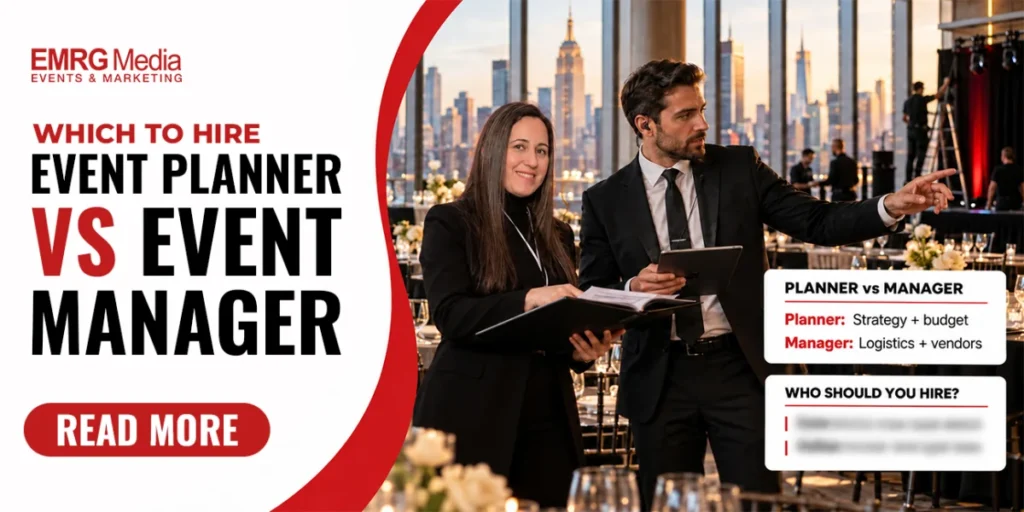
Here is the direct answer, an event planner owns the strategy, budget, and vendor relationships from concept through wrap-up.
An event manager typically owns logistics and vendor oversight for weeks or months once that plan exists. The titles overlap constantly in New York because most full-service firms fold both functions into one team.
The Real Difference Between an Event Planner and an Event Manager
When breaking down the core differences in event planner vs event manager, an event planner starts at the beginning.
They run discovery sessions, build the budget, source venues, negotiate vendor contracts, and develop the creative concept before a single chair is rented.
They oversee logistics, track the budget against the plan already built, manage vendor deliverables over the following weeks or months, and keep the production schedule on track.
The event manager vs event planner distinction matters most when comparing proposals, a planner’s scope typically includes financial creation and vendor negotiation from scratch.
Role | Timeline Involvement | Core Responsibility | Budget Authority | Best For |
Event Planner | Concept through wrap-up (often months) | Strategy, vendor negotiation, budget creation | Builds and owns full budget | Complex events, corporate approval chains, high-stakes budgets |
Event Manager | Weeks to months out from date | Logistics oversight, vendor management, schedule | Tracks and manages existing budget | Events needing sustained operational oversight after strategy is set |
Event Coordinator | Final 2 to 4 weeks | On-site execution, day-of troubleshooting | Rarely holds budget authority | Events already planned internally needing day-of execution support |
Event Coordinator vs Event Planner: Where the Line Actually Falls
The difference between event planner and event coordinator comes down to timeline and authority, and it is a wider gap than the planner-manager split above.
A coordinator usually steps in during the final two to four weeks before an event to execute a plan someone else already built. A planner owns the entire lifecycle, including the strategic decisions made months earlier.
For a full breakdown of what this role covers day-to-day in New York, see our guide on NYC event coordinator, the event coordinator vs event planner comparison also affects pricing.
Why New York Corporate Events Blur These Titles Even Further
Someone needs budget authority to catch that before a contract is signed, which is a planner function, not a coordinator function and often not a manager function either.
Union labor requirements under IATSE and Teamsters agreements at certain Manhattan venues also affect crew scheduling and cost over the full production window.
For a deeper look at what a full-service role actually covers across all seven responsibility areas in this market, review what does an event planner do.
If you are still unsure which role fits your event, reach out to EMRG Media can walk through your scope on a short discovery call and tell you exactly what level of support you need, no obligation attached.
A Simple Framework for Choosing the Right Role in New York, NY
If your team is weighing an event planner vs event manager for an upcoming gathering, use event size, internal bandwidth, and timeline to decide:
- Under 50 guests, low complexity: A coordinator is often sufficient if your team has already built the plan.
- 100+ guests, multiple vendors, corporate approval chains: A full planner is the safer choice, since budget creation and vendor negotiation carry real financial risk.
- Multi-month production with an existing plan: An event manager can carry logistics oversight without you needing to rebuild the strategy layer.
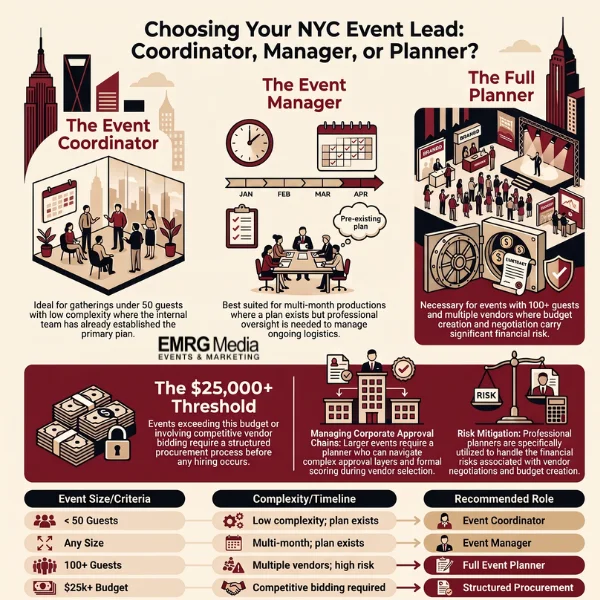
If your event also involves competitive vendor bidding, formal scoring, or a $25,000-plus budget, a structured procurement process helps clarify scope before you hire anyone.
Our NYC event RFP from scope to vendor selection guide breaks down exactly how that process works.
When You Actually Need All Three Roles
Large corporate productions in New York, such as product launches or multi-day conferences, often use a planner for strategy and budget, a manager for sustained logistics oversight, and a coordinator for on-site troubleshooting in the final weeks.
At EMRG Media, these functions sit under one accountable team rather than three separate contracts, which is standard practice across our event planning and management services.
When a caterer cancels at 6 p.m. the night before, you want one person with the authority and vendor relationships to fix it, not three people debating whose job it is.
What Happens When You Hire the Wrong Role
Hiring a coordinator for a strategy-heavy event usually means no one negotiated your venue contract or caught a hidden minimum spend clause months earlier.
Hiring a full planner for a simple 30-person dinner can mean paying for strategic services you did not need.
Mismatched scope is also where change orders creep in, vague role boundaries produce vague deliverables, and vague deliverables produce budget overruns once gaps surface mid-planning.
Key Takeaways
- An event planner owns strategy, budget creation, and vendor negotiation from start to finish.
- An event manager typically oversees logistics and an existing budget for weeks or months, distinct from a coordinator's final-weeks execution role.
- A coordinator steps in during the final two to four weeks before the event date.
- New York's union labor rules, permit lead times, and venue minimums often require planner-level budget authority, even on mid-size events.
Getting Your NYC Event Staffed Correctly From Day One
The titles matter less than the scope of authority behind them, before signing with any firm, confirm who owns your budget, who negotiates your vendor contracts, and who is managing logistics between now and event day.
In New York, where a single missed permit deadline or unnoticed venue minimum can cost thousands, that clarity is not optional.
EMRG Media has built its 25-year track record on keeping that scope clear from the first conversation. You can see recent client feedback and event highlights on our Facebook page.
Not sure which role fits your event? Get in touch with EMRG Media today for a straightforward consultation, and we will match you with exactly the level of planning, management, or coordination support your event actually needs.

FAQs About Event Planner vs Event Manager
What is the difference between an event planner vs event manager?
An event planner builds the event from scratch, owning the overarching strategy, budget creation, and vendor contracts.
In contrast, an event manager steps in to track that existing budget and oversee logistical execution over the weeks or months leading up to the event.
What other titles are used for event planners?
Common alternatives include event producer, event strategist, event director, and experiential producer.
Titles like producer emphasize technical production and creative staging, whereas strategist or director reflects high-level financial and contractual authority.
Which role runs the event on the day?
On-site execution is typically led by a coordinator or an event manager following the master run-of-show document.
This lead directs vendor arrivals, manages guest flow, and resolves real-time issues so the host never has to field operational fires.