
Signing an event planning contract in New York without reading every clause is how corporate teams end up with a 50% deposit gone, a Midtown venue with a two-hour load-in window, and no idea who covers the AV crew if a vendor cancels.
Manhattan venue leases routinely require 25 to 50 percent deposits at signing, with cancellation penalties tightening inside 90 days of your event date.
A properly built contract for event planning protects you from exactly that scenario before you ever pay a dollar.
Here is what belongs in your agreement, clause by clause, and why New York’s specific market conditions make each section carry more weight than a generic template.
Why New York Contracts Carry More Risk Than a Standard Template
A generic event planning contract template downloaded from a search result rarely accounts for New York-specific realities.
Union labor rules under IATSE and Teamsters agreements apply at select Manhattan venues, and those rules affect both cost and scheduling in ways a national template will not flag.
Venue exclusivity clauses at hotel properties can also lock you into in-house catering or AV vendors without you realizing it until after signature.
A contract written for New York conditions addresses these variables directly instead of leaving you to discover them mid-production.
The Scope of Services Clause: What Should Be Spelled Out
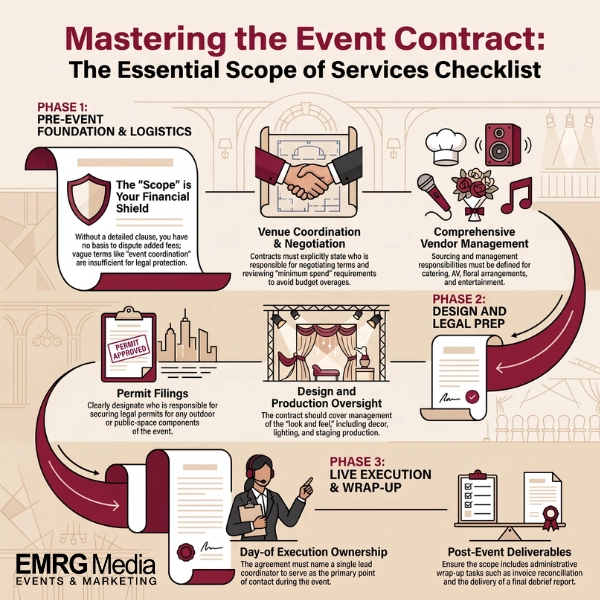
The scope of services section is the backbone of any event planning contract agreement, if your agreement only says event coordination, you have no basis to dispute an added fee once one appears.
A properly scoped clause names each phase and who owns it.
Before signing, confirm your contract explicitly lists:
- Venue coordination, including who negotiates the contract and who reviews minimum spend terms.
- Vendor sourcing and management for catering, AV, florals, and entertainment.
- Permit filings for outdoor or public-space components.
- Design and production oversight, from decor to lighting to staging.
- Day-of execution, naming a single lead coordinator as your point of contact.
- Post-event deliverables, such as invoice reconciliation or a debrief report.
This same itemization discipline is the foundation of a strong vendor brief.
Our NYC event RFP from scope to vendor selection guide walks through how to define these deliverables before vendors ever submit a bid, which makes comparing contracts far easier once proposals come back.
Deposit, Payment Schedule, and Cancellation Terms in New York
Most New York contracts require a deposit between 25 and 50 percent at signing, with the balance due on a schedule tied to milestones like final headcount confirmation or 30 days before the event.
Before you sign, check that the cancellation section answers these four questions:
- What percentage of the deposit is refundable, and at what point does that percentage change?
- Do penalties increase inside a specific window, such as 90 days out?
- What happens if the planner cancels, rather than the client?
- Are weather or force majeure cancellations handled differently from a standard cancellation?
Reviewing a sample event planning contract from a planner before you commit gives you a real baseline to compare against whatever you are actually being offered.
Ready to see what a transparent agreement looks like in practice? Get in touch with EMRG Media builds every contract around written scope and payment terms agreed before a single vendor is booked. Talk to our team about your event.
Insurance, Liability, and Additional Insured Language
Every legitimate New York event contract references insurance directly. A missing additional insured endorsement can block your load-in access on event day, regardless of how well everything else is planned.
Before signing, confirm your contract specifies:
- Who secures the Certificate of Insurance, the planner, the venue, or you as the client.
- Minimum liability limits, typically $1 million per occurrence for Manhattan venues.
- Additional insured parties, naming the venue and, in some cases, the city agency issuing your permit.
- Deadline for COI submission, usually 10 to 30 days before the event date.
For a full breakdown of coverage limits, COI requirements, and vendor verification, see our guide on event insurance for NYC corporate events.
Vendor and Subcontractor Responsibility Clauses
Your contract for event planning should clarify whether the planner manages vendor contracts directly or whether you are separately responsible for signing with each caterer, florist, and AV team.
Before signing, your contract should state:
- Who holds each vendor contract, the planner or the client directly.
- Liability terms if a subcontracted vendor fails to show, including what remedy applies.
- Backup vendor protocols for high-risk categories like catering and AV, named before event day.
- Approval rights, confirming whether you sign off on vendor selections or the planner has discretion.
This is standard practice across full-service event planning and management engagements, where one accountable team manages every vendor relationship under a single contract.
Force Majeure and Weather Contingency Provisions
Outdoor New York events need explicit weather contingency language written into the contract, not assumed as common sense.
Before signing, confirm the agreement addresses:
- Who pays for a rain plan, including tent rental or an indoor venue switch.
- Transit shutdowns or road closures that block vendor access or guest arrival.
- Permit denials or revocations from NYC Parks or the Department of Transportation.
- Notice requirements, meaning how far in advance a weather call must be made.
Without this clause, a canceled rooftop reception due to weather becomes a costly dispute instead of a planned contingency.
Key Takeaways
- A strong event planning contract itemizes scope, payment schedule, and cancellation terms in specific, written detail, not vague summaries.
- New York agreements must address union labor rules, venue exclusivity clauses, and additional insured language unique to this market.
- Deposit ranges of 25 to 50 percent and tightening cancellation penalties inside 90 days are standard across Manhattan venues.
- Reading a contract clause by clause before signing prevents the change orders and disputes that come from vague scope language.
A Track Record That Reflects the Standard, Not Just a Template
Reviewing dozens of event planning contract examples over 25 years of New York production has shaped a clear internal standard at EMRG Media 1,100+ events managed for clients including Google, JPMorgan, Netflix, Bloomberg, LVMH, and Condé Nast.
With every scope item, deposit term, and cancellation clause agreed in writing before a vendor is booked. No hidden deliverables. No surprise fees mid-production.
Reach out to EMRG Media today to start your consultation and see exactly what a fully scoped New York event agreement looks like before you sign anything.

FAQs About Event Planning Contract
Can I legally write my own contract?
Yes, you can legally draft your own event planning contract without an attorney. However, professional legal review is strongly recommended to ensure complex liability and cancellation terms remain enforceable.
What's the difference between a deposit and a retainer?
A deposit applies toward your final balance and is often partially refundable based on your cancellation terms. In contrast, a retainer secures the planner’s exclusive availability and is typically non-refundable.
How much should an event planner charge?
Planners generally charge a flat fee, an hourly rate, or 10% to 20% of the total event budget. The final cost depends on the scope of production, guest count, and required level of coordination.