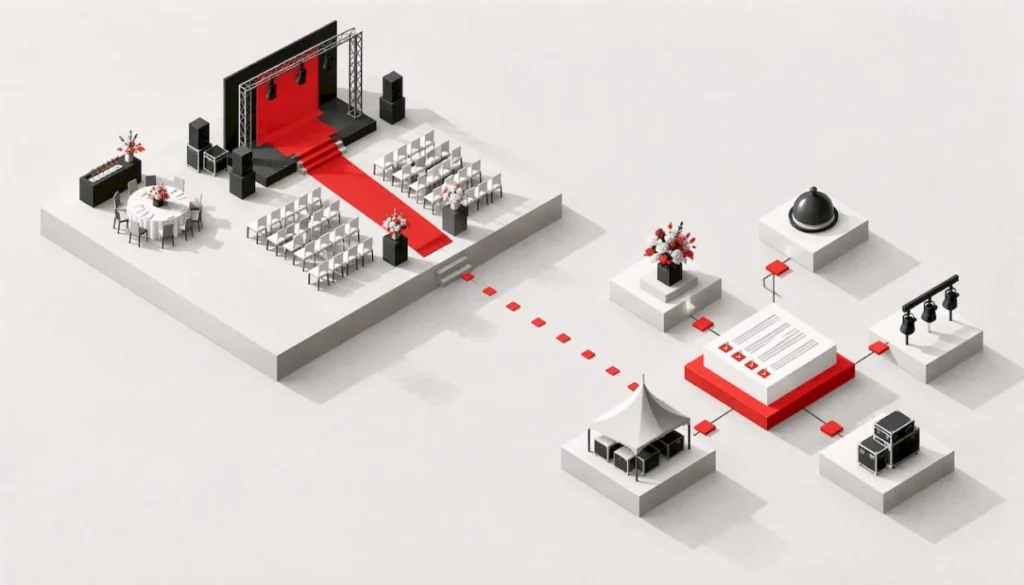

Event vendor management is the work of choosing, contracting, briefing, coordinating and reviewing every outside supplier an event depends on: caterers, AV crews, florists, décor builders, security, transportation. Done well, it means every vendor knows what to deliver, when, where and to whom, and one person can answer any question about any of them. This guide walks through the process in the order you will actually live it.
TL;DR
- Vendor management covers the whole lifecycle: define needs, shortlist, contract, brief, coordinate on site, then review. Coordination is only one part of it.
- Write the scope per vendor before you ask for quotes, then compare proposals on the same weighted criteria.
- Tie payments to milestones, get insurance certificates before load-in, and name escalation contacts in every contract.
- Route all vendor communication through one owner on your side, and give every vendor the same briefing.
- Finish with a scored review of each vendor while memories are fresh, and keep the results for the next event.
Table of Contents
- What event vendor management actually includes
- Step 1: Define what you need before you contact anyone
- Step 2: Build a shortlist and compare like with like
- Step 3: Put the agreement in writing
- Step 4: Verify insurance, permits and compliance
- Step 5: Coordinate communication and on-site logistics
- Step 6: Review every vendor after the event
- When to hand vendor management to a team
- Let one team manage the whole vendor list
- FAQ
- Sources
What event vendor management actually includes
The terms get used loosely. Event vendor management, event supplier management and vendor coordination overlap, but they are not identical.
- Vendor management is the full cycle. One glossary definition describes it as selecting, briefing, coordinating and monitoring external suppliers before, during and after the event so their activities stay aligned.
- Supplier relationship management leans toward the long game: supplier selection, contract negotiation, ongoing communication, performance evaluation and issue resolution, as Eventbrite’s guide to supplier relationships lays out.
- Vendor coordination is the logistics layer: schedules, deliveries, load-in order and who is standing where at 7 a.m.
In practice you need all three. Coordination without selection and contracts leaves you managing problems you could have prevented. Contracts without coordination leave good paperwork and a chaotic loading dock.
Step 1: Define what you need before you contact anyone
Vendors quote what you describe. A vague request produces vague, incomparable proposals. For each category, write a short requirements sheet first.
- Catering: guest count, dietary requirements, service style, menu preferences.
- AV: equipment needs, room dimensions, technical requirements, power and rigging limits.
- Décor and staging: footprint, load-in access, height limits, brand standards.
Add a budget ceiling per category at this stage. A vendor shortlist guide from Abastio makes the point that a scope of work and a ceiling set up front keep you from falling for a vendor who is out of range.
If the venue is not yet chosen, settle it first, because the venue often dictates which vendors are allowed, what loading windows exist and what insurance is required. Our explainer on what a venue sourcing company does covers how that decision shapes everything downstream.
Step 2: Build a shortlist and compare like with like
For each category, a shortlist of three to five vendors is workable. Good sources are venue recommendations, referrals from peers, and past events you have attended yourself. For critical vendors, such as the AV team who will run your main stage, see their work live if you can.
Then score the proposals on the same criteria. Published frameworks vary, but they agree on the ingredients. The Abastio framework, for example, weights relevant experience at 25%, pricing transparency at 20%, and references, responsiveness and insurance or compliance at 15% each, with flexibility at 10%. Use it as a starting point and adjust to your event.
| Criterion | Sample weight | What to look at |
|---|---|---|
| Relevant experience | 25% | Events of similar size and format, portfolio |
| Pricing transparency | 20% | Itemized quotes, clear exclusions |
| References and reviews | 15% | Two recent clients you can call |
| Responsiveness | 15% | Speed and quality of replies during the quote stage |
| Insurance and compliance | 15% | Current certificate, licenses, permits |
| Flexibility | 10% | Handling of changes, backup plan |
Before you decide, interview your finalists about contingencies: what happens if a lead technician is ill, if a delivery is late, if the guest count jumps by 20%? The answers tell you more than the brochure.
Step 3: Put the agreement in writing
A handshake and an email thread are not a vendor agreement. A solid contract does five jobs.
- Defines scope precisely. Exactly what is delivered, how many units or hours are included, and what falls outside. A contract clause overview notes that precise scope is what prevents the “I thought that was included” argument.
- Sets deliverables and standards. Quantities, specifications, quality standards and service levels.
- Ties money to milestones. Abastio’s guide to managing corporate vendors gives an example of 30% on signing, 40% on confirmed delivery of materials and 30% after the event. Other structures exist, such as a 50% deposit with the balance due before or after the event.
- Covers cancellation and postponement. Notice periods, fees, deposit refunds and what happens if performance becomes impossible.
- Allocates risk. Limits of liability, indemnities and insurance obligations.
Also name escalation contacts: who can make a decision on the day when the answer cannot wait. For New York specifics, see our event planner contract template and the five clauses to settle before you sign a Q4 contract.
How vendor fees and deposits typically work
There is no single typical vendor fee, because it depends on the category, the event and the vendor’s pricing model. Vendors may charge flat fees, a percentage of revenue, or a hybrid. One festival payments overview from Ticket Fairy describes a 50% deposit with the rest paid after the event, often within 30 days, and notes that performer deposits commonly range from 10% to 50% of the guaranteed fee. Treat these as reference points for the conversation, not rules. Ask each vendor for an itemized quote and compare line by line.
Step 4: Verify insurance, permits and compliance
This is where well-run events differ from lucky ones. Collect every vendor’s documents before the event, not at the loading dock.
A practical onboarding checklist, adapted from Abastio’s guidance, includes:
- Insurance verification and a certificate on file
- Executed contract
- Compliance acknowledgments such as NDAs or safety forms, where they apply
- A logistics briefing with load-in times and contacts
Requirements are local, so read your venue’s and city’s rules. Municipal handbooks show the pattern. The City of Port Moody’s special event handbook in Canada, for instance, asks for a general liability policy naming the city as additional insured, with the certificate provided two weeks ahead and host liquor liability when alcohol is served. In the US, the City of Bryan, Texas publishes a special events guide listing separate vendor permits and a temporary food service permit through the county health department. Your city will have its own version, and many New York venues set their own insurance minimums in the venue contract.
For New York events, especially in the busy fourth quarter, our guides to event vendor insurance for Q4 holiday events and event liability insurance by NYC venue explain what to request and when. For food and beverage, a banquet event order is the document that pins down the details with the venue.
Step 5: Coordinate communication and on-site logistics
Most vendor problems are communication problems. These habits prevent the majority of them.
One owner, one channel
Each vendor should talk to a single person on your team. When the CEO’s assistant, the marketing lead and the facilities manager all email the florist, the florist ends up with three versions of the plan. Name one point of contact on both sides and set regular check-ins.
One source of truth
Keep a shared document with signed scopes, key contacts, deadlines, delivery times, payment terms, insurance documents, floor plans, technical requirements and escalation contacts. Momencio’s vendor management overview stresses the same idea. A spreadsheet works. What matters is that it is current and everyone reads from it.
One briefing
Once an event reaches roughly 100 attendees or eight vendors, Abastio suggests a single briefing call so every vendor hears the same overview, timeline and escalation procedure. It also surfaces conflicts early: the band and the AV crew both assuming they own the same corner of the stage.
A run of show and a load-in schedule
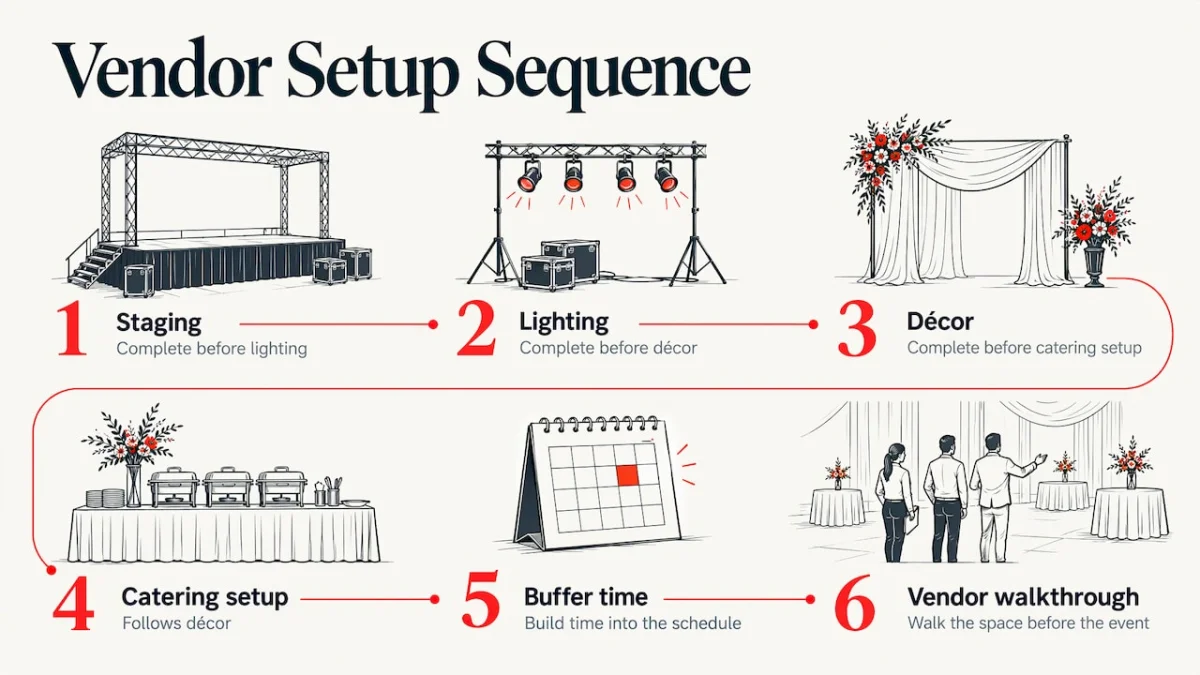
Sequence vendors by dependency. Staging before lighting, lighting before décor, décor before catering setup. Build in buffer time, and walk the space with the key vendors before the event. Our run of show template shows the format NYC producers use, and the conference logistics guide applies it to multi-room programs. If something still goes sideways, our event crisis management tips cover what to do in the first minutes.
Step 6: Review every vendor after the event
The event is not over when the doors close. Within a week or two, while details are fresh:
- Score each vendor against the same criteria you used to select them: delivery on scope, punctuality, quality, communication, problem handling.
- Reconcile final invoices against the contract and approved changes.
- Hold a short debrief with your internal team and, for major vendors, with the vendor.
- Record what to repeat, what to change and who you would rebook.
Keep the scores in the same shared document you used during planning. After two or three events you will have a vetted bench, and your next shortlist starts from evidence instead of searching.
Software can help with tracking, but it does not replace judgment. A tool will hold your contracts, reminders and payment dates. It will not call the caterer at 6 a.m. when the truck is late.
When to hand vendor management to a team
Managing five vendors for a 60-person dinner is a manageable side task. Managing 25 vendors across a conference, a gala dinner and a hotel room block while your day job continues is a different workload. The cost of fragmented management shows up as missed handoffs, duplicate orders and finger-pointing between suppliers.
Our perspective on vendor management
After more than 1,100 events since 2001, we have come to believe that vendor management is less about forms than about structure. Every handoff between companies is a place where information gets lost: the AV company that never saw the floor plan, the caterer who was not told the program ran long.
That is why we run events with a single in-house team that covers venue sourcing, logistics, hospitality, technical AV and on-site coordination, with one point of contact for the client from the first call to the last load-out. Fewer subcontractor handoffs means fewer gaps for problems to hide in, and consistent quality control across every part of the event.
Our advice to any organizer is the same whether or not they hire us: decide who owns each vendor relationship, write the scope down, and make sure someone has the authority to solve problems on the day. When the event is large enough that no one on your team can be that person, that is the moment to bring in a production partner.
EMRG
Let one team manage the whole vendor list
If you would rather not manage vendors yourself, we plan and produce corporate events, conferences, galas, fundraisers and private celebrations in New York City with an in-house team and a single point of contact. Venue sourcing, AV, staging, lighting and on-site coordination sit under one roof. Explore our event planning services or our event production services, and we will scope your event with you.
Not sure how early to start? Our NYC event planning timeline explains lead times, and what an event management company does shows where an agency fits.
FAQ
How do you find vendors for an event?
Start with a written requirements sheet for each category, then ask the venue for recommendations, ask peers for referrals and research online. Shortlist three to five vendors per category, check portfolios, reviews and insurance, and compare quotes on the same weighted criteria. For critical vendors, see their work at a past event if possible.
What should an event vendor contract include?
A detailed scope with quantities and standards, fees and payment milestones, how changes are approved and priced, cancellation and postponement terms, liability and insurance obligations, and named escalation contacts. Have a lawyer review contracts for large or high-risk events.
What is the difference between vendor management and vendor coordination?
Vendor management covers the full lifecycle: selection, contracting, briefing, monitoring and evaluation. Vendor coordination is the logistics part of that: schedules, deliveries, communication and on-site sequencing. Supplier management is generally used as a synonym for the broader process.
When should vendors be paid?
It depends on the contract. A common approach is a deposit on signing, with further payments tied to milestones such as delivery of materials, and a final balance after the event. Write the schedule into the agreement so both sides know what triggers each payment.
Sources
- Vendor Management, Momencio
- Supplier Relationship Management: A Guide for Events, Eventbrite
- How to Create a Vendor Shortlist for Events, Abastio
- How to Manage Corporate Event Vendors, Abastio
- Event Vendor Contract Template: Key Clauses to Include
- Festival Vendor Payments, Deposits, and Settlements, Ticket Fairy
- City of Port Moody Festival and Special Event Handbook
- City of Bryan Special Events Guide