The Ultimate Guide to NYC Launches That Command Attention and Drive Sales
Executing an activation in Manhattan requires masterful product launch event planning. New York City is the most competitive market on the planet. For brand executives and homeowners hosting exclusive unveilings, the problem is clear. You are fighting against hundreds of invitations for the attention of editors and elite buyers.
Getting it right means earning national press and immediate sales. Getting it wrong means watching a massive budget vanish by morning with zero return on investment. You need more than just a curated guest list. You need a bulletproof strategy.
This guide delivers exactly what you are searching for. We break down the precise budgets, realistic timelines, and insider strategies needed to run an unforgettable launch. EMRG Media brings 25 years of expertise, having produced thousands of activations across the city. We know what separates a fleeting moment from a media sensation.
Stop gambling with your next big reveal. Partner with the expert event planners at EMRG Media to transform your vision into a cultural milestone. Begin mapping out your extraordinary experience today.
Corporate Event Planner Inquiry
What Makes a Product Launch Event in NYC Different
New York City adds complexity that most brands do not anticipate. Venue lead times in Manhattan run 3 to 6 months ahead of date. Manhattan venue minimums have risen 12 to 18 percent since 2023.
Any event that impacts public space, requires crowd management support, or involves road closures in NYC will likely require an NYPD Special Event Permit. This applies to product launches with outdoor components, large-scale conference arrivals at Midtown venues, and branded experiential activations on public-adjacent property. Applications are submitted through the NYPD Highway District and typically require a minimum of 30 days’ lead time.
The upside is proportional. A well-executed product launch event in NYC reaches a press market with over 200 active lifestyle, business, and trade media outlets. A product launch is a calculated moment designed to generate press coverage, social proof, and market momentum. In New York City, where editors, influencers, and industry leaders are bombarded with event invitations weekly, your launch must deliver an experience that earns attention.
With 54 percent of corporations increasing their product launch events in 2026 and the event marketing industry projected to reach $2.33 trillion, the stakes for getting your product launch event right have never been higher.
The 5 Types of Product Launch Events EMRG Media Produces in NYC
Choosing the right format is the first strategic decision in product launch event planning. It dictates your budget, timeline, and staffing. EMRG Media produces five core formats across New York City.
- Press Preview Launch
An exclusive, invite-only event for 50 to 100 editors and influencers. These events are best hosted in private SoHo, Tribeca, or Flatiron venues to generate first-look media coverage. Tuesday through Thursday dates consistently outperform Monday and Friday launches. - Consumer Pop-Up Activation
A public-facing, multi-day experience in a high-footfall area such as the Meatpacking District or Hudson Yards. Attendance ranges from 300 to 2,000 or more per day. Consumer demand supports this format directly: 78 percent of attendees prefer investing in an experience rather than a product, according to FIT’s Brand Experience white paper.For more NYC pop-up and brand activation ideas that drive real press coverage, EMRG Media’s resource library covers the full tactical breakdown. - Trade and Retailer Launch
A closed-door presentation tailored for wholesale buyers and distribution partners. These are ideal for brands entering physical retail. Showroom spaces in the Garment District or Chelsea work best for this B2B format. - Brand Activation and Grand Opening
An experiential, interactive format designed to connect consumers with the product through participation rather than presentation. Often used alongside a flagship store opening. See EMRG Media’s guide to grand opening and store opening planning for a complete breakdown of how these two formats work in tandem. - Hybrid Launch Event
A physical NYC anchor event combined with a live-streamed digital component. Hybrids are the 2026 default for major reveals, delivering the high engagement of in-person events while achieving 50 percent broader reach. Successful hybrid plans require early structural integration.
How to Plan a Product Launch Event in NYC: The EMRG Media Timeline
When figuring out how to plan a product launch event in NYC, adhering to a structured timeline is your most critical step. Compressing it costs money and limits options. A meaningful launch event needs a minimum of 8 weeks. Flagship reveals with large audiences, broadcast-grade livestreams, and heavy press typically run 12 to 16 weeks.
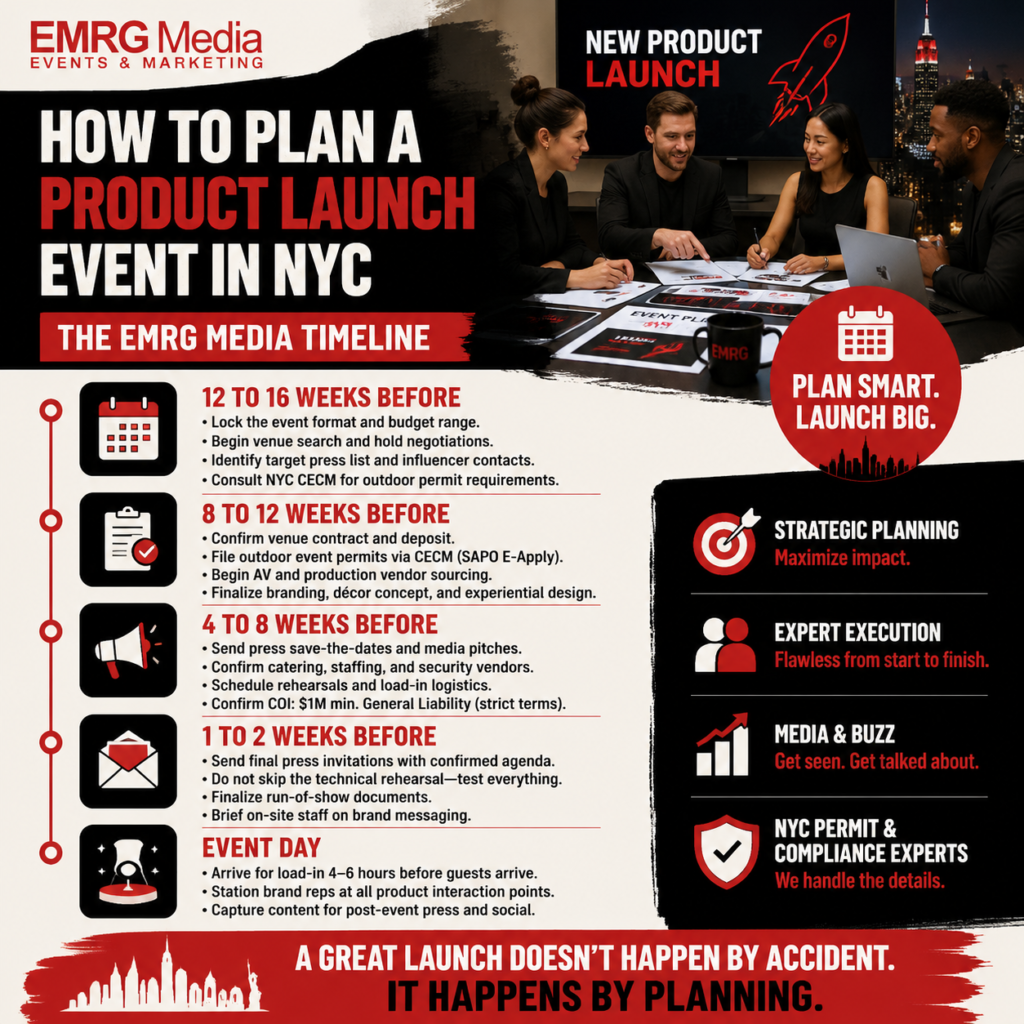
12 to 16 Weeks Before
- Lock the event format and budget range.
- Begin venue search and hold negotiations.
- Identify target press list and influencer contacts.
- Consult the NYC Office of Citywide Event Coordination and Management (CECM) for outdoor permit requirements if the event involves public space.
8 to 12 Weeks Before
- Confirm venue contract and deposit.
- Outdoor event permit applications in Manhattan for street-level activations, sidewalk closures, and footprint extensions go through SAPO via the Mayor’s Office of Citywide Event Coordination and Management (CECM) using their official E-Apply permitting system, though they require strict DOT and NYPD coordination.
- Begin AV and production vendor sourcing.
- Finalize event branding, décor concept, and experiential design.
4 to 8 Weeks Before
- Send press save-the-dates and media pitches.
- Confirm catering, staffing, and security vendors.
- Schedule rehearsals and load-in logistics.
- Confirm Certificate of Insurance (COI), which requires a minimum $1 million General Liability policy and carries strict indemnification terms.
1 to 2 Weeks Before
- Send final press invitations with a confirmed agenda.
- Do not skip the technical rehearsal. Walk through every presentation slide, every video cue, and every lighting change before guests arrive.
- Finalize run-of-show documents and brief on-site staff on brand messaging.
Event Day
Arrive for load-in 4 to 6 hours before guest arrival. Station brand representatives at all product interaction points. Capture content for post-event press and social distribution.
Best NYC Neighborhoods and Venues for a Product Launch or Pop-Up Event
Location is not just logistics. In New York City, location is part of an activation’s meaning. A street corner, storefront, rooftop, or gallery shapes the pace of an encounter. It also sets expectations before a guest reaches the first product touchpoint.
- SoHo and Nolita: Best for fashion, beauty, and lifestyle product launches. Raw loft spaces on Mercer Street and West Broadway accommodate 100 to 500 guests and carry strong editorial associations with tastemaker culture. Branded activations on public sidewalks or plazas in SoHo require DOT Street Activity Permits from SAPO.
- Hudson Yards: Best for tech, financial, and enterprise product launches. The Vessel plaza and Shed venue offer modern infrastructure with capacities from 300 to 3,000 guests. Outdoor activations along the Hudson Yards corridor and High Line now require permit submissions 10 to 12 weeks in advance due to peak spring season demand.
- Meatpacking District: Best for consumer-facing activations and evening launch events. Foot traffic between Gansevoort Street and Little West 12th Street consistently exceeds 20,000 people per weekend day in spring and fall 2026.
- Flatiron and NoMad: Best for B2B and media-first launches. Proximity to major agency offices and publications clustered near Madison Square Park makes journalist attendance logistically easy.
- Tribeca: Best for premium brand launches and private client events. Venue spaces in the 250 to 500-person range with high ceilings and architectural detail align well with luxury and hospitality categories.
Explore the full breakdown of experiential marketing events in NYC to understand how venue selection affects activation ROI.
How Much Does a Product Launch Event Cost in NYC?
NYC product launch event budgets vary by format, guest count, production complexity, and permit requirements. Here is the realistic cost structure for 2026.
Format | Typical Budget Range |
Press Preview Launch (50 to 100 guests) | $25,000 to $75,000 |
Consumer Pop-Up Activation (1 to 3 days) | $75,000 to $250,000+ |
Trade or Retailer Launch | $20,000 to $60,000 |
Hybrid Launch Event | $50,000 to $150,000 |
Full Brand Activation (multi-day, outdoor) | $150,000 to $500,000+ |
Venue costs typically represent 25 to 35 percent of total event spend.Hybrid AV production adds $5,000 to $15,000 to average event budgets.COI insurance coverage in 2026 commonly requires a $2 million to $5 million aggregate General Liability policy.
NYC outdoor event permit fees start as low as $25 for a Street Activity Permit. Full NYC event compliance costs, including permits, insurance, and agency filings combined, commonly reach $1,500 to $5,000 or more depending on event scope.
The $100,000 to $500,000 budget range shows optimal ROI at 3.8x return. But throwing money at a launch event does not guarantee success. Strategic allocation does.Brands with budgets under $25,000 are best served by private loft venues in Brooklyn’s Williamsburg neighborhood or Long Island City, which carry lower union minimums and faster permit timelines.
How to Get Press to a Product Launch Event in NYC
Press attendance is not automatic at NYC product launch events. The city’s editors and reporters receive hundreds of event invitations each week. Securing coverage requires a deliberate media strategy that begins 6 to 8 weeks before the event date.
- A Newsworthy Hook: Press attend events that give them a story. A product launch without a first-look angle, a celebrity tie-in, a cause partnership, or a surprising venue creates no editorial incentive. Define the hook before you write a single media pitch.
- A Targeted Invite List: Build a targeted list of 30 to 60 journalists and editors whose beats match the product category. Quality of outlet matters more than volume of invites.
- A Journalist-First Experience: Press arrivals need a clearly designated check-in area, immediate product access, and a pre-briefed brand spokesperson available for quotes within 15 minutes of arrival. A room at 80 percent capacity feels energetic. A room at 120 percent capacity feels uncomfortable, and guests leave early.
- A Next-Morning Story Package: Provide all attending media with a digital press kit that includes high-resolution product images, key data points, and a brand spokesperson quote ready for use. Embargo dates aligned with publication schedules give outlets time to prepare thorough coverage rather than rushing a brief mention.
EMRG Media’s Google Acceleration Launch case study demonstrates how this press strategy structure translates into measurable coverage outcomes for major brand partners.
Measuring ROI After Your NYC Brand Activation or Product Launch
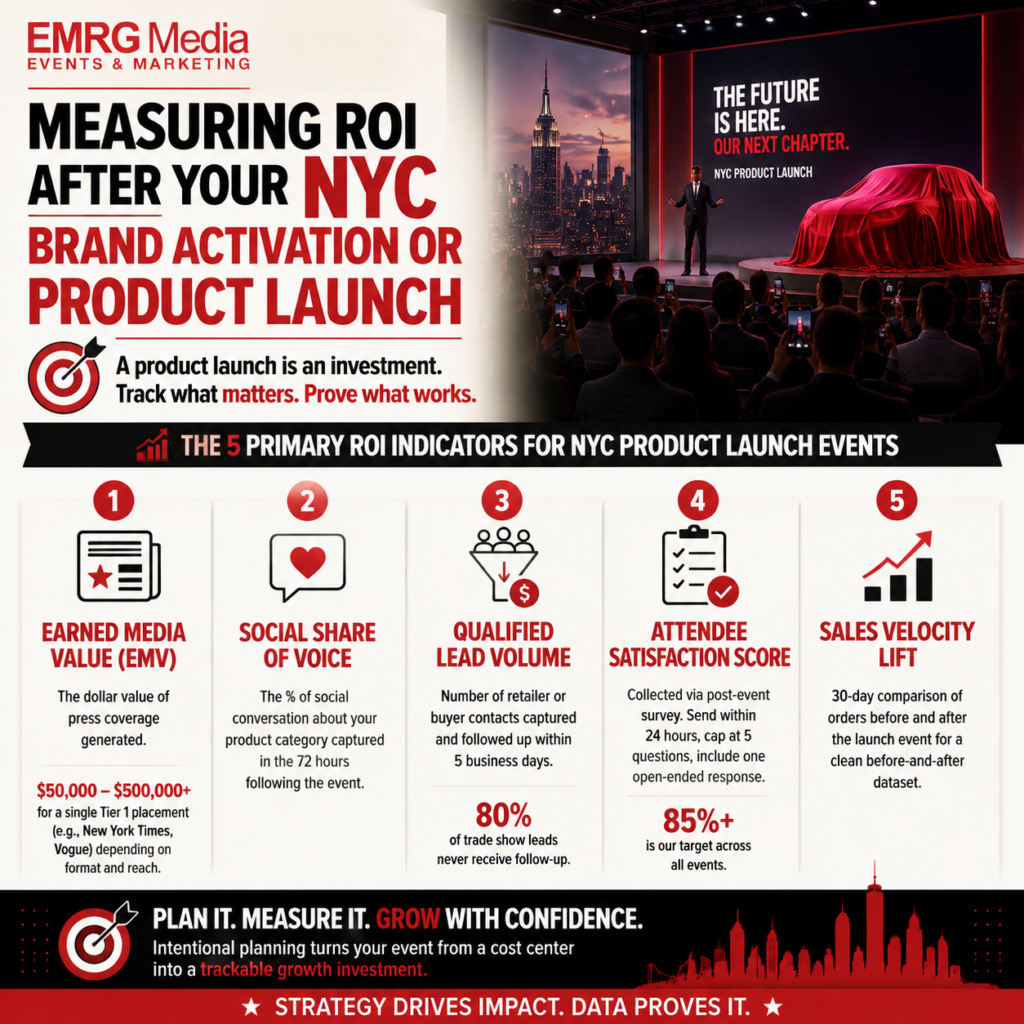
A product launch event is an investment. It requires defined success metrics established before the event date, not after. ROI measurement should be defined before the event. Useful metrics include meetings booked, qualified leads, account engagement, attendee satisfaction, session attendance, content downloads, and post-event follow-up activity.
The five primary ROI indicators for NYC product launch events are:
- Earned Media Value (EMV): The dollar value assigned to press coverage generated. A single placement in a Tier 1 outlet such as the New York Times or Vogue carries an EMV of $50,000 to $500,000 depending on format and reach.
- Social Share of Voice: The percentage of social conversation about your product category captured by your launch content in the 72 hours following the event.
- Qualified Lead Volume: For B2B and trade launches, the number of retailer or buyer contacts captured and followed up within 5 business days. Despite massive budgets, 80 percent of trade show leads never receive follow-up, which is one of the most common and costly post-launch failures.
- Attendee Satisfaction Score: Collected via post-event survey. Send the post-event survey within 24 hours, cap it at five questions, and include one open-ended response field. EMRG Media targets a minimum 85 percent satisfaction score across all managed events.
- Sales Velocity Lift: A 30-day comparison of direct-to-consumer or retail orders before and after the launch event, providing a clean before-and-after dataset.
Consistent corporate event ROI measurement starts with intentional planning. An experienced NYC event team ensures your numbers reflect strategy, not guesswork. For brands new to New York event planning, setting these benchmarks in advance turns the event from a cost center into a trackable growth investment.
Why EMRG Media Is New York City's Product Launch Event Partner
Over 25 years, EMRG Media has set the standard for product launch event planning, producing more than 5,000 events for Fortune 500 brands, global media companies, financial institutions, luxury houses, law firms, and nonprofit organizations. Founder Erica Maurer was named the No. 1 Most Influential Event Planner in NYC by The Event Planner Expo in 2026, a recognition built on a quarter-century of work in this city.
Instead of assembling temporary freelancers for individual projects, the EMRG Media team consists of 20 full-time, in-house specialists handling production, planning, design, and audio-visual needs. If a technical issue occurs during an event, it is resolved by a permanent staff member who possesses deep operational experience.
The agency maintains multi-year partnerships across numerous campaigns with leading corporations, including Google, Netflix, BuzzFeed, Bloomberg, Barclays, Condé Nast, Moët Hennessy, Columbia Records, and Sotheby’s.
EMRG Media plans and produces events throughout New York City, including Manhattan, Brooklyn, Queens, and the NJ Metro, with venues sourced from Tribeca rooftops to Wall Street ballrooms and SoHo galleries.
If you are ready to begin product launch event planning in New York City, contact EMRG Media for a strategy consultation.
Frequently Asked Questions
Yes. Branded activations, red-carpet arrivals, and street-level events in areas like SoHo or the Flatiron District require Street Activity Permits from the NYC Department of Transportation. Indoor private venues may still require FDNY, SLA, or DOB permits, making strict NYC venue licensing a critical step depending on your format and planned elements. Consult the NYC Office of Citywide Event Coordination and Management (CECM) for the authoritative permitting guide before filing.
Press-focused launches perform best at 50 to 150 guests. Consumer-facing pop-ups in high-footfall areas like SoHo or Hudson Yards can scale to 300 to 500. The format should match the product and the intended outcome. Smaller formats can create better conversation, clearer audience fit, and more focused follow-up. Tight, curated rooms consistently outperform large, unfocused guest lists.
Fall (September through November) and spring (March through May) are NYC’s strongest launch windows. Avoid major industry conferences and Fashion Week. Your launch will be buried if it coincides with events that absorb all editorial attention. Marquee green spaces for summer 2026 fill at 10 to 12 weeks out, so submit early or lose the date entirely.
Hire a specialist for any NYC launch exceeding $50,000 or involving outdoor activations, press, or AV production. Experienced corporate event planning partners consistently deliver stronger ROI than in-house planning. The best outcomes do not come from spending more; they come from spending smarter. In-house teams regularly underestimate NYC permitting timelines, union labor requirements, and multi-vendor coordination complexity.
Press-focused launch events run best at 2 to 3 hours, typically scheduled between 6 p.m. and 9 p.m. Late morning (10 to 11 a.m.) or early evening (6 to 7 p.m.) start times accommodate journalist schedules. Midday launches compete with deadline pressure. Consumer pop-up activations can run 4 to 8 hours per day. Format and audience type should drive duration decisions, not venue availability alone.