Early bird registration is one of the few conference decisions that can go exactly right or badly wrong, and organizers in New York, NY feel the consequences faster than planners in most other markets. Q1 conference season here collides with New York Fashion Week and a wave of financial sector events, which means hotel inventory and attendee attention disappear early.
Close your deadline too soon and you leave revenue on the table. Close it too late and you lose the urgency that drives your fastest sign-ups.
For a Q1 2027 conference in New York City, the early-bird window should typically close 60 to 75 days before event day, with pricing set 15 to 25 percent below your standard rate. That timing gives your team enough runway to convert the discount into real registrations before winter weather and competing events slow momentum.
Why Early-Bird Registration Deadlines Matter More in New York City
When planning early bird registration, New York conferences compete against a packed 2027 calendar. February brings Fashion Week traffic and inflated Midtown hotel rates, and Q1 is already dense with finance sector programming.
Out-of-town attendees booking travel to a Manhattan conference commit to flights and hotel rooms months ahead, not weeks ahead like a regional event.
That travel behavior means your early-bird pricing window needs to align with when attendees actually make travel decisions, not just when your internal team feels ready to launch a campaign.
The Ideal Window to Close Early-Bird Registration for a Q1 Conference
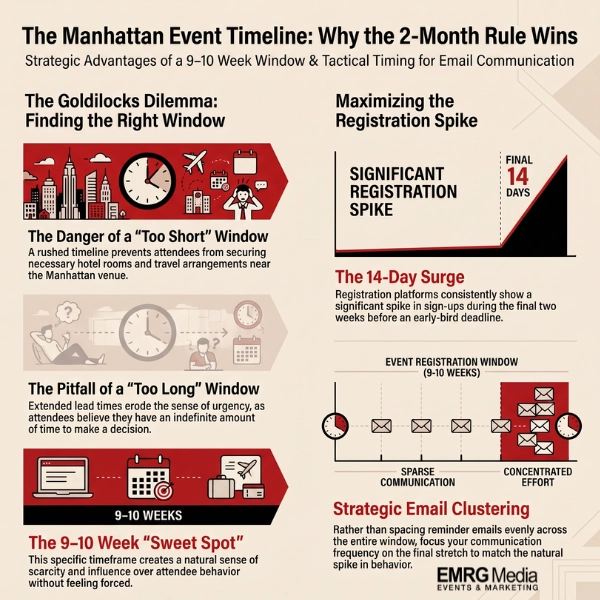
Most experienced NYC producers close conference registration discount tiers right around the two-month mark before the event. This window gives your marketing team room for two full promotional pushes: an announcement wave and a final reminder campaign before the deadline hits.
Why the Two-Month Mark Works Best for Manhattan Events
A shorter window rushes attendees who need lead time to secure travel and hotel rooms near your venue. A longer window quietly erodes urgency, since attendees know they still have months to decide.
Roughly nine to ten weeks out is the point where real scarcity starts to influence behavior without feeling forced.
Registration platforms typically show a noticeable spike in the final two weeks before an early-bird deadline closes. Build your reminder emails around that final stretch instead of spacing them evenly across the entire window.
Setting the Right Early-Bird Pricing for Your 2027 Conference
Once your deadline is set, pricing needs to reflect real value, not just a symbolic discount. Attendees increasingly recognize when an “early bird” tier is early-bird in name only.
How Much Should the Early Bird Fee Be?
For most 2027 New York City conferences, the early bird fee should offer roughly a standard one-fifth discount off your baseline registration price. Anything smaller rarely changes behavior, and attendees notice when the gap feels token.
Anything larger can undercut the perceived value of your standard and VIP tiers later in the campaign.
If your standard ticket runs $895, a 20 percent early-bird discount lands around $716, a gap most attendees recognize as worth acting on quickly rather than waiting.
Building Registration Forms That Reduce Drop-Off Before the Deadline
Even the perfect pricing strategy will fail if your checkout process creates friction. Strong registration for conference sign-ups depends on more than a fair deadline and good pricing.
If your conference registration forms ask for too much information up front, attendees stall out before finishing checkout, even when the discount is worth acting on.
Keep your form to the essentials: name, email, company, and payment. Save deeper attendee data, like session preferences or dietary needs, for a follow-up confirmation email sent after registration is complete.
This two-step approach protects your conversion rate during the exact window when urgency is highest.
For a full breakdown of registration platforms, badge printing, and check-in logistics, the 2026 NYC Conference Registration Guide covers the operational side of this process in more depth.
Common Mistakes New York Conference Planners Make With Early-Bird Deadlines
Even experienced teams misjudge this window. Three mistakes show up repeatedly on Q1 New York conferences:
- Setting the deadline too close to the event, leaving no runway for travel-dependent attendees to act on the discount.
- Pricing the discount too small to influence behavior, which trains attendees to simply wait for the standard rate.
- Ignoring the broader event calendar, like Fashion Week or major finance summits, when choosing both the conference date and the registration deadline.
Avoiding these mistakes ties directly back to your overall event calendar. If your venue and date are not finalized yet, the NYC Conference Planning Timeline outlines the full 18-month sequence and shows exactly where registration decisions fit into your broader schedule.
Not sure if your registration timeline lines up with your venue contract and speaker deadlines? EMRG Media’s Conference Planning team can review your full 2027 schedule in one call and flag conflicts before they cost you registrations.
Key Takeaways
- Close early-bird registration roughly eight to ten weeks before your Q1 2027 New York conference to match travel-decision timing.
- Set the discount around that standard one-fifth mark below your regular rate so it meaningfully influences behavior.
- Keep registration forms short at sign-up and collect deeper attendee data afterward to reduce drop-off.
- Cross-check your deadline against the broader NYC event calendar, including Fashion Week and finance sector programming.
Getting Your 2027 Registration Timeline Right From the Start
An early-bird deadline is not a marketing detail, it is a financial decision that shapes your head count, your budget, and how your event competes against everything else happening in New York during Q1 2027. Set the window too loosely and you lose the urgency that fills seats early. Price it without discipline and you either leave money on the table or fail to move attendees at all.
EMRG Media has spent 25 years managing conference registration, pricing, and timelines for organizations producing events across New York City. That experience is exactly why getting this deadline right the first time matters more than adjusting it after registrations stall.
Ready to lock in your early-bird strategy before Q1 2027 fills your competitors’ calendars first? Contact EMRG Media today and let’s set a registration timeline built for how New York attendees actually decide to show up.
Further Reading on Registration Strategy
Looking for more ways to incentivize attendees beyond just a percentage discount? For data-backed tactics on driving advance sign-ups and reducing last-minute RSVP panic, we highly recommend checking out Cvent’s guide to Early-Bird Marketing Tips for More RSVPs [2.1.1].
FAQs About Early Bird Registration
What is an early bird registration?
Early bird registration is a discounted conference ticket tier offered for a limited window before the standard registration price takes effect. It rewards attendees who commit early, which helps organizers build momentum, secure sponsor confidence, and lock in accurate headcount projections well ahead of event day.
For Q1 2027 New York conferences, this early commitment also helps attendees plan travel around a crowded local event calendar.
What is the early bird fee?
The early bird fee is the reduced ticket price offered during the discount window, typically set around a standard 20 percent discount off the base rate. For a 2027 New York City conference priced at $895 standard, an early bird fee would land around $716.
The exact figure should reflect your venue costs, program value, and competing events on the calendar.
Is early bird pricing worth it?
Early bird pricing is worth it when the discount is large enough to genuinely influence attendee behavior. It drives faster commitment from travel-dependent attendees, gives organizers earlier budget certainty, and builds registration momentum that carries into later marketing pushes.
A token discount rarely produces a meaningful shift in sign-up timing.