
How NYC Planners Set Up Conference Registration in 2026

Avoid Check-In Chaos: Your 2026 NYC Conference Registration Blueprint

Conference registration in New York City typically costs between two and fifteen dollars per attendee in platform fees alone. Those figures multiply rapidly before badge stock, dedicated check-in staffing, or on-site hardware are even added to the budget. The biggest planning mistakes usually happen in one specific place: choosing a software platform before your final headcount, event format, and venue contract are firmly locked.

This comprehensive guide reveals exactly what conference registration actually costs in 2026. You will learn how to build an optimized intake form that significantly reduces expensive no-shows, and how to execute a flawless check-in process without causing a massive bottleneck at the front doors. Planners who wait to map out these critical logistics often face limited staffing options and ballooning rush fees.

Do not let hidden hotel costs or a broken data flow sabotage your most important event of the year. Premium check-in hardware and specialized on-site staff are already booking up months in advance for the 2026 season. Read our complete strategic guide below to lock in your exact platform choices right now, or contact EMRG Media today to guarantee your next NYC summit runs flawlessly from the first badge printed to the final keynote.

Corporate Event Planner Inquiry

What Conference Registration Costs in NYC in 2026

Conference registration banner by EMRG Media for 2026 NYC Setup Blueprint, featuring an event check-in scene.

In the broader scope of conference planning, registration is rarely a single line item. It is a stack of smaller costs that add up fast once a program passes 300 attendees. 

PER-ATTENDEE PLATFORM FEES VS. FLAT LICENSING

Most registration platforms charge either a per-registrant fee, generally $2 to $15 depending on features, or a flat annual license, typically $3,000 to $25,000 for enterprise-tier tools. A 400-person single-day summit using a per-attendee model at $8 per registrant runs roughly $3,200 in platform fees alone. That number grows quickly on multi-day programs where attendees register for individual sessions or add-on workshops, since many platforms bill per transaction, not per person.

WHERE REGISTRATION COSTS HIDE INSIDE THE VENUE CONTRACT

Hotel ballrooms and dedicated conference centers often bundle a “registration desk fee” into the master service agreement, separate from the platform cost itself. This can include desk rental, power drops, and Wi-Fi bandwidth allocated specifically to the check-in area. Our conference venues NYC guide covers the broader AV and service-fee structure in Midtown hotel contracts, and registration desk power and connectivity should be confirmed in that same walkthrough, not negotiated separately after the floor plan is set.

EARLY BIRD PRICING WINDOWS THAT MOVE NYC REGISTRATIONS

September is consistently the strongest month for conference registration search activity in the New York market, driven by fall program launches tied to the fourth quarter. Opening early bird pricing 90 days before the event date, then closing it 30 days later, gives out-of-town attendees enough runway to book travel while still creating urgency. Programs that skip an early bird tier see registration activity cluster in the final two weeks, which is the worst possible time to discover a form field is broken.

Building a Conference Registration Form That Reduces No-Shows

A registration form is not just a data collection tool. It is your first line of defense against attendee drop-off. A poorly built form directly increases no-shows and complicates your on-site logistics. When utilizing professional conference event planning services, the priority shifts from simply gathering data to designing a frictionless user experience that guarantees your expected headcount actually walks through the door. 

Six Fields Every NYC Corporate Form Needs
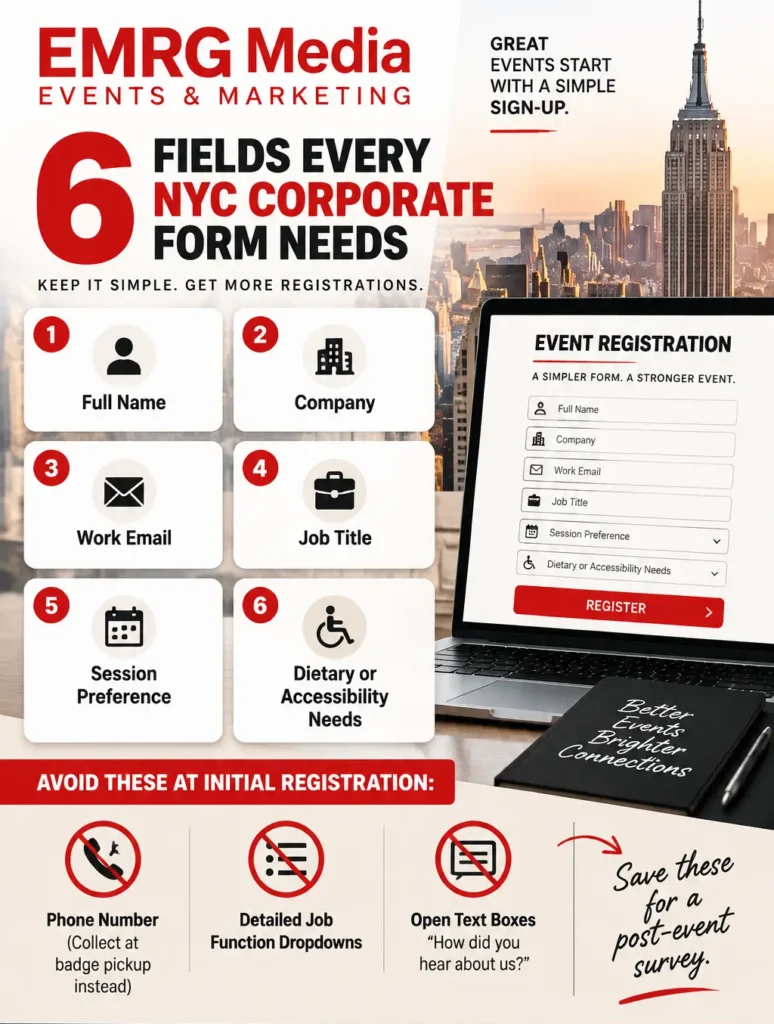
EMRG Media infographic detailing 6 essential fields for NYC corporate event registration forms.

Keep the form to six fields: full name, company, work email, job title, session preference, and dietary or accessibility needs. Every additional field drops completion rates. Fields to avoid at initial registration: phone number (collect at badge pickup instead), detailed job function dropdowns, and open text boxes asking “how did you hear about us.” Save those for a post-event survey.

Registration Forms for Hybrid Programs

A critical rule of hybrid conference planning in NYC is setting up two completely separate registration paths rather than relying on a single form with a toggle. In-room attendees require badge and seating data, while virtual attendees need a streaming link delivery method and time zone confirmation. Combining both audiences into a single flow is the most common reason hybrid programs mis-badge attendees on-site, printing an expensive in-person badge for someone who registered to watch remotely. 

Accessibility and Refund Language to Build Into the Form

Registration forms tied to public-facing events fall under federal web accessibility standards. The U.S. Department of Justice’s guidance on ADA web accessibility requirements points to WCAG 2.1 Level AA as the technical benchmark, and an inaccessible registration form can limit a person with a disability from completing sign-up, which carries real compliance exposure for public-facing programs. Pair that with clear refund and attrition language directly on the form, not buried in a confirmation email, so attendees know the cancellation window before they pay.

Choosing a Conference Registration Platform for a NYC Program

The right platform depends on headcount and format, not brand recognition. Here is how the major categories compare for a New York program:

Platform Type

Best For

Badge Printing

Typical Cost

Free tools (Eventbrite basic, Google Forms)

Under 100 attendees, internal events

Manual, no on-site printer integration

Free to $2/registrant

Mid-tier (Cvent Basic, RegFox)

100 to 500 attendees, single-day programs

On-site printer support, limited badge design

$3 to $8/registrant

Enterprise (Cvent, Bizzabo)

500-plus attendees, multi-day or hybrid

Full badge design, kiosk self-check-in

$8 to $15/registrant or flat license

WHEN A FREE PLATFORM WORKS AND WHEN IT COSTS YOU ON-SITE

A free platform is fine for a 100-person boardroom session with a printed sign-in sheet. It becomes a liability at 400-plus attendees because most free tiers cap badge printing integrations, forcing manual data entry at the door. For a Midtown ballroom program near Grand Central Terminal, where doors typically open on a tight window before the first keynote, manual entry at that scale creates a visible line that stretches into the lobby before the first session even starts.

Badge Printing and Check-In Flow for Midtown and FiDi Venues

Floor plan and registration desk placement determine how fast attendees clear the door, and New York venues add specific constraints most out-of-town planners miss.
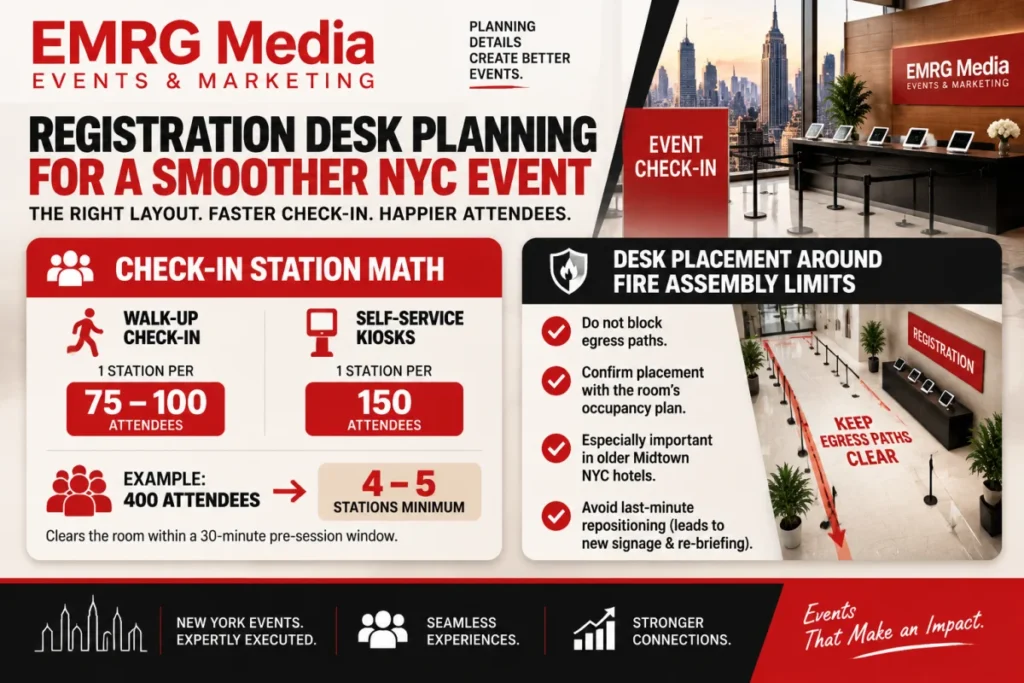
EMRG Media guide on NYC event check-in math and desk placement for fire safety.

Check-In Station Math
Plan for one check-in station per 75 to 100 attendees for a standard walk-up check-in, and one per 150 if attendees use self-service kiosks with pre-printed badges. A 400-attendee program should run four to five stations minimum to clear the room within a 30-minute pre-session window.

Desk Placement Around Fire Assembly Limits
Registration desks cannot block egress paths, a rule enforced strictly in older Midtown Manhattan hotel properties where lobby footprints are already tight. Confirm your desk placement against the room’s occupancy plan before badges are ordered, since a desk repositioned the week of the event often means reprinting signage and re-briefing on-site staff.

Registration Timeline: When to Open, Promote, and Close

Registration should open the moment your venue and date are contracted, typically 6 to 9 months out for programs over 300 attendees. Our NYC conference planning timeline walks through the full 18-month planning calendar in detail; the registration-specific milestones inside that window are opening early bird pricing at the 9-month mark, launching general promotion at 6 months, and closing standard registration 2 weeks before doors, with a smaller late window for walk-up passes priced at a premium.

Case Study: A 400-Attendee Midtown Summit

A financial services client planning a single-day summit near Grand Central Terminal needed registration live within 60 days. The team set a $450 early bird rate for the first 30 days, rising to $650 standard, with a six-field form and a separate VIP path for panelists. Four check-in stations were staffed for a 7:30 a.m. door open ahead of an 8:30 a.m. keynote. Because the venue’s lobby had a strict 14-foot ceiling clearance affecting signage placement, badge pickup signage was mounted on freestanding stands instead of hung banners. Registration closed at 380 confirmed attendees, and the four-station check-in cleared the queue in 22 minutes.

Frequently Asked Questions

Attendee-facing registration fees for NYC corporate conferences typically range from $200 to $650 for early bird pricing, rising to $400 to $900 for standard rates. Platform-side processing fees, separate from the attendee price, usually run $2 to $15 per registrant depending on the tool.

Most registration platforms, including Cvent, RegFox, and Eventbrite, provide built-in form templates you can customize by field. A planning agency can also supply a pre-tested six-field template designed specifically to reduce drop-off during the registration process.

Setting up registration starts with selecting a platform matched to your headcount, then building a short form, connecting a payment processor, and testing the confirmation email flow. This should be completed and live at least 6 months before a 300-plus attendee program.

There is no single best app; the right choice depends on scale. Cvent and Bizzabo suit 500-plus attendee hybrid programs, while RegFox or Eventbrite handle single-day events under 300 attendees efficiently and at lower cost.

Google Forms and Eventbrite’s free tier work well for internal events under 100 attendees. Both lack on-site badge printing integrations, so programs expecting a staffed check-in desk should budget for a paid tier instead.

Get Your Registration Plan Built Before the Date Locks

Mastering your conference registration is the foundation of any successful event in New York City. From navigating hidden venue fees to selecting the right software for your precise headcount, every detail shapes the attendee experience long before doors open. Waiting until the last minute guarantees long check-in lines, frustrating data errors, and inflated rush costs. A proactive setup protects your budget and ensures your guests are greeted with seamless efficiency rather than lobby chaos.

You do not have to untangle this logistical web on your own. Let our seasoned team handle the hardware, on-site staffing, and complex platform integrations so you can focus on delivering an incredible program to streamline your setup. Let us map out your custom check-in flow and lock down a reliable, line-itemized budget for your next summit.