
New York City’s holiday party season turns conference rooms and rooftop venues into open bars almost overnight, and that is exactly where host liquor liability becomes a real exposure for employers rather than a theoretical one.
If your company is pouring free drinks at a December event in Manhattan, Brooklyn, or anywhere in the five boroughs, the venue, your insurer, and potentially a courtroom will all look at the same question who actually provided the alcohol, and under what terms.
A typical CGL policy usually covers basic host exposures by default, though New York venues routinely attach conditions that test those limits.
EMRG Media works through this exposure with corporate clients planning NYC holiday parties every year, and this guide breaks down what host liquor liability actually covers, what New York law really says about social hosts, and where the real coverage gaps tend to show up.
What Host Liquor Liability Actually Covers for an NYC Employer
When a company provides an open bar, this policy defends against liability if an overserved guest leaves and causes an accident or physical damage.
If drinks are complimentary and poured under your event’s name rather than a licensed vendor’s liquor license, this is the coverage that applies.
Not sure if your company’s existing policy already covers your December open bar, or if you need a standalone endorsement? Reach out EMRG Media now to review alcohol service plans and venue insurance riders for NYC companies every holiday season.
Liquor Liability vs Host Liquor Liability, and Why Venues Care Which One You Have
The moment money changes hands for drinks through cash or purchased vouchers, your company crosses into commercial vendor territory, which demands full liquor liability coverage.
A licensed caterer pouring drinks under its own SLA authorization usually carries its own liquor liability policy, and planners should request that caterer’s certificate of insurance to confirm it rather than assuming it exists.
See our full breakdown in event liability insurance NYC venue guide for how additional insured endorsements interact with this coverage.
New York Dram Shop Rules: Where Employer Liability Stops
To gauge your actual risk under New York’s dram workshop statutes, you have to examine GOL § 11-101, as the statutory exposure is significantly more restricted than what many hosts expect.
New York’s highest court addressed this directly in D’Amico v. Christie, holding that the statute does not extend to a social host who serves complimentary drinks to an adult guest.
In practice, this means a company serving free drinks to adult employees at a holiday party does not automatically face statutory dram shop liability the way a bar selling drinks would.
Permits and Insurance Required for a Manhattan Venue Booking
To finalize a booking in Manhattan, properties generally insist on headcount-specific NYPD or FDNY permits and a COI that formally adds the building’s owner and management entity as additional insureds.
If alcohol is part of an event, the venue will typically also ask which liability applies, host or standard, depending on how drinks are being served.
Security staffing is often reviewed alongside these documents rather than as a separate checklist item, our guide on event security in NYC what to know covers how guard ratios and off-duty NYPD details intersect with alcohol service at larger events.
EMRG Media coordinates COIs, additional insured endorsements, and liquor liability wording as part of every holiday party we produce.
Pricing a Host Liquor Liability Endorsement for Your NYC Event
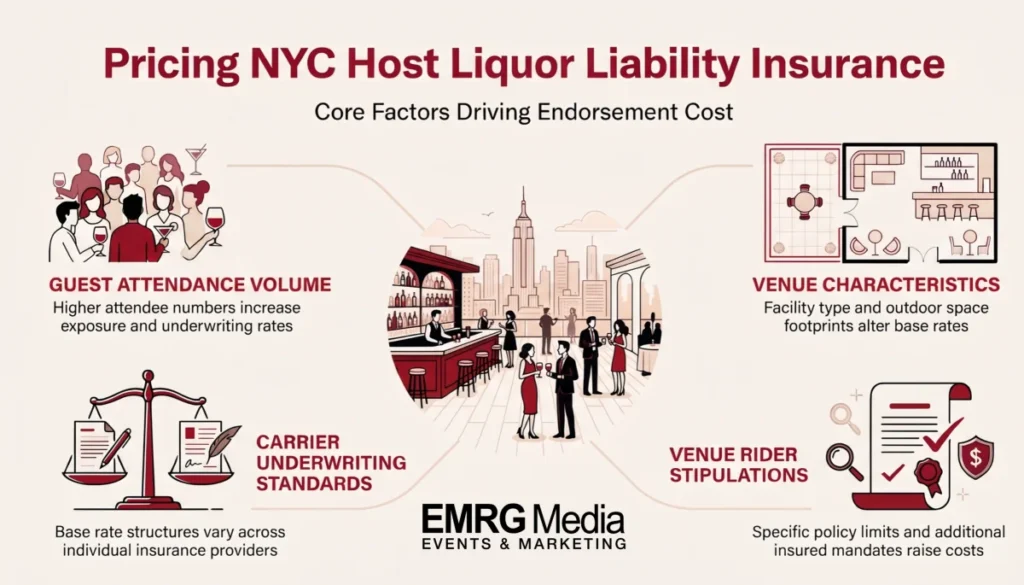
The cost of adding host liquor liability to a one-day general liability policy is influenced by several event-specific variables:
- Attendance numbers: Larger guest counts increase overall risk and underwriting rates.
- Venue characteristics: Rates shift depending on the type of facility and whether the footprint includes outdoor areas.
- Insurance carrier standards: Base underwriting guidelines and premium structures vary across providers.
- Venue rider stipulations: Specific property manager requirements, requested policy limits, and additional insured mandates shape the final premium.
For a full cost breakdown by guest count and type of the venue, see NYC event insurance guide 2026: costs, COI & coverage.
Building a Compliant Holiday Party in New York, NY
Employers hosting a December event in New York, NY should treat alcohol service as a planning decision, not an afterthought.
Practical controls that reduce exposure include limiting drink tickets to two or three per guest, closing the bar 30 to 45 minutes before the event ends, and keeping food service running throughout rather than relying on passed appetizers alone.
These are the same standards EMRG Media builds into the holiday parties covered in our company holiday party planning NYC services.
Key Takeaways
- Host liquor liability applies when your company provides alcohol free of charge, and it is often already included in standard unendorsed general liability policies, though venue-specific endorsements and aggregate limits create real gaps.
- New York's dram shop statute requires an unlawful sale and generally does not extend to social hosts serving free drinks to adult guests, but employers still face exposure through negligence, premises liability, and respondeat superior claims.
- Manhattan venues typically require a COI with additional insured language before releasing access, and alcohol service usually triggers a separate liquor-specific question.
- Charging any admission fee for a company event can pull the host back into direct dram shop exposure.
Protecting Your Company Before the Bar Opens
A compliant holiday party in New York comes down to matching the right coverage to how alcohol is actually served, confirming venue insurance requirements early, and building drink controls into the event itself rather than reacting after an incident.
Employers who treat this as a line item on the planning checklist, rather than an afterthought in December, avoid the gap between what their base policy already covers and what a venue contract actually demands.
EMRG Media has coordinated insurance, permitting, and alcohol service planning for more than 1,100 NYC events, and that track record is reflected directly in client feedback on our facebook page.
Ready to plan a holiday party with the right coverage already confirmed? Get in touch with EMRG Media today to start your 2026 event timeline with a team that handles insurance, venue sourcing, and production under one roof.
FAQs About Host Liquor Liability
What is host liquor liability?
Host liquor coverage defends your company when a visitor causes an accident after drinking complimentary alcohol served under your event’s name.
While standard general liability policies often include this protection by default, off-premises venues usually require a standalone event endorsement naming them additional insured.
What is the difference between liquor liability and host liquor liability?
Host liquor liability covers free alcohol service, such as an open bar at a holiday party, whereas standard liquor liability applies whenever drinks are sold.
Charging any fee, even a nominal admission ticket, legally shifts your company into an alcohol vendor role that requires commercial liquor liability coverage.
What permits or insurance do you need to host an event in a Manhattan venue?
Most Manhattan spaces require a Certificate of Insurance naming the venue as an additional insured, along with FDNY or NYPD permits depending on your headcount and space use.
If drinks are provided, venues also mandate proof of host or standard liquor liability coverage before releasing access to the property.