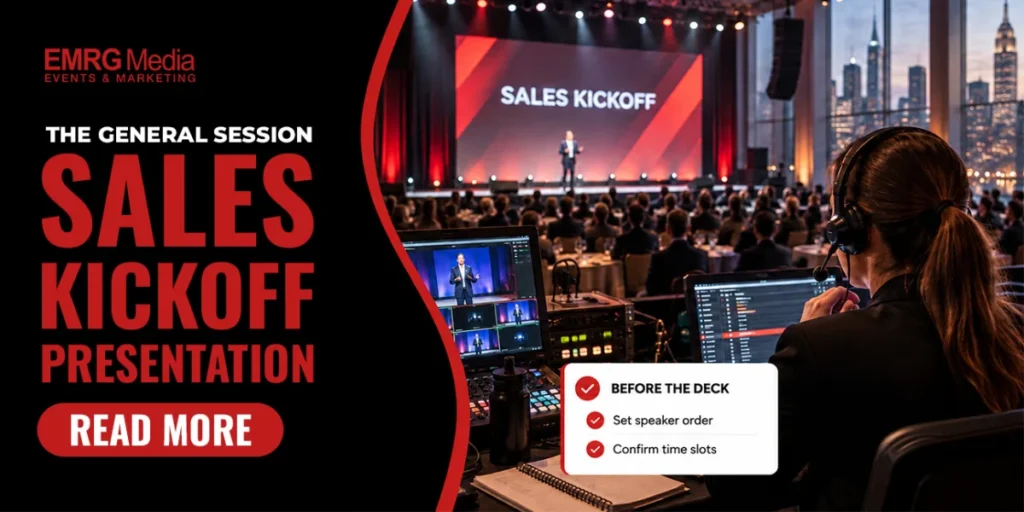

In New York, most sales kickoff meetings share the same failure point in the room. Manhattan ballrooms and Hudson Yards event floors were not built with sightlines for 200 reps and a confidence monitor in mind, so production crews spend the first hours of load-in solving problems a keynote speaker never sees.
If your sales kickoff presentation is opening the show, the stage has to carry the message the moment the lights come up, not catch up to it by slide ten.
Get in touch with EMRG Media has staged general sessions for revenue teams across the five boroughs for more than two decades, and the pattern repeats every year.
Teams spend weeks polishing a presentation deck and almost no time on how it will actually play in the room, sightlines, mic count, screen height, and the rehearsal block that ties it together.
What the General Session Has to Do in New York, NY
The general session is the one block on a sales kickoff agenda where the entire revenue org sits in the same room at the same time.
It sets the quota story, introduces the theme, and hands off cleanly into breakouts, all inside a tightly rehearsed window.
In a Manhattan venue, that window is usually shorter than teams plan for, because Midtown load-in schedules leave less rehearsal time than a leadership team expects when they first build the run-of-show.
Build the Agenda Before You Touch the Slides
Most teams start with last year’s slide deck pulled straight from the archive, then try to fit new content into old timing.
Decide who speaks, in what order, and for how long, then build the deck and stage plan around that structure.
A session that opens with a CRO, moves into a product reveal, and closes on a recognition video needs a different stage plan than one built around a single keynote.
This is also where a good sales kickoff presentation template earns its place, not as a design shell, but as a timing framework that forces every speaker to commit to a slot before the deck gets built.
Staging the Room So Every Rep Can See the Message
A general session for under 200 reps on a flat floor needs a stage 16 to 24 inches high, and once attendance passes 200 that height climbs to 24 to 32 inches so the back rows can see over the heads in front of them.
Screen size follows its own rule, the image height should equal roughly one sixth of the distance to the farthest seat, so a 60-foot-deep room needs a screen close to 10 feet tall.
EMRG Media’s stage design and production team drafts the build against the venue’s actual rigging points and seating chart weeks before doors open, so the presentation is staged for the room it’s actually in, not a generic floor plan.
The AV Layer That Makes or Breaks the Keynote
Audio is the layer nobody notices until it fails. A four-person leadership panel needs four microphones, not two passed back and forth, plus a tested spare wireless mic on standby for questions.
Add a lectern mic if there’s a podium, and confirm every wireless channel in advance, since a Manhattan ballroom running a dozen wireless devices at once will find interference if channels aren’t coordinated ahead of time.
A new slide added the night before, a swapped speaker, or a last-minute timing shift can break the show if the operator running playback never gets the update.
EMRG Media’s AV production team builds in that redundancy and a locked content cutoff specifically so the presentation doesn’t break on the one day it matters most.
Where Most General Sessions Actually Break Down
The general session rarely fails because of the keynote itself. It fails at the seams, the handoff from the CRO to the product demo, the recognition video that doesn’t cue on time, breakout rooms opening before the main room has closed.
A show caller running the room from a locked run-of-show is what keeps those seams invisible, and it’s a role most internal planning teams don’t have anyone assigned to fill.
Planning the general session for your next kickoff? EMRG Media’s producers can walk through your agenda, staging, and AV plan before your deck is finalized, not after the venue is already booked.
A Structure That Holds Up in a New York Ballroom
A sales kickoff presentation example that performs well in an NYC general session usually follows this shape:
- Opening 10-15 min: theme reveal, welcome, quota story framing.
- Leadership keynote 20-30 min: strategy and market position.
- Recognition moment 10-15 min: prior year wins, top performers.
- Skills or product segment 20-30 min: live demo or roleplay preview.
- Transition and handoff 5-10 min: a clear cue into breakouts.
Every block needs its own cue in the run-of-show, and every transition needs a technician who already knows it’s coming.
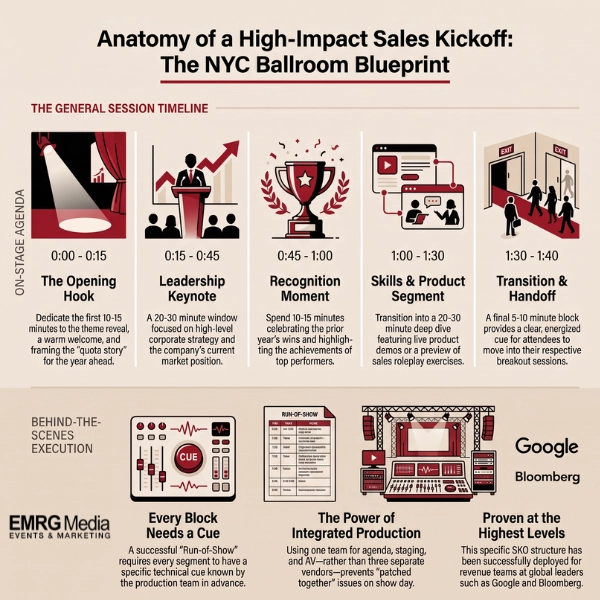
EMRG Media has run this exact structure for revenue teams from Google to Bloomberg as part of full event production services, one team handling agenda, staging, and AV together instead of three vendors patched together on show day.
Key Takeaways
- A sales kickoff presentation is only as strong as the room it's staged in, sightlines and screen height follow fixed ratios, not guesswork.
- Build the agenda and speaker order first, then build the deck and staging plan around it, not the other way around.
- One microphone per active speaker and a locked content cutoff before rehearsal prevent the most common technical failures at a general session.
- A show caller running a locked run-of-show keeps transitions between speakers, video, and breakouts invisible to the room.
Your General Session Is a Production, Not a Slide Deck
A strong sales kickoff presentation is built the same way every other live show in New York is built: agenda first, staging second, AV locked before rehearsal ever starts.
EMRG Media has produced general sessions for revenue teams across Manhattan and the wider metro area for more than 25 years, and the teams that keep coming back are the ones who stopped treating the general session as a deck with a stage attached to it.
For a full breakdown of budgets, venues, and timelines for the entire sales kickoff meeting, see our definitive guide to sales kickoff meetings in New York, NY.
Ready to build the general session for your next sales kickoff meeting? Reach out to EMRG Media producers today and get a technical outline plus a ballpark budget within one business day.
FAQs About Sales Kickoff Presentation
How long does load-in take for a Midtown ballroom hosting a general session?
Standard load-in for a basic screen, audio, and lighting setup typically takes 4 to 6 hours. However, adding custom scenic backdrops or an LED wall requires a full day to certify rigging and hang drape before AV integration begins.
What AV equipment is non-negotiable for a 200-person general session?
Essential gear includes a room-scaled sound system, dedicated stage lighting, a properly proportioned screen, and dedicated microphones for every on-stage speaker. You must also keep a pre-tested backup wireless mic on standby to prevent dropped cues during transitions.
When should slides be locked before an SKO rehearsal?
Presentation slides must be fully locked before the final rehearsal starts rather than after it wraps. This ensures the playback operator tests the exact deck against live show cues and prevents untested last-minute edits from disrupting the program.