

A call for speakers for a spring New York City conference needs to open roughly nine to ten months ahead, generally by early summer of the prior year, not the following February.
New York’s spring calendar runs directly into Fashion Week’s security perimeters and hotel rate spikes, which squeezes the runway for outreach, briefing, and rehearsal before an April or May event date.
If your organization is building a call for speakers 2026 lineup for a spring event, the math is unforgiving, Manhattan venues book 12 to 18 months out, and speakers need signed agreements well before doors open.
EMRG Media has managed conference speaker logistics across New York City for 25 years, and the pattern is consistent. Teams that open their call for speakers early get a real selection process.
Why Spring Dates Squeeze Your Call for Speaker Timeline in New York City
A spring conference date, typically April through June, sits close behind Fashion Week and a full winter of finance and industry summits competing for the same venues.
Speaker outreach for a May conference should realistically begin the prior June or July, giving you 9 to 10 months to confirm agreements before event day.
Waiting until January leaves roughly three months for outreach, review, briefing, and rehearsal combined.
That works for a single-track half-day session. It does not work for a multi-track conference with keynote, breakout, and panel slots to fill.
Building a Call for Speaker Brief That Attracts the Right Voices
A call for a speaker is only as strong as the brief behind it. Vague submission pages attract vague pitches, wasting a review committee’s time during a compressed timeline.
Every brief needs six elements:
- Theme and audience profile: Who is in the room and what problem they need solved.
- Session formats: Keynote, panel, breakout, or workshop, each with a defined time slot.
- Deadlines: A hard close date and an estimated notification date.
- Compensation disclosure: Paid, honorarium, or travel-covered.
- Technical requirements: Stage size, AV needs, and whether slides are due at submission.
- Selection criteria: What the committee is actually scoring.
A call for a speakers leadership program built around executive development draws sharper pitches than an open share your expertise post, and the same logic applies to a call for a speakers women’s conference program anchored to a defined outcome rather than a broad topic field.
Our guide on find the right speaker for NYC conferences breaks down matching expertise and presentation style to your goals in more detail.
Not sure your brief is tight enough to filter for fit? Reach out to EMRG Media now to build a submission brief and review process tailored to your conference goals.
Setting Submission Windows and Selection Deadlines
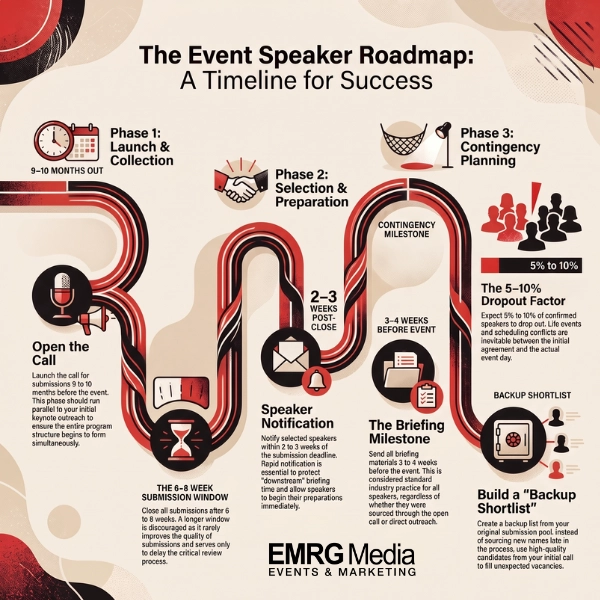
A realistic spring timeline looks like this:
- Open the call 9 to 10 months out, aligning with when keynote outreach should already be underway.
- Close submissions after 6 to 8 weeks. A longer window rarely improves quality, it just delays review.
- Notify selected speakers within 2 to 3 weeks of close to protect briefing time downstream.
- Send briefing materials 3 to 4 weeks before the event, standard practice regardless of how a speaker was sourced.
Expect 5 to 10 percent of confirmed speakers to drop out between agreement and event day, build a backup shortlist from your original submission pool instead of sourcing new names late.
The NYC conference planning timeline maps exactly where this fits against venue and production deadlines.
Call for Speakers vs. Call for Papers: Know the Difference
A call for papers is not the same request as a call for a speaker, and mixing the two confuses applicants.
A call for papers asks for a written abstract reviewed for academic or technical merit, common in scientific and legal circuits.
A call for a speaker asks for a session pitch, bio, and often a short sample, evaluated for delivery fit as much as content depth.
Corporate conferences in New York City almost always run a call for a speaker, since attendees want applied insight, not peer-reviewed research.
What Happens After Submissions Close
Review committees should score submissions against the published criteria, not personal familiarity with a name.
Registration should move in parallel, since the 2026 NYC conference registration guide notes early-bird promotion typically launches around the same window speakers are finalized.
Many organizers wrapping their call for a speaker 2026 cycle are already scoping compensation tiers and timelines for call for speakers 2027, since Manhattan lead times do not shrink year over year.
Still reviewing pitches without a clear scoring system as your deadline nears? EMRG Media manages speaker selection and rehearsal scheduling as part of full conference planning support.
Key Takeaways
- Open your call for a speaker 9 to 10 months before a spring date, generally by early summer of the prior year, to account for Fashion Week and venue timelines.
- A strong brief includes theme, format, deadlines, compensation, technical needs, and scoring criteria.
- Plan for a 5 to 10 percent speaker drop-out rate and keep a backup list ready.
- A call for a speaker and a call for papers request different materials, so confirm the right fit before publishing.
Your Spring Stage Deserves a Lineup Locked Early
A call for speakers is not a formality between booking a venue and printing badges. It determines whether your spring conference delivers the sessions attendees registered for.
Opening the call early and running selection on a fixed timeline gives your team room to brief and rehearse speakers properly instead of finalizing a lineup two weeks before doors open.
EMRG Media has run this process across hundreds of New York City conferences over 25 years, and the teams that plan around the city’s real calendar land stronger lineups.
Ready to open your call for a speaker for a spring New York City conference? Get in touch with EMRG Media now to build your submission brief and selection process from the ground up, or review our client history and reviews on Facebook.

FAQs About Call for Speakers
Which conferences are looking for speakers for 2026?
Corporate leadership summits, industry associations, and finance or tech events across New York City actively run open calls for 2026.
Most publish submission windows directly on their event sites 9 to 12 months ahead, giving organizers a reliable timeline benchmark.
How can I get paid to speak?
Speakers typically build an initial track record through unpaid or low-fee sessions before commanding fixed rates based on audience draw.
For conference organizers, recognizing this career progression helps determine whether to offer travel stipends, honorariums, or professional talent fees.
What is the 83% rule for speakers?
The 83% rule refers to physical audio speaker placement distance, not an event industry standard for presenters or talent selection.
Organizers should ignore this myth and focus on proven planning benchmarks, such as a 5 to 10 percent speaker drop-out buffer and a 9 to 10 month booking runway.