



Why Good Team Building Activities Are Essential for Your Organization
Good team building activities are structured exercises designed to strengthen relationships, improve communication, and boost collaboration among team members. Here’s what you need to know:
Top Categories of Team Building Activities:
- Icebreakers – Quick games like Two Truths and a Lie or Human Bingo to help teams connect
- Communication Exercises – Activities like Blind Drawing or Human Knot that improve collaboration
- Creative Challenges – Problem-solving tasks such as the Marshmallow Challenge or Egg Drop
- Trust Builders – Deeper activities like Storytelling Circles or Personality Test Discussions
- Fun Morale Boosters – Lighthearted games including Office Trivia, Scavenger Hunts, or Charades
Key Benefits:
- Increase productivity by up to 13% through improved employee happiness
- Strengthen the 7 C’s: Communication, Collaboration, Commitment, Competence, Confidence, Creativity, and Cohesion
- Build trust and psychological safety within teams
- Reduce employee turnover and boost engagement
Mention “team building activities,” and you might get some eye rolls from employees expecting awkward exercises. But when done right, these activities transform workplace dynamics.
The reality is simple: happy workers are 13% more productive, according to a study from the University of Oxford. Team building creates genuine connections that translate into better work outcomes, making a measurable difference whether you’re onboarding new hires or strengthening company culture.
The challenge for busy professionals is planning effective events that genuinely engage teams and achieve specific objectives, not just feel like a waste of time.
I’m Jessica Stewart, Vice President of Marketing & Sales for EMRG Media, where I’ve spent years helping companies like Google, JP Morgan, and Estee Lauder find good team building activities that drive real results through The Event Planner Expo. From my experience, I know what works—and what doesn’t.
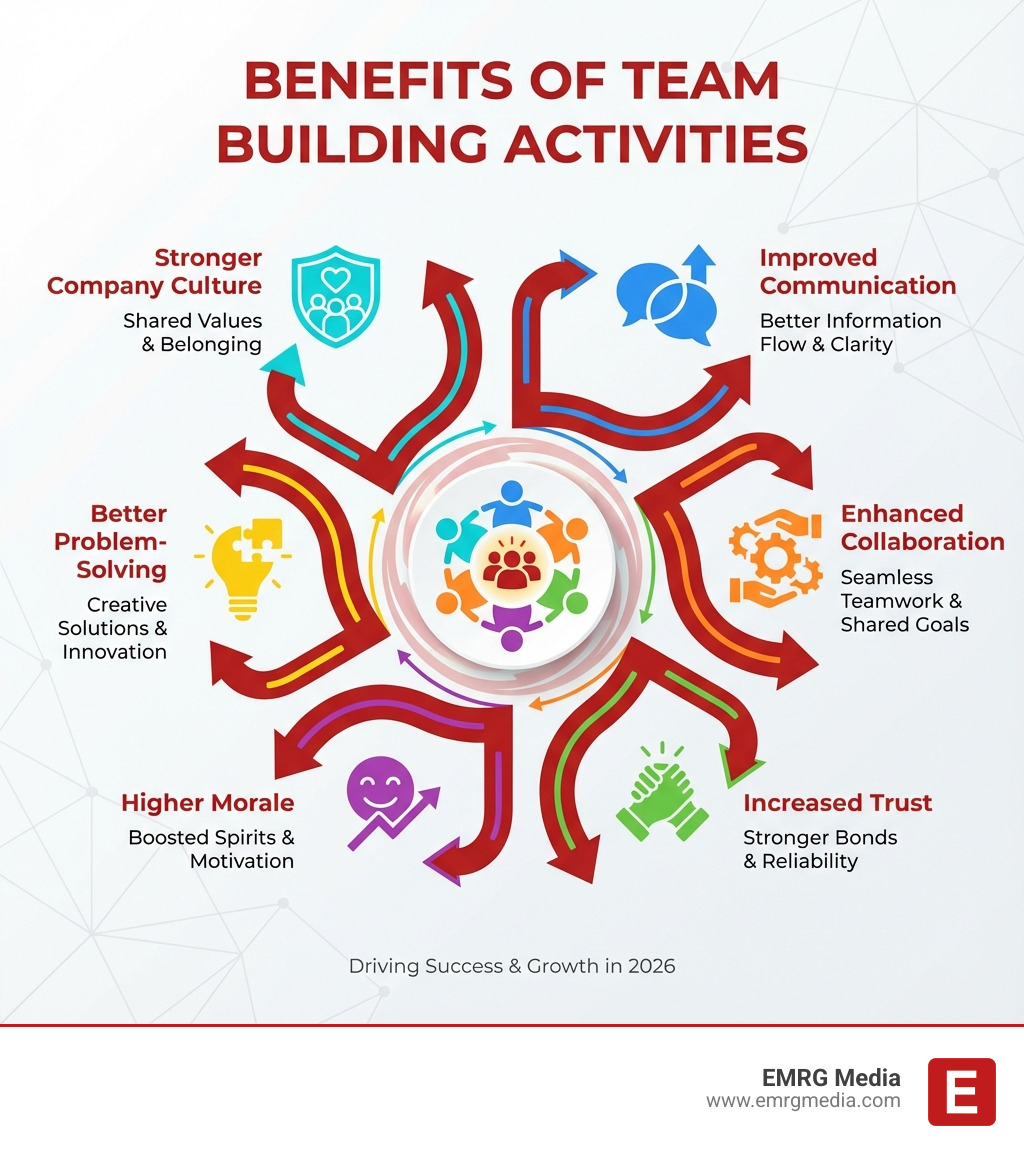
Key Benefits of Investing in Good Team Building Activities: Exploring the 7 C’s
Investing in team building is a critical decision for your organization. As Forbes notes, it’s “the most important investment you can make for your people.” These activities foster community and happiness, which translates into tangible benefits like better onboarding, communication, morale, trust, and creativity.
Team building should be a continuous process, not a one-off event. It forms stronger ties, yielding significant returns as connected, valued employees become more engaged and productive.
To understand the benefits, we refer to the “7 C’s” framework:
- Communication: Activities provide a safe space to practice active listening and clear articulation, ensuring messages are truly understood.
- Collaboration: Activities teach teams to work toward a common goal by pooling resources and supporting each other.
- Commitment: Shared successes and connections deepen an individual’s commitment to the team and its mission.
- Competence: Activities highlight individual strengths and hidden talents, allowing teams to use each other’s competencies more effectively.
- Confidence: Successful team challenges build individual and collective confidence, making employees feel more secure in their roles.
- Creativity: Activities spark out-of-the-box thinking and encourage experimentation. This is crucial, as a Gallup study shows only 29% of employees feel they’re expected to be creative at work.
- Cohesion: The 7 C’s lead to team cohesion—a sense of unity that helps teams work seamlessly and steer challenges with a shared purpose.
By intentionally focusing on these “C’s,” we can design team building experiences that are not just fun, but strategically beneficial, helping your team perform at its peak.
Top Good Team Building Activities Tailored to Your Goals

Selecting the right activities requires a goal-oriented approach. Whether you want to improve communication, problem-solving, or morale, understanding your objectives is key. Here, we’ve categorized some of the best team building activities to help you foster connections, sharpen skills, and build a stronger team.
Effective Icebreakers to Build Early Team Connections
Icebreakers are crucial for warming up a team, especially for new hires or project kick-offs. They ease anxiety, encourage initial connections, and set a positive tone.
- Two Truths and a Lie: Each person shares three statements about themselves—two true, one false—and the team guesses the lie. This classic activity breaks down preconceived notions and reveals surprising facts, fostering immediate connection.
- One-Word Icebreaker: Ask everyone to describe their current mood or week in one word. This quick check-in gives leaders an immediate pulse on the team’s emotional state and helps spot excitement or potential burnout.
- Human Bingo: Create bingo cards with descriptive statements (e.g., “Has traveled to another continent”). Team members mingle to find colleagues who match the descriptions. This encourages interaction and helps people find commonalities in a fun, structured way.
- Birthday Lineup: Challenge the team to line up by birthday (month and day only) without speaking. This simple activity tests non-verbal communication, problem-solving, and coordination.
- What Do We Have In Common?: In small teams, find as many obscure things in common as possible in 5-10 minutes. This encourages deeper conversation and helps break down assumptions.
Here are some top icebreaker questions we love:
- What’s a skill you’d love to learn outside of work?
- If you could have any superpower, what would it be and why?
- What’s your favorite thing about working remotely/in the office?
- What’s a fun fact about you that most people don’t know?
- What’s the best piece of advice you’ve ever received?
Proven Activities to Enhance Collaboration and Communication
These activities are designed to put communication and teamwork skills to the test, often in challenging or unusual scenarios. They highlight the importance of clear instructions, active listening, and collective problem-solving.
- Human Knot: Team members stand in a circle, grab hands with two different people, and then work to untangle the “knot” without letting go. This game highlights the importance of teamwork, coordination, and communication.
- Blind Drawing: Participants pair up and sit back-to-back. One person describes an image for their partner to draw based only on verbal instructions. This activity showcases the difficulty of clear communication and the importance of precise language.
- Team Puzzles: Provide teams with complex jigsaw puzzles, but with a twist: some pieces are swapped between teams, or teams must complete their puzzles without talking. This enforces the importance of working together, sharing resources, and problem-solving, often revealing natural leaders.
- Lost at Sea: Teams imagine they’ve survived a shipwreck and must rank 15 items by importance for survival, then compare their list to an expert’s. This exercise pushes teams to think analytically and build consensus, showing how teamwork produces better results. You can find ready-to-use Lost at Sea worksheets online.
- Pictionary Telephone: This non-verbal communication exercise is a fun warm-up. Divide into teams of five to eight. One person at the back is shown a word to act out silently. They tap the person in front to start the pantomime, which is passed down the line. The person at the front guesses the original word. It’s a hilarious way to see how messages can get distorted and the importance of clear transmission.
Dynamic Exercises to Ignite Creativity and Problem-Solving
To foster innovation, teams need opportunities to think outside the box and tackle challenges creatively. These activities are designed to ignite ingenuity and test problem-solving skills under unique constraints.
- Marshmallow Challenge: Teams get 20 minutes to build the tallest freestanding structure using 20 sticks of spaghetti, tape, string, and one marshmallow. This iconic challenge teaches rapid prototyping and collaborative design, often revealing that doing can lead to better outcomes than over-planning.
- Egg Drop: Task teams with building a protective casing for a raw egg using limited materials (e.g., paper, straws, tape). They then drop their creation from a height to see if it survives. This activity encourages innovation, design, and learning from failure.
- Lego Challenge: Using Lego bricks, teams are asked to build a representation of an abstract concept, such as “team success,” “our company culture,” or “a future goal.” This visual and tactile exercise, often called Lego Serious Play, helps individuals express complex ideas, visualize abstract concepts, and fosters communication in a unique way.
- Moonshot Brainstorms: Challenge teams to develop a “moonshot strategy”—seemingly impossible, radical solutions to a significant company problem or opportunity. This pushes creative thinking to an entirely new level, encouraging teams to think beyond current constraints of time, money, and resources. It’s about dreaming big and fostering a culture of ambitious innovation. You can learn more about the moonshot strategy concept.
- Grab Bag of Creativity: Divide groups into small teams. Provide each team with a bag containing 3-5 random, everyday items (e.g., a TV remote, a tennis ball, a paperclip, a screwdriver, gloves). Challenge them to brainstorm as many combined uses for these items as possible in a set time. This exercise sparks divergent thinking and encourages teams to find innovative connections between disparate objects.
Enjoyable Activities to Elevate Team Morale and Energy
Sometimes, the best team building is simply about having fun, letting loose, and creating shared positive experiences. These activities are designed to boost morale, reduce stress, and strengthen bonds through laughter and friendly competition.

- Office Trivia: Host a quiz show about general knowledge, pop culture, or even specific company facts. Divide into teams and offer small prizes. This lets people with niche knowledge shine, sparks friendly rivalry, and can be a great way to welcome new recruits by including questions about company history or values.
- Scavenger Hunts: Organize a scavenger hunt around your office or a local NYC park. Teams follow clues to complete tasks, requiring creative problem-solving and strategic planning. This activity challenges business skills like prioritization and role allocation.
- Pictionary or Charades: These classic games are fantastic for encouraging creative chaos and lowering professional guards. Whether drawing on a whiteboard or acting out a scene, they force people to be silly and engage in non-verbal communication, leading to plenty of laughs. Playing charades is a timeless way to foster communication and a positive work environment.
- Office Olympics: Organize low-stakes, quasi-athletic events using available office supplies. Think paper airplane distance throws, wastebasket basketball, or a timed stapler relay. This sparks camaraderie, lighthearted competition, and a chance for everyone to show off their playful side. Cue the yogurt lids and paper clip medals!
- Karaoke Party: Nothing levels the playing field quite like karaoke. Whether you have budding superstars or tone-deaf enthusiasts, a karaoke party allows team members to show their personality and talents, fostering cooperation and building unforgettable memories and friendships.
Meaningful Activities to Strengthen Trust and Relationships
Building trust and fostering deeper relationships requires vulnerability and understanding. These activities create safe spaces for team members to share, learn about each other’s perspectives, and build empathy.
- Storytelling Circle: Create a safe space for members to share personal stories based on prompts like “A mistake I learned from.” This activity deepens respect and helps peers see the human behind the job title, fostering empathy.
- Personality Test Discussions: Have the team take a personality assessment like Myers-Briggs or DiSC. Then, discuss the results to understand each other’s operating manuals. Learning that someone isn’t “rude,” but simply “direct,” can save years of conflict and significantly improve communication and conflict resolution.
- Memory Wall: Create a shared physical or digital timeline where everyone adds sticky notes of their favorite team memories, inside jokes, big wins, or even funny mishaps. This reinforces positive team culture, celebrates shared history, and boosts a sense of belonging.
- Compliment Circle / Appreciation Shower: One person sits in the “hot seat” while everyone else spends a minute peppering them with genuine praise and appreciation. This activity provides an overwhelming morale boost, validates individual contributions, and helps strengthen the team by reinforcing how important each person is to the team’s success.
- User Manual of Me: Each person writes a short “manual” for themselves, covering topics like “My working hours,” “How I like to receive feedback,” “What stresses me out,” or “My communication preferences.” Sharing these “manuals” sets clear boundaries, clears up unspoken expectations, and fosters a deeper understanding of individual work styles.
Adapting Activities for Modern Workplaces
The modern workplace is dynamic, with remote and hybrid models requiring adapted team building strategies for inclusivity. It’s also important to align activities with company goals like corporate social responsibility (CSR).
Top Good Team Building Activities for Remote and Hybrid Teams
The majority of desk workers identify as hybrid or remote employees, according to a 2023 Future Forum survey. This trend means that successful companies must learn to build culture even in digital-first environments. Here are some good team building activities designed for remote and hybrid teams:
- Virtual Coffee Chats: Randomly pair team members for 15-minute, agenda-free virtual coffee chats. This breaks down silos and recreates informal office interactions, helping colleagues connect on a human level.
- Online Team Games: Engage the digital natives with browser-based games like GeoGuessr, Among Us, or Jackbox Games. GeoGuessr is a free online game especially fun for international teams, where players guess locations from Google Maps street views. These games are interactive, engaging, and encourage strategic thinking and persuasion skills in a fun, low-pressure environment.
- Shared Digital Vision Board: Use a platform like Miro to create a collaborative digital vision board. Teams contribute images and ideas representing collective goals. This asynchronous exercise respects everyone’s time while building team culture.
- Virtual Show & Tell: Ask remote workers to grab one item from their desk or room that has a special story or meaning. They then share its significance with the team. This humanizes remote colleagues, builds rapport, and offers insights into each other’s lives outside of work.
- Emoji Check-in / Question of the Day: Start meetings with a quick emoji check-in (e.g., “Describe your morning in three emojis”) or a low-stakes “Question of the Day” (e.g., “Is a hotdog a sandwich?”). These quick bursts of interaction are effective for waking up the room, reducing meeting anxiety, and fitting into busy schedules.
Scaling Good Team Building Activities for Various Group Sizes
The size of your team significantly impacts the type of activity that will be most effective. We tailor our recommendations to ensure maximum engagement and impact.
- Small Groups (2-10 people): Small groups are ideal for deep bonding. Activities like Storytelling Circles or “User Manual of Me” work best, allowing for personal sharing. The “Minefield” activity (a blindfolded person guided through an obstacle course) also builds immense trust. These settings encourage comfortable sharing.
- Medium Groups (11-30 people): This size is perfect for collaborative challenges. Activities like the Marshmallow Challenge, Egg Drop, or Escape Room Challenges thrive here, fostering dynamic interaction and healthy competition.
- Large Groups (30+ people): For large teams, tournament-style games like “Office Olympics” or large-scale scavenger hunts work well. Activities that can be broken into sub-groups, like “Human Bingo” or a “Charades” tournament, keep everyone engaged. In NYC, we organize city-wide scavenger hunts for hundreds, turning the city into a collaborative playground.
Goal-Oriented Good Team Building Activities to Support Business Objectives
Team building can be more than just fun; it can be a powerful tool for advancing company objectives and reinforcing values.
- Mini Hackathons: Dedicate a few hours or a full day for teams to brainstorm, prototype, and present solutions for a specific company issue. This empowers employees to fix things they struggle with, turning complaints into creative solutions, and directly addressing real business problems.
- Skill-Swap Workshops: Encourage employees to lead short, informal workshops on a skill they possess (e.g., “Intro to Photoshop,” “Public Speaking Tips”). This uncovers hidden talents, celebrates outside interests, and builds trust by highlighting internal expertise.
- Volunteering Together: Organize a local volunteer opportunity that aligns with your company’s values. Whether it’s serving meals at a shelter, cleaning up a park, or participating in a charity walk, working together for a public good lifts the collective spirit, provides a sense of shared purpose, and deepens bonds outside of typical work tasks. EMRG Media often integrates CSR-focused activities into our team building programs, such as assembling donation packages for local charities in NYC.
- Values-Based Exercises: Use a “Values Assessment” to help team members understand their own core values and how they might interact with others. Peter Phelan of ValuesCulture emphasizes that understanding values is crucial, as many people don’t realize that differing values can be a source of conflict. Discussing these openly can prevent misunderstandings and build a more empathetic team. Alternatively, teams can “Write a Manifesto” defining aspirational behaviors based on company values, getting them to commit to concrete actions for success.
- The “Aliens Have Landed”: Tell the team that aliens have landed and don’t understand simple human concepts (like “brushing teeth” or “synergy”). The team must write clear, jargon-free instructions for the alien. This activity highlights communication clarity and often reveals how much jargon and assumption is used in daily communication, making teams more effective at explaining complex ideas.
Essential Steps for Planning and Leading Successful Team Building Events
The success of any team building event depends on intentional planning and expert facilitation. Simply selecting an activity is not enough. The experience must be designed and delivered in a way that drives meaningful engagement and real takeaways. With so many options available, choosing the right activity and knowing how to spark genuine participation can feel overwhelming, but the right approach makes all the difference.
Key Tips for Organizing Effective Team Building Events
As an NYC-based event planning company, we understand the intricacies of orchestrating memorable events. Here are our top tips for planning good team building activities:
- Set Clear Goals: Before choosing an activity, define what you want to achieve. Is it improved communication, problem-solving skills, or just fun? Your goals will guide your choices.
- Consider Team Preferences: Survey your team to understand their interests and comfort levels. Forcing participation in an activity people dislike can backfire. Tailor the event to the team that’s gathering and their objectives.
- Establish a Budget: Team building doesn’t have to be expensive. Many effective activities are low-cost or even free. However, if you’re planning a larger event, allocate funds for venue, materials, facilitators, and any F&B.
- Assign Roles and Set Expectations: Clearly define who is responsible for what. Whether it’s booking, logistics, or facilitation, clear roles ensure a smooth event flow.
- Use Organizational Tools: Leverage platforms like Slack or other project management tools to organize activities, poll for choices, and keep everyone coordinated, especially for hybrid or remote teams.
- Gather Feedback: After the event, solicit feedback from participants. What did they enjoy? What could be improved? This continuous feedback loop helps refine future team building initiatives.
Mastering Facilitation for Impactful Team Building Experiences
Even the best-planned activities can fall flat without effective facilitation. Our professional facilitators are exceptionally engaging and quick-thinking, ensuring a seamless and impactful experience.
- Professional Facilitators: A skilled facilitator can read the room, adapt to unexpected situations, and ensure everyone feels included. They are unflappable in high-pressure situations and excel at entertaining while managing flawless events.
- Asking Guiding Questions: Facilitators don’t just lead games; they guide discussions. Asking questions like “What did you learn about your team today?” or “How can we apply these lessons back in the workplace?” is crucial for turning an activity into a valuable learning experience.
- Creating Psychological Safety: A good facilitator creates an environment where team members feel safe to be vulnerable, take risks, and share ideas without fear of judgment. This is essential for fostering trust and deeper relationships.
- Post-Activity Debriefing: The debriefing is arguably the most important part of any team building event. This is where participants reflect on their experiences, discuss insights, and connect the activity back to real-world workplace scenarios. It’s how we ensure that the fun translates into tangible improvements.
Frequently Asked Questions about Good Team Building Activities
How often should a company do team building?
Ideally, teams should participate in office team building activities at least once a quarter for larger, more structured events. However, smaller, more frequent touchpoints, like quick icebreakers at the start of meetings or virtual coffee chats, can help maintain momentum and build stronger relationships over time. Team building is a continuous process, not a one-time fix. Regular engagement helps to consistently strengthen bonds and reinforce positive team dynamics.
What makes a team building activity successful?
A truly successful team building activity has a clear purpose, high engagement from all participants, and promotes inclusivity. It should be well-facilitated, allowing for reflection and discussion afterward. The most successful activities foster a positive shared experience that reinforces the 7 C’s: Communication, Collaboration, Commitment, Competence, Confidence, Creativity, and Cohesion. We measure success through post-activity feedback, observed engagement levels, and improvements in communication and collaboration dynamics back in the workplace.
Can team building be effective for kids and students?
Absolutely! Team building activities are incredibly beneficial for students from elementary school all the way to high school and beyond. They help children and young adults develop crucial skills such as problem-solving, creative thinking, verbal communication, listening skills, and resilience. Activities like the “Human Knot,” “Marshmallow Challenge,” or even active games like Chuck the chicken (a crazy striking and fielding game for burning energy) can be used as fun first-day-of-school activities or as everyday boredom busters. These experiences teach students to think outside the box, try and try again to solve problems, and effectively work together, skills that serve them well in all aspects of life.
Final Thoughts on Building Stronger Teams Through Activities
Good team building activities serve as vital tools for enhancing workplace dynamics, fostering collaboration, and boosting overall productivity. By incorporating these exercises, organizations can create lasting bonds and a positive culture that drives success. At EMRG Media, with our extensive experience in New York City event planning, we craft tailored team building experiences that align with your goals, handling every detail to ensure seamless execution and meaningful results.
When the goal is impact, not just attendance, EMRG Media delivers. From corporate productions to once-in-a-lifetime celebrations, we handle the details so your event shines.
Reach out to EMRG Media, and let’s start designing something exceptional.
